Follow 


Industrial milling depends on grinding media that can withstand repeated impact, abrasion, and contact with process materials. The scale is substantial. The USGS Mineral Commodity Summaries 2025 estimates world bauxite mine production at about 430 million metric tons in 2024. The International Aluminium Institute also tracks global aluminium production, illustrating the size of industries that rely on mineral processing. These figures describe production, not grinding-ball performance.
An Al2o3 Grinding Ball is valued for its hardness, wear resistance, and density, which can support efficient particle-size reduction in suitable milling conditions. In a ceramic mill, balls tumble against ore or powder, producing repeated impacts and friction. Lower media wear can help limit contamination, though actual results depend on the feed, mill design, loading, and operating speed. Ceramic is not magic.
For plant operators, the choice is practical: compare media life, product purity, throughput, and total cost per tonne. A high-alumina ball may suit some applications, but it is not automatically the best option for every mill. Supplier specifications should be checked against measured plant trials, including ball-size distribution and wear rates. Small details matter. Published production reports provide useful industry context, while site data should guide the final decision. That distinction is easy to overlook.
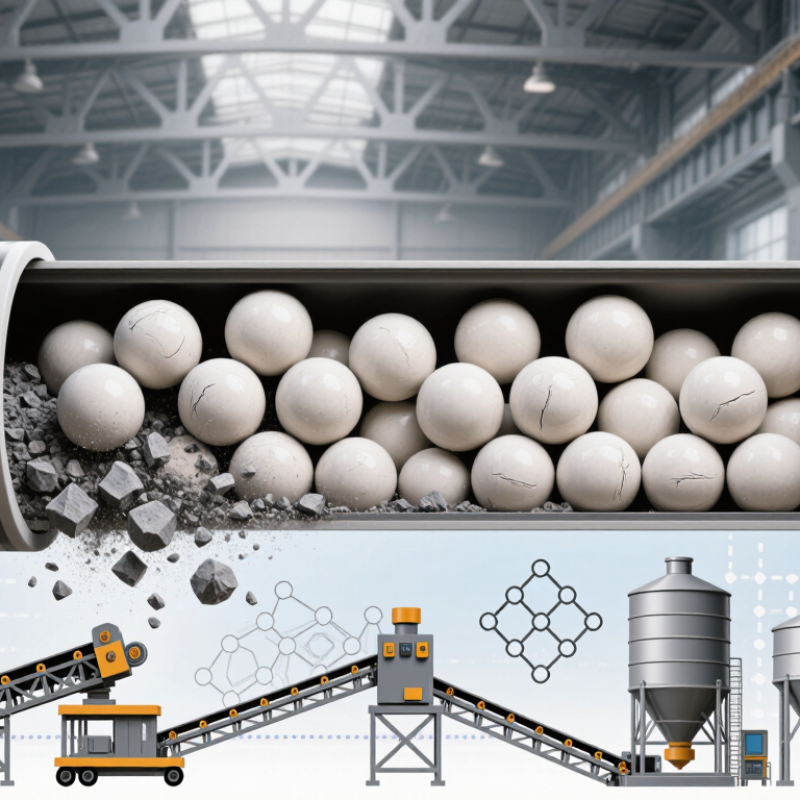
Al2O3 grinding balls are ceramic milling media made mainly from aluminum oxide, also called alumina. They are hard, dense, and resistant to wear, making them useful for reducing powders in mills. Their smooth, rounded surfaces move through the mill and help break material into smaller particles. They are available in different diameters, so the right size depends on the mill, feed material, and target particle size. Not all alumina balls are identical; composition and manufacturing quality can affect performance.
Tips: Check the ball diameter against your mill’s recommendations. Match alumina purity to your contamination limits. Inspect the media for chips before loading. Small details matter.
One detail is easy to overlook: hard media can still wear, especially under demanding conditions. Worn balls may add alumina to the processed material, which matters when product purity is critical. A simple product label may not tell the full story, so ask for composition and wear information. I would also test a small batch before changing an established milling setup. Results can vary with load, speed, and material hardness.
| Dimension | Typical Information | Industrial Milling Relevance |
|---|---|---|
| What they are | Spherical grinding media made from sintered aluminum oxide (Al₂O₃) ceramic. | They reduce particle size through impact and abrasion in ball mills and other milling equipment. |
| Alumina content | Common grades contain approximately 92–99.5% Al₂O₃ by mass; exact grades vary by product. | Higher-alumina grades generally offer greater density and wear resistance, but the best grade depends on the material and process. |
| Typical density | Approximately 3.6–3.9 g/cm³, depending on composition and manufacturing quality. | Higher-density media can deliver stronger grinding action, while also increasing mill and drive loading. |
| Hardness | Alumina ceramic is typically rated around 9 on the Mohs scale. | High hardness supports effective grinding and can help limit media wear when operating conditions are suitable. |
| Chemical behavior | Alumina is generally chemically stable in many milling environments; compatibility depends on the slurry chemistry and temperature. | Useful where limiting metallic contamination from steel media is important. It is not suitable for every chemical process. |
| Available diameters | Commercial sizes commonly range from a few millimeters to several centimeters; availability depends on the supplier and grade. | Smaller balls provide more contact points for fine grinding; larger balls deliver greater impact for coarser feed. |
| Common applications | Ceramic and mineral processing, pigments, chemicals, and other applications requiring ceramic grinding media. | Selection should account for the mill type, feed size, target fineness, slurry, and acceptable contamination level. |
| Key selection factors | Alumina grade, ball diameter, density, toughness, mill speed, and operating conditions. | Confirm the media size and grade through process requirements or milling trials; properties and performance vary by product. |
Note: Values are typical reference ranges, not guaranteed specifications. Check the technical data for the specific grade and operating conditions.
A rotating mill lifts the balls with the material. They then fall, collide, and create friction. Particles are gradually reduced between hard surfaces. It is not one crushing event.
High-alumina balls often reach about 9 on the Mohs scale. This hardness helps resist abrasion during long milling cycles. Less wear can support cleaner powder and steadier performance. Hardness alone is not enough.
Common densities range from about 3.6 to 3.9 g/cm³. Higher density can create stronger impact energy. It may also increase stress on mill liners. Check the actual batch data.
Yes, they can move effectively through slurry. Their ceramic composition may reduce metallic contamination compared with steel media. Slurry viscosity still changes the collision pattern. Wet milling can behave unexpectedly.
Larger balls usually help break coarse particles. Smaller balls offer more contact points for fine grinding. A mixed charge may work well. For example, 30–50 mm balls suit coarse feed, while 5–15 mm balls support refinement.
Mill speed, filling ratio, slurry chemistry, and feed hardness all matter. Ball size also changes impact frequency and contact area. Temperature and particle-size distribution deserve regular checks. Small changes can matter.
Check the media size distribution during operation. Inspect chipped edges before loading. Compare product fineness over time. A slight shift may reveal meaningful wear.
No, laboratory tests may miss actual slurry behavior and mill conditions. Production results can be messier than technical sheets suggest. Run a short trial with the real feed. I would not trust a catalog alone.
Al2o3 Grinding Ball is a high-performance ceramic media designed for efficient and reliable industrial milling. Made primarily from aluminum oxide, it combines high hardness, wear resistance, and chemical stability, allowing it to grind materials effectively while minimizing contamination and media loss. During milling, the balls transfer impact and friction energy to the feed material, reducing particle size and improving product uniformity.
Choosing the right Al2o3 Grinding Ball requires consideration of ball diameter, alumina content, feed characteristics, target fineness, and mill operating conditions. Larger balls are generally suitable for initial size reduction, while smaller balls provide better results during fine grinding. These ceramic balls are widely used in ceramics, minerals, chemicals, coatings, and other processing industries. Proper loading, speed control, and regular inspection can improve grinding efficiency, extend service life, and support stable production performance.