Follow 


In the era of modern nano-materials processing, industrial wet-grinding performance depends directly on the physical and chemical properties of the microcrystalline grinding media. As global high-tech industries shift towards sub-micron and true nanometer particle size distributions (d50 < 100 nm), traditional media such as steel balls, natural flint, and standard alumina beads fail due to high wear rates, cross-contamination, and inadequate kinetic energy transfer.
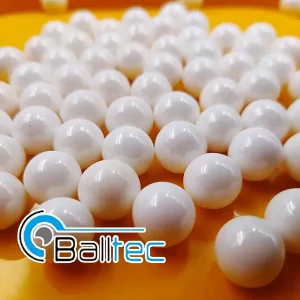
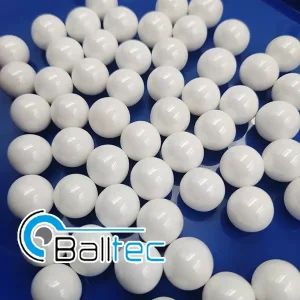
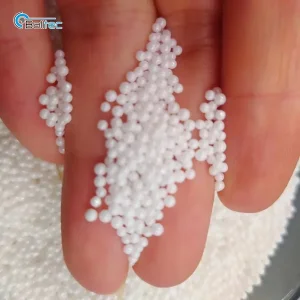
As a leading Zirconia Grinding Media Manufacturer & Factory, Pingxiang Baitian (Ball-tec) New Materials Co., Ltd. engineers advanced ceramic beads using high-purity raw powders processed through specialized thermal transformation techniques. Pure Zirconium Oxide ($\text{ZrO}_2$) undergoes structural phase transitions: monoclinic at room temperature, transforming to tetragonal at 1170°C, and cubic at 2370°C. By stabilizing the crystal lattice with rare earth oxides such as Yttria ($\text{Y}_2\text{O}_3$) or Ceria ($\text{CeO}_2$), our factory retains the high-density tetragonal phase at room temperature, creating Tetragonal Zirconia Polycrystals (TZP).
The exceptional fracture toughness of Yttria-Stabilized Zirconia (YSZ) media stems from a unique physical phenomenon known as Stress-Induced Transformation Toughening. When an external mechanical shock or micro-crack propagates within a YSZ bead, the localized stress concentration destabilizes the metastable tetragonal ($\text{t}$) phase, triggering an instantaneous martensitic transformation into the monoclinic ($\text{m}$) phase.
This $\text{t} \rightarrow \text{m}$ transformation involves a localized volume expansion of approximately 3% to 5% and a shear strain of 7%. The volumetric expansion squeezes the advancing crack tip shut, effectively shielding the bead from further catastrophic failure. As a result, YSZ beads withstand intense shear forces in high-energy agitator bead mills (such as pin-type and disc-type horizontal mills) running at tip speeds up to 18 m/s without chipping, fracturing, or creating dangerous micro-debris.
Our wet-chemical titration synthesis yields ultra-fine, uniform grains (<0.5 μm) after sintering. This eliminates internal voids, ensuring uniform wear across millions of milling cycles.
High chemical inertness prevents color shift in organic pigments, preserves electrical insulation in dielectric slurries, and ensures zero heavy metal leaching in battery materials.
Selecting the optimal grinding media requires matching material properties to process fluid mechanics, slurry viscosity, rotor velocity, and maximum allowable impurity thresholds. The engineering matrix below details the technical specifications across our complete zirconia product portfolio.
| Property Parameter | 95% YSZ (Y-TZP) | Ceria-Stabilized (Ce-TZP) | Zirconium Silicate ($\text{ZrSiO}_4$) | Alumina ($\text{Al}_2\text{O}_3$ 95%) |
|---|---|---|---|---|
| Specific Density (g/cm³) | 6.00 – 6.05 | 6.20 – 6.25 | 4.00 – 4.15 | 3.65 – 3.80 |
| Bulk Density (g/cm³) | 3.60 – 3.75 | 3.75 – 3.85 | 2.50 – 2.65 | 2.20 – 2.35 |
| Vickers Hardness (HV10) | > 1250 kg/mm² | > 1150 kg/mm² | > 900 kg/mm² | > 1100 kg/mm² |
| Fracture Toughness (MPa·m¹/²) | 9.0 – 10.0 | 12.0 – 13.0 | 4.5 – 5.0 | 3.5 – 4.0 |
| Wear Rate (%/24h) | < 0.005% | < 0.008% | < 0.05% | < 0.10% |
| Crush Strength (Ø 1.0mm) | > 250 N | > 280 N | > 110 N | > 90 N |
| Primary Application Scope | Nano-milling (Batteries, MLCC) | High Viscosity Paints & Minerals | Paper Coating, Calcium Carbonate | Glaze Milling, Mining |
As demonstrated in the matrix, 95% Yttria-Stabilized Zirconia (Y-TZP) represents the pinnacle of performance for sub-micron milling. Its combination of high density ($6.0\text{ g/cm}^3$) and fracture toughness allows mill operators to increase flow rates, reduce mill residence times, and shorten pass counts by up to 40% compared to traditional alumina media.
The demand for specialized zirconia media is undergoing unprecedented expansion, driven by five transformative global industrial sectors. Factory procurement teams must understand these shifting parameters to ensure maximum operational throughput.
In Lithium Iron Phosphate ($\text{LiFePO}_4$), NCM/NCA precursor, and silicon-carbon anode manufacturing, particle size uniformity directly dictates C-rate charging kinetics and battery lifespan. Micro-beads ($0.05\text{ mm}$ to $0.3\text{ mm}$) are essential for dispersing battery slurries to sub-100 nanometer scales without introducing iron or heavy metal impurities that lead to internal short-circuits.
Multi-Layer Ceramic Capacitors (MLCCs) require ultra-pure Barium Titanate ($\text{BaTiO}_3$) powders milled down to $d_{50} < 50\text{ nm}$. Zirconia media prevent micro-cracks in dielectric layers. Similarly, Chemical Mechanical Planarization (CMP) silica and ceria slurries rely on low-impurity YSZ beads to avoid scratching semiconductor silicon wafers.
Active Pharmaceutical Ingredients (APIs) milled to nanometer dimensions exhibit exponentially higher bioavailability and dissolution rates. Zirconia beads engineered under strict cleanroom conditions guarantee zero toxic leaching, satisfying international pharmacopeia standards for injectable formulations and mineral sunscreens ($\text{TiO}_2/\text{ZnO}$).
Traditional stone milling of green tea leaves is inefficient and prone to grit contamination. Stainless steel media cause oxidation and color degradation. High-density YSZ beads enable hygienic, low-temperature continuous wet milling, producing smooth 6000-mesh matcha powder while preserving delicate chlorophyll compounds.
Inkjet inks, transparent metallic coatings, and automotive OEM topcoats require intense pigment jetness and optical clarity. Micro-dispersion with 0.1mm zirconia media breaks down pigment agglomerates to single primary crystals without damaging molecular chromophores.
Pre-sintered dental blocks and Solid Oxide Fuel Cell (SOFC) electrolyte sheets demand nano-powders with exceptionally narrow particle size distributions. Grinding raw zirconia materials with matching YSZ beads guarantees phase purity during sintering.
Manufacturing world-class zirconia grinding media requires more than standard kilns; it demands an integrated industrial ecosystem. Pingxiang, Jiangxi Province, stands as China’s premier industrial ceramic cluster, providing unmatched structural advantages for international enterprise buyers.
Our 100,000 m² modern manufacturing campus benefits from direct access to localized chemical refinement clusters and long-term raw material partnerships. By controlling powder synthesis, hydrothermal co-precipitation, forming, and sintering in-house, we eliminate price volatility and secure consistent supply chains for multi-ton contract orders.
Operating continuous multi-zone tunnel kilns and computerized roller hearth kilns, our facility achieves automated temperature control accurate to within $\pm 1^\circ\text{C}$ at $1500^\circ\text{C}$. This eliminates batch-to-batch thermal variance, delivering consistent micro-hardness across thousands of metric tons per annum.
Compared to European or North American producers, China's advanced ceramic ecosystem delivers a 30% to 50% improvement in total cost-to-performance ratio without compromising metallurgical purity or dimensional sphericity.
For procurement officers and process engineering leads, evaluating grinding media purely on initial purchase price per kilogram is a costly error. The true operational cost is governed by the Total Cost of Ownership (TCO) formula:
TCO = Media Purchase Cost + (Wear Rate × Operating Hours × Media Unit Cost) + Energy Consumption + Downtime Maintenance + Downstream Filter/Contamination Costs
International trade compliance and consistent quality control form the foundation of our global operations. We support international corporate buyers with complete regulatory compliance and logistics services.
Fully certified under ISO 9001:2015 (Quality), ISO 14001:2015 (Environmental), and ISO 45001:2018 (Occupational Health). Every batch includes a Certificate of Analysis (COA) detailing chemical composition, density, crush strength, and grain size analysis.
Our products comply fully with EU REACH regulations (Substances of Very High Concern screening), RoHS 3 directives, and FDA food contact guidelines (21 CFR 175.300 / EC 1935/2004) for food and pharmaceutical grinding.
We offer complete international logistics services, including DDP (Delivered Duty Paid), CIF, and FOB incoterms. Customized export packaging includes heavy-duty steel drums, plastic pails, and moisture-proof wooden crates on fumigated pallets.
Superior ceramic beads require complete precision across all manufacturing phases. The flow chart below outlines our factory's core production methodologies.
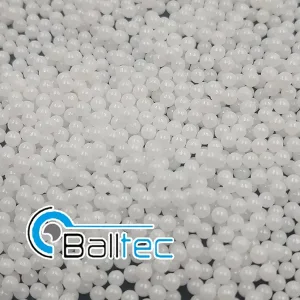
For micro-beads below $0.5\text{ mm}$, we utilize Electrolyte Titration Dropping. A liquid zirconium slurry is atomized into an electrolyte bath to form perfectly spherical green beads through surface tension. For larger sizes ($1\text{ mm}$ to $50\text{ mm}$), high-speed dry powder rolling and cold isostatic pressing (CIP) are used to guarantee internal structural homogeneity.
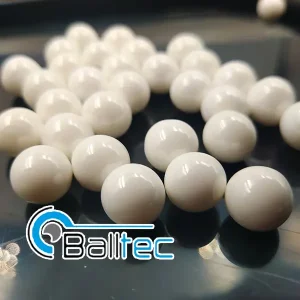
Green beads are sintered in high-temperature kilns where crystal growth is carefully limited to under 0.5 microns. Following sintering, beads undergo chemical and mechanical surface polishing for up to 48 hours to remove surface irregularities, achieving a mirror-like finish ($Ra < 0.01\ \mu\text{m}$) that minimizes wear during operation.
Answers to common technical and commercial questions from plant managers, process engineers, and procurement specialists.