Follow 


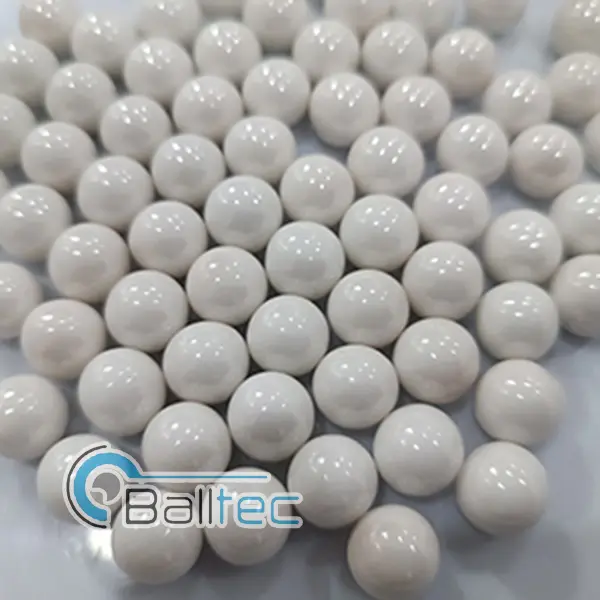
Material grinding is a crucial process in ink production, and the quality of grinding can be represented by the dispersion degree of the material. The use of zirconia beads with different particle sizes affects the grinding effect and efficiency of the material. In ink production, it is necessary to pre-disperse the material with zirconia beads first, and then use grinding equipment for grinding until the grinding fineness meets the process requirements.
Pigment grinding is an important link in the production process of solvent-based and water-based inks. Grinding equipment relies on grinding media such as balls and zirconia beads to impact, friction, and shear the material through different movements, thereby crushing and dispersing the material.
The smaller the diameter of the zirconia beads, the higher the probability of mutual collision; the larger the active area, the greater the shear force on pigment dispersion, resulting in a narrower particle size distribution of the ink. After grinding, the overall pigment particle size becomes smaller, with a higher proportion of small-particle-size pigments, leading to superior grinding effect and efficiency. Conversely, zirconia beads with larger diameters have a smaller specific surface area and active area, resulting in a wider particle size distribution of the ink with a higher proportion of large-particle-size pigments. Therefore, when using small-diameter zirconia beads as the grinding medium, the pigment particle size can be reduced.
Experimental Insight: According to our experiments, when using our Baitian’s 1.0–1.2 mm zirconia beads for grinding, 95% of the ink particle size is less than 1 micron, achieving excellent grinding results.
Parameter |
Specification Range |
Remarks |
Material Composition |
ZrO₂ ≥95%, Y₂O₃ (3–8 mol%) |
Yttria-stabilized for structural stability |
Impurity Content |
Fe₂O₃ ≤0.02%, SiO₂ ≤0.03%, Al₂O₃ ≤0.03% |
Ensures pigment purity (no color contamination) |
Vickers Hardness |
1250–1450 HV |
Measured at 25°C; ensures wear resistance |
Fracture Toughness |
≥6 MPa·m¹/² |
Prevents bead breakage during high-speed grinding |
Wear Rate |
≤0.0015%/1000 hours |
Tested in horizontal sand mill (2000 rpm, water-based pigment slurry) |
Density |
6.0–6.1 g/cm³ |
Optimizes kinetic energy for efficient dispersion |
Diameter Range |
0.1 mm – 10 mm |
Custom sizes available for specific processes |
Sphericity |
≤0.005 mm |
Reduces equipment wear and ensures uniform force distribution |
Surface Roughness (Ra) |
≤0.05 μm |
Minimizes pigment adhesion and contamination |
Operating Temperature |
-50°C – 800°C |
Stable in high-temperature drying or grinding processes |
Chemical Compatibility |
Compatible with solvents, water-based systems, UV-curable resins; resistant to acids/alkalis (except HF) |
Suitable for all mainstream pigment formulations |
Smaller diameter zirconia beads increase collision probability, active surface area, and shear force during dispersion. This results in a narrower particle size distribution and higher grinding efficiency compared to larger beads.
According to experimental results, using Baitian’s 1.0–1.2 mm zirconia beads allows 95% of the ink particle size to be reduced to less than 1 micron, ensuring optimal dispersion fineness.
Yes. The beads feature broad chemical compatibility and are suitable for solvent-based systems, water-based formulations, and UV-curable resins, resisting both acids and alkalis (except HF).
The beads have a Vickers Hardness of 1250–1450 HV and an ultra-low wear rate of ≤0.0015%/1000 hours (tested in a horizontal sand mill at 2000 rpm), ensuring long service life and zero contamination.
The zirconia beads maintain structural stability across a wide temperature spectrum from -50°C up to 800°C, making them suitable for high-temperature drying or grinding environments.