China’s ceramic industry has become an important source of Ceramic Grinding Media for mining, pigments, coatings, ceramics, and advanced material processing. Manufacturers compete through alumina purity, zirconia content, density, wear resistance, and production consistency. Yet product brochures rarely tell the complete story.
This guide examines China’s leading Ceramic Grinding Media manufacturers through practical selection criteria. It considers factory experience, raw-material control, shaping methods, sintering technology, laboratory testing, export capability, and customer support. Buyers should also compare ball-size distribution, bulk density, crush strength, and contamination levels. Small differences can affect mill efficiency, final particle size, and replacement costs.
Dr. James S. Reed, a respected ceramic-processing specialist, stated, “Grinding media performance is measured inside the mill, not on the brochure.” That principle remains useful today. Supplier claims need verification. Independent samples, test reports, and controlled trial runs provide stronger evidence than attractive catalogs. The best manufacturer is not always the largest one.
Some factories may offer impressive pricing but limited technical guidance. Others may provide excellent materials but weak delivery coordination. This matters. No ranking is perfect.
The following outline presents notable Chinese manufacturers and explains their strengths, product ranges, certifications, and application experience. It also highlights questions that buyers should ask before placing an order. Consider media wear in your actual mill, not only laboratory figures. A cheaper product may create more dust, contamination, or downtime. That lesson is easy to overlook. And sometimes, the buyer’s own operating data is incomplete. Reliable decisions require honest comparisons, repeatable testing, and a willingness to reconsider initial assumptions.
Ceramic grinding media are small, hard beads used to reduce solid materials into finer particles. They are commonly made from alumina, zirconia, or other engineered ceramic compounds. Their role is simple but important: transfer energy inside a mill while limiting contamination. Unlike many metallic alternatives, ceramic beads resist corrosion and usually add less unwanted metal to the processed material.
In mineral processing, coatings, pigments, chemicals, and battery materials, particle size affects quality and performance. Ceramic media help produce a more uniform dispersion or powder. Their low wear rate can also support cleaner production and longer milling cycles. Experienced operators consider bead density, diameter, hardness, and mill speed together. A smaller bead may improve fine grinding, while a denser bead can deliver stronger impact. The choice is not always perfect. Real materials behave differently than laboratory samples.
Tips: Check the feed size before selecting media. Inspect worn beads regularly. Mixed sizes can improve grinding in some processes, but they may also complicate separation. Keep the mill properly filled, and record temperature changes during operation. Excessive heat may damage sensitive materials. Supplier test data is useful, yet plant trials remain essential. Small process details often decide the final result.
China’s ceramic grinding media manufacturers produce several material types for wet and dry milling. Alumina grinding beads remain widely used because they offer balanced hardness, density, and cost. They suit mineral processing, coatings, ceramics, and chemical powders.
Zirconia media provide higher density and stronger impact resistance. They are useful when a fine particle size requires shorter milling time. However, their higher price may not fit every production line.
Silica and zirconium silicate beads offer practical options for less demanding applications. They can reduce contamination risks in selected formulations.
Cerium-stabilized zirconia is another specialized type. It performs well under intense grinding conditions, but buyers should check its chemical compatibility.
In factory evaluations, bead size often matters as much as material grade. Small beads reach narrow spaces and improve fine grinding. Larger beads handle coarse feed more effectively.
I usually inspect roundness, surface defects, bulk density, and batch consistency before testing performance. A simple sieve check can reveal uneven sizing.
Not every supplier reports wear data clearly. That is a weakness worth questioning.
Requesting samples and comparing residue levels under identical milling conditions gives more reliable evidence.
Operators should also review mill speed, slurry viscosity, and separator settings. A strong ceramic bead can still perform poorly when the process is poorly adjusted.
China’s leading ceramic grinding media manufacturers serve demanding industries such as mining, coatings, ceramics, and advanced materials. Their strongest advantage is manufacturing scale combined with material specialization. Many produce alumina, zirconia, and silicon carbide beads in multiple sizes, from tiny laboratory media to larger industrial cylinders.
Product strength starts with purity and density. High-alumina media can resist wear during mineral processing and ceramic milling. Zirconia media offers higher density and lower contamination for sensitive formulations. Carefully controlled firing improves hardness and reduces internal pores. Buyers should request test data for wear loss, crushing strength, bulk density, and size tolerance.
Factory experience matters too. Reliable producers often use automated molding, precision classification, and batch-based quality checks. A useful audit may include checking kiln records, sampling finished beads, and observing packaging conditions. Moisture-proof bags and clear lot numbers help protect traceability during long shipments. Communication is another practical test. Technical teams should explain application limits, not only quote a low price.
No supplier is perfect. Some catalogs look impressive, yet real performance varies between batches. I would compare three samples under identical milling conditions before placing a large order. This extra step can reveal unexpected abrasion, dust, or contamination. Chinese manufacturers continue improving consistency, but buyers still need careful verification and realistic operating data.
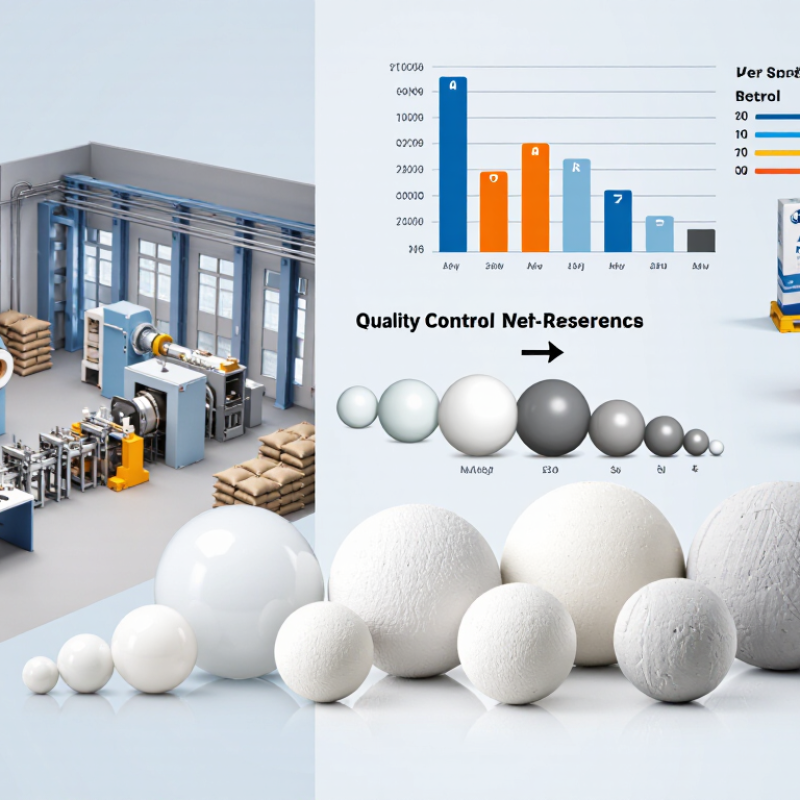
This comparison highlights common ceramic grinding media categories supplied by Chinese manufacturers. Zirconia media offers the highest density and strong impact resistance, alumina provides high hardness at a lower cost, silicon nitride combines low density with excellent wear resistance, and glass media is suited to lighter-duty milling. Values shown are representative technical ranges for each material type rather than company-specific data.
Ceramic grinding media should be judged by measurable performance, not polished packaging. ISO 13320 supports laser diffraction testing for particle-size distribution, while ASTM C20 provides methods for apparent porosity, absorption, and bulk density. These tests expose weak spots. A bead with high absorption may contain hidden pores and break faster in continuous milling.
Material selection changes the result. High-alumina media usually offers strong wear resistance and stable density. Zirconia-based media can deliver higher impact resistance and lower contamination in demanding applications. The U.S. Geological Survey’s Mineral Commodity Summaries 2024 reported roughly 1.4 million metric tons of global zirconium mineral concentrate production in 2023. That figure describes raw material supply, not finished media output, but it shows why sourcing transparency matters.
Production technology is equally important. Spray granulation, controlled sintering, and precision polishing can improve roundness and reduce surface defects. In practice, manufacturers should record kiln temperature curves, shrinkage rates, batch density, and abrasion loss. A useful test is the mass-loss comparison after a fixed milling cycle. Simple, but revealing. Independent laboratory verification adds credibility, especially when supplier data looks unusually perfect. No test replaces field experience. Slurry viscosity, mill design, and loading conditions can still change wear results. The uncomfortable point is this: the “best” ceramic bead may fail when the operating conditions are poorly matched.
Selecting a reliable Chinese ceramic media supplier requires more than comparing quotations. Check technical evidence, factory controls, and shipment consistency. Ceramic grinding media affects wear, contamination, product purity, and mill efficiency.
The 2023 Mining Energy Consumption study from CEEC International notes that comminution can consume 25–50% of a mine’s total energy. Media density and wear rate therefore deserve careful testing. Request a certificate showing zirconia or alumina content, bulk density, hardness, size tolerance, and abrasion loss. Ask for test results from an independent laboratory. A supplier that only sends polished product photographs is not ready for serious evaluation.
Production details reveal practical reliability. Visit the plant, or request a live video inspection of mixing, forming, sintering, sorting, and packaging. Look for batch codes on every pallet. Ask how rejected beads are separated. Simple answers matter. The International Organization for Standardization’s ISO 9001 framework emphasizes documented processes, corrective actions, and traceability, but certification alone proves little about media performance. Check recent batch records and customer references from comparable mills. A 2024 industry outlook from Grand View Research identifies rising demand for high-performance ceramic media, yet market forecasts cannot replace a pilot test. Send samples through your own mill for at least one controlled trial. Measure particle-size distribution, liner wear, power draw, and contamination before approving a long-term contract. My own caution: the cheapest quotation often hides inconsistent sizing. That mistake becomes expensive.
Common types include alumina, zirconia, silica, and zirconium silicate beads. Cerium-stabilized zirconia suits intense grinding. Each material has different costs, density, and impact resistance.
Alumina beads offer balanced hardness, density, and cost. They suit minerals, coatings, ceramics, and chemical powders. They are practical, but not always the finest choice.
Zirconia provides higher density and stronger impact resistance. It can achieve fine particles with shorter milling times. The higher price may challenge smaller production lines.
Small beads enter narrow spaces and support fine grinding. Larger beads handle coarse feed more effectively. A mixed size range may help, but testing remains necessary.
Check roundness, surface defects, bulk density, and batch consistency. A simple sieve test can reveal uneven sizing. Small defects matter.
Request samples and test them under identical milling conditions. Compare residue levels after a fixed cycle. Review wear data carefully, because some reports lack useful detail.
Spray granulation, controlled sintering, and precision polishing can improve roundness. They may also reduce surface defects. Kiln curves and shrinkage records deserve attention.
Particle-size testing, porosity checks, absorption testing, and bulk-density measurements provide useful evidence. Mass loss after a fixed milling cycle shows wear. Perfect-looking data still needs independent verification.
Yes. Mill speed, slurry viscosity, separator settings, and loading conditions affect results. A strong bead can fail in a poorly adjusted process. That is easy to overlook.
Ceramic Grinding Media plays an important role in industries such as mining, minerals processing, ceramics, chemicals, and advanced materials by reducing particle size efficiently while minimizing contamination. Made from materials including alumina, zirconia, and silica-based compounds, it is available in forms such as beads, balls, cylinders, and customized shapes. Chinese manufacturers produce media for different milling conditions, offering options that vary in density, hardness, wear resistance, and energy efficiency.
When selecting a reliable Chinese supplier, buyers should evaluate raw material purity, dimensional consistency, crushing strength, wear rate, and compatibility with wet or dry grinding systems. Quality certifications, stable production processes, laboratory testing, and strict inspection procedures are also important indicators of dependable performance. A qualified supplier should provide clear technical specifications, flexible size ranges, application guidance, consistent delivery, and responsive after-sales communication. Comparing samples and testing them under actual operating conditions can help confirm whether the Ceramic Grinding Media meets the required efficiency, service life, and cost objectives.