Oxygen concentrators commonly use lithium-exchanged low-silica X zeolite, often called LiLSX, as the nitrogen-selective adsorbent. Some systems use other zeolite formulations, including sodium-based grades. The exact choice depends on the concentrator’s design, operating pressure, and performance requirements. There is no single grade used in every device.
The process is practical and precise. Compressed air passes through beds filled with small zeolite beads. Their microporous structure preferentially adsorbs nitrogen, while oxygen-rich gas moves onward. When pressure drops, the beds release much of the trapped nitrogen and prepare for another cycle. The beads may look ordinary. Their internal pore structure is doing the important work.
For anyone researching Zeolite For Oxygen Concentrator applications, the material’s name alone is not enough. Lithium content, particle size, crush strength, water resistance, and adsorption performance can all affect operation. Moisture matters. Water can compete for adsorption sites and reduce performance, so system design and air pretreatment are important considerations. Manufacturers also evaluate the complete adsorption cycle, not just a zeolite sample in isolation.
This overview examines which zeolite types are used, how they separate nitrogen from air, and what properties matter when selecting a grade. Specific compositions can vary by supplier and equipment model, so broad claims deserve caution. That distinction is easy to miss. A material’s published performance does not automatically predict how it will behave inside a finished concentrator.
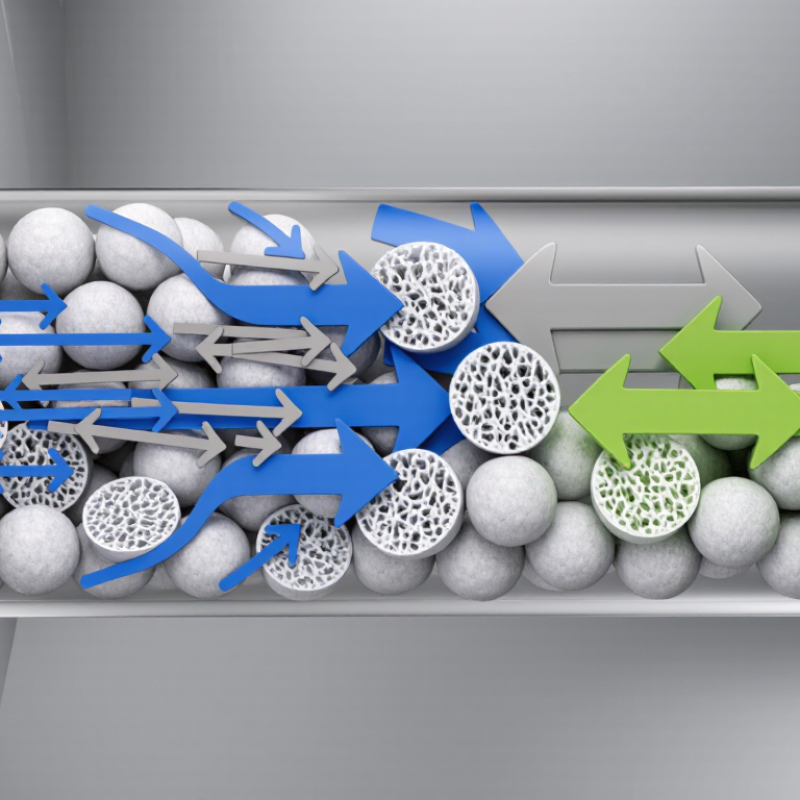
Inside an oxygen concentrator, zeolite acts as a selective molecular sieve. Most home units use synthetic zeolite, often lithium-exchanged forms such as LiX. Under pressure, its tiny pores capture nitrogen more readily than oxygen. Oxygen, along with some argon, passes through and becomes part of the product gas. The separation is physical, not a chemical reaction. That distinction matters.
A concentrator typically has two sieve beds that take turns. One bed adsorbs nitrogen while the other releases its captured nitrogen during depressurization. This repeating pressure-swing process helps provide a steady oxygen-enriched flow. The sieve is not a bottomless filter. Moisture, dust, or oil contamination can reduce its performance, so clean filters and proper servicing matter.
Real units also vary; the exact zeolite composition depends on their design. It is tempting to treat every sieve as identical, but that is an oversimplification. A technician checks the device’s output and alarms rather than judging performance by sound alone. The quiet cycling can be easy to miss.
Many oxygen concentrators use lithium-exchanged X-type zeolite, often called LiLSX, as their molecular sieve. The material is formed from tiny, connected cages with openings measured at the molecular scale. Inside, charged lithium sites attract nitrogen molecules more strongly than oxygen molecules. The difference is subtle, but useful.
Under pressure, nitrogen settles onto the zeolite’s internal surfaces while oxygen-rich gas passes through the bed. Not a simple size filter. The separation depends on both the pore network and the electric fields created by the zeolite’s ions. Imagine a packed column of pale beads: gas moves through narrow channels, and nitrogen pauses at countless microscopic sites. Meanwhile, the concentrator directs the oxygen-enriched flow toward its outlet.
Most systems use two sieve beds that alternate between adsorption and regeneration. One bed captures nitrogen; pressure then drops in the other, allowing stored nitrogen to leave. The cycle repeats. Water vapor and carbon dioxide can interfere with adsorption, so concentrators typically control moisture and other contaminants before they reach the sieve. The explanation is useful, though incomplete: real performance also depends on bed design, pressure, and operating conditions. A zeolite’s structure enables separation, but does not guarantee the same output in every machine.
| Dimension | Typical Zeolite or Process | How It Enables Oxygen Separation |
|---|---|---|
| Common adsorbent in modern units | Lithium-exchanged low-silica X zeolite (LiLSX) | Lithium cations provide strong adsorption sites for nitrogen, helping the adsorbent preferentially retain nitrogen from air. |
| Zeolite framework | Crystalline aluminosilicate with a regular network of pores and exchangeable cations | The framework creates a large internal surface area. Its cations influence how strongly different gas molecules interact with the pore surfaces. |
| Main separation mechanism | Preferential adsorption, rather than simple molecular-size sieving | Nitrogen interacts more strongly with the cation sites than oxygen does, so more nitrogen is captured under the operating conditions. |
| Role of molecular properties | Different adsorption strengths and electric quadrupole moments | Nitrogen’s stronger interaction with the zeolite’s electric field supports selective adsorption; the process does not rely on pores being large enough for only one of these gases. |
| Adsorption step | Compressed air passes through a bed of zeolite | The bed preferentially adsorbs nitrogen while oxygen-enriched gas passes through as product gas. |
| Regeneration step | Pressure is reduced, often with a purge flow | Lower pressure releases much of the adsorbed nitrogen, preparing the bed for another separation cycle. |
| Typical system arrangement | Two or more beds operating in alternating cycles | While one bed adsorbs nitrogen, another can depressurize and regenerate, enabling a continuing supply of oxygen-enriched gas. |
| Other zeolites | Sodium-form X zeolite (often called 13X) and other nitrogen-selective molecular sieves | These materials can also adsorb nitrogen, but the adsorbent choice and performance depend on the concentrator’s design and operating conditions. |
| Product-gas note | Oxygen-enriched gas, not necessarily pure oxygen | Actual oxygen concentration depends on the device, flow setting, operating conditions, and maintenance; check the device specifications for its rated output. |
Most oxygen concentrators use zeolite molecular sieves in a pressure-swing adsorption system. The sieve preferentially captures nitrogen from incoming air, allowing oxygen-rich gas to pass through. Sodium-form zeolite 13X is a well-known option, while lithium-exchanged zeolite X is widely used in compact concentrators. Lithium low-silica X, often called LiLSX, can offer strong nitrogen adsorption under suitable operating conditions. Details matter.
Tip: Check the equipment’s service documentation before identifying its sieve. Different beds can look alike, and appearance alone cannot confirm the zeolite type. Keep the material dry; moisture can reduce adsorption performance.
The choice depends on more than the zeolite name. Manufacturers consider adsorption capacity, pressure changes, airflow, and the bed’s expected service life. Some systems may use other sieve formulations, including 5A, but this is not universal. A higher-capacity material does not automatically make a concentrator more reliable. Bed design and operating conditions matter too. There is a practical limitation: without specifications or laboratory testing, the exact composition of a sealed sieve bed may be difficult to verify.
Oxygen concentrators commonly use lithium-exchanged zeolite, a porous adsorbent that preferentially captures nitrogen. In a pressure swing adsorption (PSA) cycle, compressed air enters one bed; nitrogen sticks to the zeolite while oxygen-rich gas passes through. A second bed regenerates at lower pressure, releasing the trapped nitrogen into the exhaust. The beds then switch roles. Simple in principle, but humidity, dust, and aging can affect performance.
This is separation, not oxygen creation. Ambient air contains about 20.9% oxygen and 78.1% nitrogen, according to the U.S. National Institute of Standards and Technology’s standard reference data. PSA reduces nitrogen in the product stream, producing oxygen-enriched gas. WHO’s Technical Specifications for Oxygen Concentrators set 82% oxygen concentration as a minimum performance threshold under specified test conditions. Actual concentration depends on flow, maintenance, and operating conditions; a single number does not describe every device.
Tips: Keep air inlets clear and follow the service schedule. A blocked filter can impair airflow, while wet or contaminated air may burden the adsorbent. Check outlet oxygen concentration with a suitable analyzer rather than judging by sound or airflow alone.
What Type of Zeolite Is Used in Oxygen Concentrators?
Lithium-exchanged low-silica X zeolite, often called LiLSX, is widely used in pressure-swing adsorption concentrators. It preferentially adsorbs nitrogen, allowing oxygen-rich gas to pass through. But the material does not work in isolation. Water vapor and carbon dioxide can occupy adsorption sites, reducing nitrogen separation. Warm, humid intake air and blocked filters may therefore place extra stress on the sieve beds. Small details matter.
Performance also depends on bead quality, airflow, pressure cycling, and how often the unit runs. Repeated pressure changes can gradually abrade beads, creating dust and reducing effective contact area. The WHO-UNICEF Technical Specifications for Oxygen Concentrators (2019) use 82% oxygen concentration as a minimum performance benchmark. That figure helps assess output, but it does not predict sieve-bed life. A device may fall short because of leaks or poor maintenance, not just aged zeolite. I would treat any single lifespan estimate cautiously. Check concentration at the prescribed flow, keep intake filters clean, and avoid storing the unit in damp, dusty spaces.
What type of zeolite is used? Oxygen concentrators commonly use lithium-exchanged low-silica X zeolite (LiX or LiLSX) to preferentially adsorb nitrogen during pressure-swing adsorption. Moisture, heat, contamination, and repeated cycling can reduce adsorbent performance over time.
The chart shows typical dry-air composition by volume. Because nitrogen makes up most of the air, selectively capturing it allows oxygen to be concentrated.
Its tiny pores contain charged sites that attract nitrogen more strongly. Oxygen-rich gas passes through the bed.
Not exactly. Separation depends on pore structure and electrical attraction, not size alone.
Compressed air enters one bed, where nitrogen collects on the zeolite. The other bed releases stored nitrogen at lower pressure.
One bed captures nitrogen while the other regenerates. They switch roles, keeping the process running.
No. It reduces nitrogen in ambient air, leaving an oxygen-enriched stream.
Flow rate, pressure, moisture, dust, and adsorbent aging can all matter. A single reading may not tell the whole story.
A blocked filter can restrict airflow. Keep the inlet clear and follow the device’s service schedule.
No. Use a suitable oxygen analyzer for a measurement. The neat explanation has limits; real performance can be messier.
Zeolite is the key adsorbent in an oxygen concentrator, selectively capturing nitrogen from air while allowing oxygen-rich gas to pass through. Its porous, crystalline structure contains channels and charged sites that interact more strongly with nitrogen molecules. Common adsorbents include lithium-exchanged and sodium-based zeolites, with the choice depending on the concentrator’s design and operating conditions. The term Zeolite For Oxygen Concentrator describes these materials and their role in producing a concentrated oxygen stream.
Most concentrators use pressure swing adsorption: air is pushed through one zeolite bed, where nitrogen is retained, while oxygen-enriched gas is collected. When pressure is reduced, the bed releases much of its captured nitrogen and can be reused; paired beds alternate between adsorption and regeneration. Performance and lifespan depend on factors such as moisture, dust or oil contamination, operating temperature, pressure conditions, and the frequency of cycling. Keeping air clean and operating within the equipment’s specified conditions helps the zeolite maintain effective gas separation over time.