Follow 


Engineered for extreme wear resistance, sub-micron particle refinement, and zero-contamination milling operations globally.
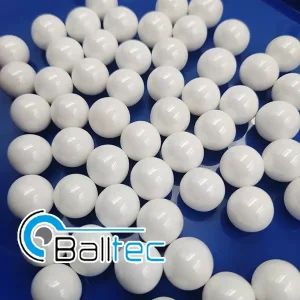
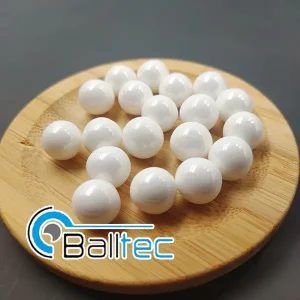
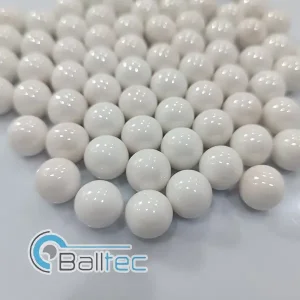
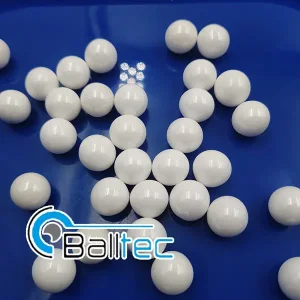
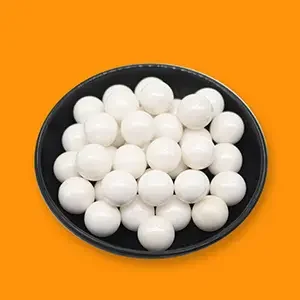
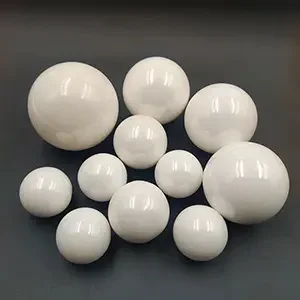
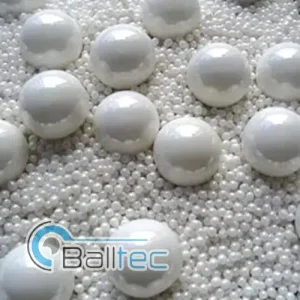
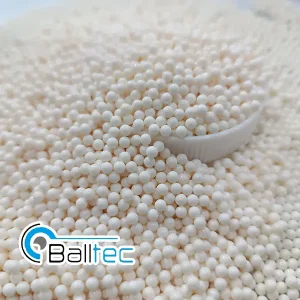
In modern high-energy density agitating bead mills and horizontal pin-type nano mills, the choice of grinding media defines the thermodynamic limits of particle refinement. Yttria-Stabilized Tetragonal Zirconia Polycrystal (Y-TZP) grinding balls manufactured in China have emerged as the global benchmark for processing advanced materials.
Unlike conventional brittle ceramics, Y-TZP utilizes stress-induced phase transformation ($t \to m$). When a micro-crack initiates under high impact shear, the surrounding tetragonal grain transforms into a monoclinic crystal structure. This phase transition induces a local 3-5% volume expansion, placing the crack tip under compressive stress and arresting fracture propagation.
The structural integrity of Chinese zirconia grinding balls relies on low-temperature rapid sintering technologies. By controlling primary grain sizes below $0.5\,\mu\text{m}$, intercrystalline void fraction is minimized. This sub-micron grain topology guarantees high fracture toughness ($K_{IC} \ge 9.0\,\text{MPa}\cdot\text{m}^{1/2}$) and exceptional Vickers hardness ($\ge 1250\,\text{HV10}$).
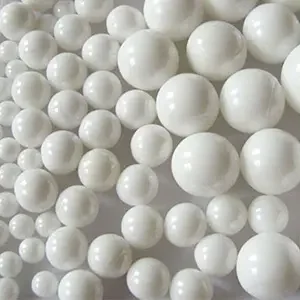
Using advanced liquid-phase dripping and isotropic rolling compression, Chinese factories achieve a sphericity ratio exceeding $98.5\%$. Multi-stage diamond mirror polishing reduces surface roughness ($R_a < 0.02\,\mu\text{m}$), minimizing wear on mill inner linings and agitation disks while preventing media crushing under hydrodynamic shear forces.
Standard commercial Y-TZP media utilizes $3\text{ mol}\%\,\text{Y}_2\text{O}_3$ ($5.2\text{ wt}\%$). Pingxiang Baitian's advanced thermal sintering protocol optimizes the dopant boundary distribution, lowering monoclinic aging phase degradation under hydrothermal conditions up to $180^\circ\text{C}$. This ensures zero chemical leaching in water-based paints, cathode slurry synthesis, and food-grade suspensions.
Global enterprise buyers in North America, Europe, and Asia-Pacific are transitioning from conventional steel, glass, and low-density alumina media to high-density Chinese zirconium oxide grinding balls. The financial driver is dictated by the Total Cost of Ownership (TCO) equation in continuous ultra-fine wet milling.
With a specific gravity of $6.0\,\text{g/cm}^3$, Y-TZP media provides $1.7\times$ the kinetic impact energy of high-purity alumina ($3.6\,\text{g/cm}^3$). Mill residence times for nano-dispersion are reduced by up to $45\%$, directly lowering energy consumption ($\text{kWh/ton}$) across high-volume production lines.
Baitian zirconium oxide grinding media features an ultra-low self-wear rate ($\le 2\,\text{ppm/hour}$). Lower media degradation directly reduces slurry contamination, which is critical for electronic components, MLCC barium titanate, semi-conductor CMP slurries, and battery cathode slurries (LFP/NCM).
Pingxiang, Jiangxi represents China's dense industrial ceramic cluster. Vertically integrated production—from raw zirconium chemical purification to automated rolling and sintering—delivers a $30\text{--}50\%$ cost advantage over European or Japanese suppliers without sacrificing dimensional precision.
To enable procurement officers and process engineers to select the optimal grinding ball composition, the table below provides verified physical parameters across primary industrial media categories.
| Media Material Type | Density (g/cm³) | Vickers Hardness (HV10) | Crush Load ($\varnothing 2\text{mm}$) | Relative Wear Life | Primary Application Areas |
|---|---|---|---|---|---|
| Y-TZP Zirconia (3mol% Y₂O₃) | $\ge 6.00$ | $1250 - 1350$ | $> 2500\text{ N}$ | $100\times$ (Benchmark) | LFP Battery Cathode, MLCC, CMP Slurry, Nano Inks |
| Ce-TZP Zirconia (Ceria Stabilized) | $\ge 6.20$ | $1150 - 1200$ | $> 3000\text{ N}$ | $85\times$ | Heavy Viscosity Paints, Calcium Carbonate Milling |
| Zirconium Silicate (ZrSiO₄) | $4.00 - 4.20$ | $1000$ | $> 1200\text{ N}$ | $25\times$ | Agrochemicals, Metallic Pigments, Paper Coatings |
| High Purity Alumina (99.99% Al₂O₃) | $3.60 - 3.80$ | $1400 - 1600$ | $> 1500\text{ N}$ | $15\times$ | Ceramic Glazes, Silica Powder, White Cement Milling |
| Chrome Steel / Stainless Steel | $7.80$ | $700 - 850$ | $> 4000\text{ N}$ | $5\times$ (High Contamination) | Ore Mining, Coarse Crushing, Non-Sensitive Minerals |
Note: Wear life benchmarks calculated under standard horizontal pin mill testing using deionized water suspensions with $0.4\text{--}0.6\,\text{mm}$ media sizes at $12\,\text{m/s}$ tip speeds.
Achieving sub-100 nanometer particle size distributions requires matching grinding media specifications with mill kinematics, shaft speeds, and slurry rheology.
Lithium Iron Phosphate (LiFePO₄) processing demands high energy input to achieve micro-structural uniformity without iron metal contamination. Baitian $0.1\text{--}0.3\,\text{mm}$ ultra-fine Y-TZP beads enable high tip speeds up to $14\,\text{m/s}$, driving particle sizes ($D_{97}$) down to $<200\,\text{nm}$ for superior battery discharge kinetics.
High-transparency automotive finishes require sub-micron dispersion of organic and inorganic pigments. Zirconia beads deliver narrow grain size distributions ($D_{90}/D_{10} < 2.1$), eliminating oversized agglomerates, reducing color haze, and increasing gloss levels while preventing nozzle clogging during spray application.
Compliant with international food contact standards, Baitian high-density zirconia balls are non-porous and chemically inert. They are widely specified for nanomedicine formulations, active pharmaceutical ingredients (APIs), microcrystalline cellulose, and high-purity dairy powder milling.
To prevent media compression and thermal spikes, the optimal charge volume ($V_m$) in horizontal agitating bead mills is calculated via: $$V_m = V_{\text{chamber}} \times (0.75 \text{ to } 0.85)$$ For target feed sizes ($d_{\text{feed}}$), the recommended media diameter ($D_{\text{media}}$) should adhere to: $D_{\text{media}} \approx (20 \text{ to } 30) \times d_{\text{feed}}$. Selecting correctly prevents media wedging within separator screens.
Pingxiang Baitian (Ball-tec) New Materials Co., Ltd. operates under full ISO integration, maintaining comprehensive batch traceability and regulatory compliance to support OEM and Tier-1 industrial buyers worldwide.
Factory production adheres to ISO 9001:2015 (Quality Management), ISO 14001:2015 (Environmental System Management), and ISO 45001:2018 (Occupational Health & Safety). Every batch of zirconia grinding balls undergoes laser particle size analysis, hydrostatic crush force testing, and XRF chemical stoichiometry validation.
Products fully comply with EU REACH SVHC guidelines and RoHS 2.0 Directives. Zero heavy metal additives are present, ensuring zero lead, cadmium, or mercury contamination risk during fine grinding processes.
Direct factory-to-port export routes from Pingxiang to Shanghai, Ningbo, and Shenzhen ports enable seamless freight forwarding. Offerings include heavy-duty 25kg steel drums, UN-approved moisture-proof composite bags, and fumigated ISPM-15 wooden pallets engineered for transoceanic container shipping.
As high-tech industries transition toward sub-10 nanometer processing targets, advanced ceramics manufacturing must evolve to meet stringent purity and particle dimensional demands.
Development of ultra-micro media down to $30\text{--}50\,\mu\text{m}$ ($0.03\text{--}0.05\,\text{mm}$) using high-pressure micro-fluidic dripping technologies to serve quantum dot display synthesis, semiconductor CMP polishing, and advanced bio-ceramic dispersion.
Engineered hybrid stabilized crystal structures ($\text{CeO}_2\text{-Y}_2\text{O}_3\text{-ZrO}_2$) combining the high hardness of yttria-stabilized media with the superior crush loading and hydrothermal decay resistance of ceria matrices.
Expanding chemical synthesis pathways to provide high-purity scandia-stabilized zirconia (SYSZ) and yttria-stabilized zirconia powders optimized for solid-state battery electrolytes and hydrogen fuel cell ceramic membranes.
Direct answers to common questions regarding specifications, media selection, factory capacity, and order logistics.
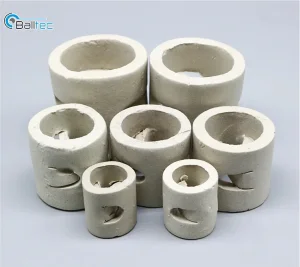
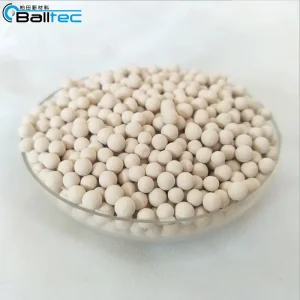
From high-purity alumina grinding spheres to catalytic bed packing rings and zeolites, Pingxiang Baitian provides complete chemical and materials processing solutions.