Follow 


Ceramic Pall rings are manufactured through a complex production process using kaolin, Suzhou clay, Guizhou clay, and other plastic clays included in the formulation. The process consists of raw material screening, ball milling, filter pressing of slurry into mud blocks, vacuum pugging, forming, drying, and high-temperature sintering.
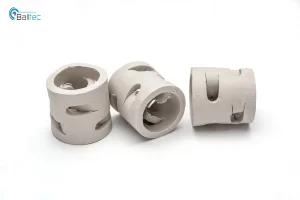
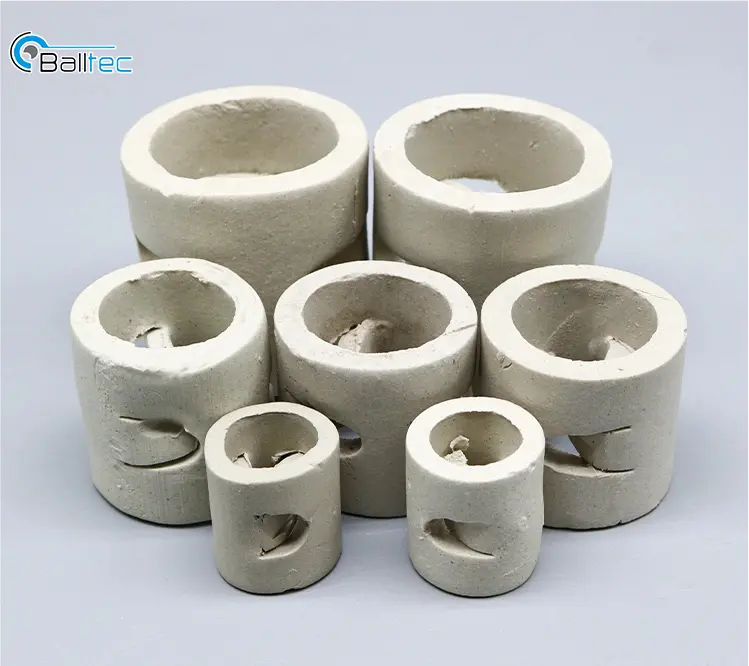
In fact, ceramic Pall rings were developed on the basis of ceramic Raschig ring packing, and their structural design was improved to overcome the critical shortcomings of Raschig rings. They are high-performance open-ring packing with equal outer diameter and height. Both the upper and lower layers are perforated like windows. This structure greatly improves gas and liquid distribution and makes full use of the inner surface area, allowing gas and liquid in the packed tower to pass freely through the “windows”.
As an open-ring packing, each layer of the ceramic Pall ring has five tongues, each bending inward toward the center of the ring. The positions of the upper and lower window layers are staggered. The total open area accounts for approximately 30% of the ring wall area. This design allows gas and liquid to pass freely through the perforations, improving gas-liquid distribution and fully utilizing the inner and outer surfaces of the ring.
Ceramic Pall rings feature excellent acid resistance, heat resistance, high and low temperature resistance, and aging resistance. They can resist corrosion from various inorganic acids (except hydrofluoric acid HF), organic acids, and organic solvents, and can be used under various high and low temperature conditions. Their acid and heat resistance comes from being sintered into dense ceramic material.
Ceramic Pall rings are widely used in washing towers, cooling towers, acid recovery towers, desulfurization towers, drying towers, absorption towers, and regeneration towers in industries such as metallurgy, chemical engineering, chemical fertilizer, acid manufacturing, coal gas, oxygen production, and pharmaceuticals. They are especially applied in petroleum, chemical industry, chlor-alkali, natural gas, and environmental protection industries. Pall ring packing is ideal for low-temperature (60–150°C) distillation, absorption, and scrubbing towers.
| Item | Specification |
|---|---|
| Product Name | Ceramic Pall Rings Tower Packing for Distillation Column |
| Raw Material | Kaolin, Suzhou clay, Guizhou clay, and other high-quality ceramic raw materials |
| Production Process | Raw material screening → Ball milling → Slurry filter pressing → Vacuum pugging → Molding → Drying → High-temperature sintering |
| Shape | Open ring, equal diameter and height, with 5 inward-bent tongues per window layer |
| Open Area | About 30% of the total ring wall area |
| Operating Temperature | ≤ 1300℃ (long-term); -50℃ ~ 1300℃ (short-term) |
| Corrosion Resistance | Resists various inorganic acids (except HF), organic acids, and organic solvents; Acid resistance ≤ 99%, Alkali resistance ≤ 85% |
| Particle Size (Diameter) | 16mm, 25mm, 38mm, 50mm, 76mm (customizable) |
| Bulk Density | 1.2 ~ 1.5 g/cm³ |
| Compressive Strength | ≥ 15 MPa |
| Key Features | High efficiency, good gas-liquid distribution, acid/heat resistance, low pressure drop, long service life |
| Packing Method | Wet packing is recommended to avoid breakage; dry packing is also available for small-size products |