Follow 


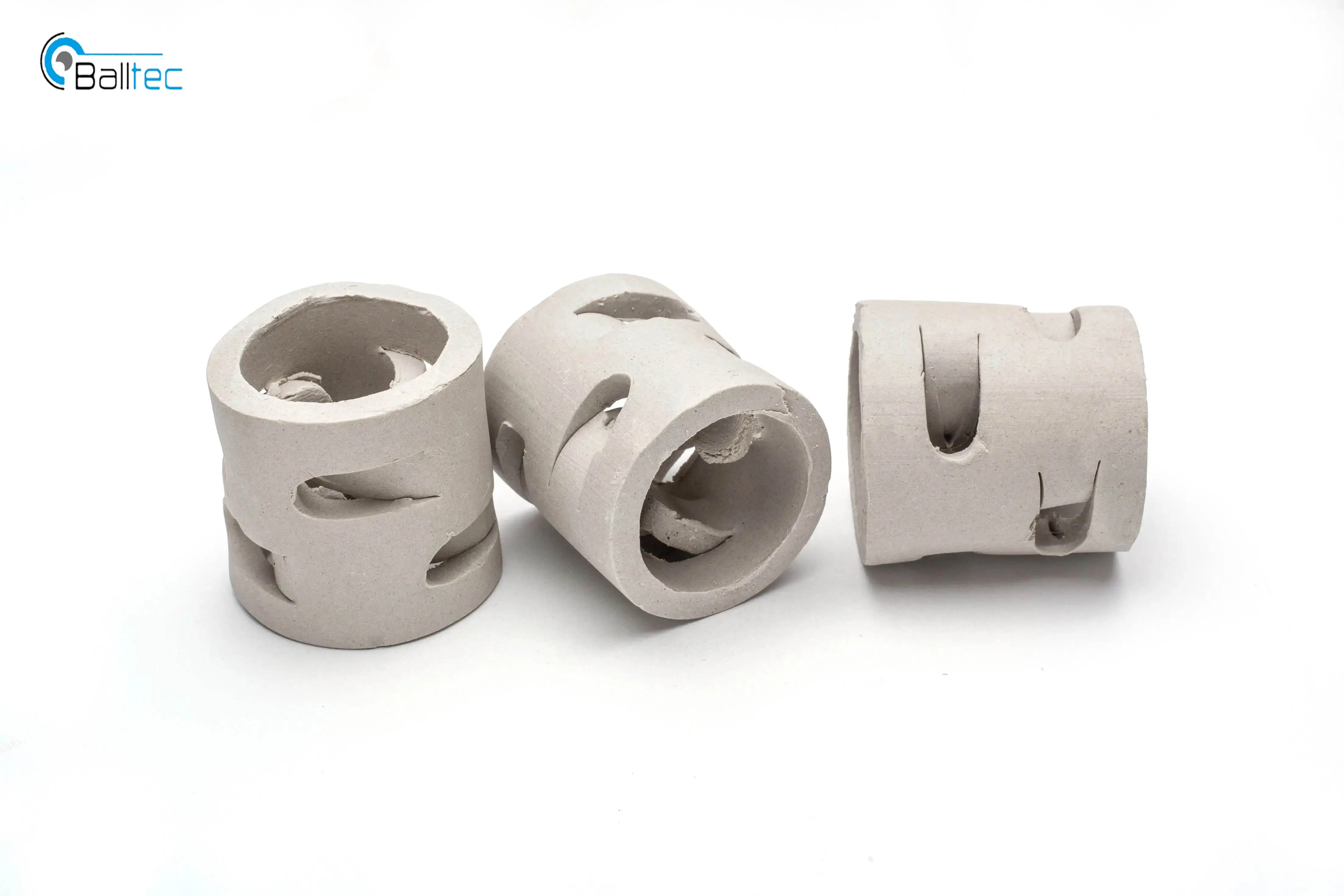
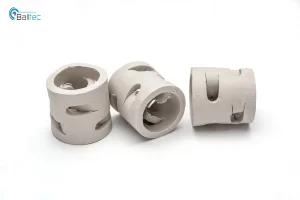
Ceramic Pall ring packing features an advanced open-ring structure with open areas accounting for approximately 30% of the total ring wall area. Developed on the basis of traditional ceramic Raschig rings with equal height and diameter, this specialized design allows gas and liquid in packed towers to pass freely through window openings, substantially improving gas-liquid distribution and fully utilizing the inner surface of the ring.
Under the same pressure drop, processing capacity is 50%–100% higher than Raschig rings. Mass transfer efficiency is increased by approximately 20%.
At the same throughput, pressure drop is reduced by 50%–70% compared to Raschig rings. Using Pall rings saves 20%–40% of overall packing volume.
Ceramic Pall ring packing exhibits exceptional acid resistance and heat resistance. It resists corrosion from various inorganic acids, organic acids, and organic solvents, making it suitable for demanding high-temperature environments across chemical, metallurgical, gas, and environmental protection industries.
Our ceramic Pall ring packing is widely deployed in critical industrial mass-transfer towers, including:
Our major client portfolio includes leading global petrochemical enterprises such as Sinopec and CNPC.
Each layer of window openings features 5 inward-curved tongues pointing toward the center of the ring. The upper and lower layers of window openings are staggered in opposite positions. This engineered structure dramatically enhances gas-liquid contact, reduces flow resistance, and optimizes tower capacity.
| Item | Standard Specification | Customizable Range | Remarks (Suitable for Drying & Dehydration) |
|---|---|---|---|
| Product Name | Ceramic Pall Ring, Scrubber Random Tower Packing | Customizable according to customer needs | Specialized for drying and dehydration in chemical industry scrubbers |
| Main Material | Cordierite, Mullite, Alumina (Al₂O₃) | Ceramic composite materials | Alumina for high temperature resistance; Cordierite for low thermal expansion, suitable for high-temperature drying |
| Structure Type | Open-ring random packing, equal height & diameter, inward-bent tongue leaves, staggered window holes | Window hole size, tongue leaf quantity | Open area ≈30% of total ring wall area, optimized for gas-liquid circulation in drying/dehydration |
| Nominal Diameter (mm) | Φ16, Φ25, Φ38, Φ50, Φ76, Φ100 | Φ8 - Φ150 | Φ16-Φ50 for fine drying; Φ76-Φ100 for large-flux dehydration |
| Height × Diameter (mm) | 16×16, 25×25, 38×38, 50×50, 76×76, 100×100 | Customizable (equal height & diameter) | Size deviation ≤±1mm to ensure uniform packing density |
| Specific Surface Area (m²/m³) | Φ16:274; Φ25:213; Φ38:151; Φ50:105; Φ76:72; Φ100:54 | 50 - 300 m²/m³ | Higher specific surface area for better drying/dehydration efficiency |
| Porosity (%) | Φ16:78; Φ25:80; Φ38:82; Φ50:85; Φ76:88; Φ100:90 | 75 - 92% | High porosity reduces pressure drop, facilitates gas circulation in drying processes |
| Bulk Density (kg/m³) | Φ16:750-780; Φ25:680-720; Φ38:620-650; Φ50:580-610; Φ76:520-550; Φ100:480-510 | 450 - 800 kg/m³ | Lower density reduces tower load, suitable for long-term operation |
| Operating Temp. (℃) | Long-term: -50 ~ 800; Short-term: Up to 1000 | Up to 1200℃ (special material) | Suitable for thermal shock and severe temperature conditions |
Ceramic Pall Rings offer 50%–100% higher processing capacity at the same pressure drop, reduce pressure drop by 50%–70% at equivalent throughput, increase mass transfer efficiency by around 20%, and save 20%–40% of the required packing volume compared to standard Raschig rings.
Ceramic Pall Rings feature superior acid resistance and can withstand virtually all inorganic acids, organic acids, and organic solvents. The only major exception is hydrofluoric acid (HF), which corrodes ceramic materials.
They are extensively used in drying, absorption, cooling, scrubbing, and regeneration towers within the chemical, metallurgical, gas, and environmental protection industries, including applications by major petrochemical firms like Sinopec and CNPC.
The open wall structure accounts for ~30% of the total ring wall area. With 5 inward-bending tongues per layer and staggered upper/lower openings, gas and liquid can circulate freely through the windows, maximizing inner surface utilization and gas-liquid distribution.
Standard Ceramic Pall Rings operate reliably in long-term temperatures ranging from -50°C to 800°C (and short-term up to 1000°C). With special ceramic composite materials, operating temperatures can reach up to 1200°C.
While standard diameters range from Φ16mm to Φ100mm, custom diameters from Φ8mm to Φ150mm are available, alongside customizable window hole sizes, tongue leaf counts, and specific material formulations like Cordierite, Mullite, or Alumina.