Follow 


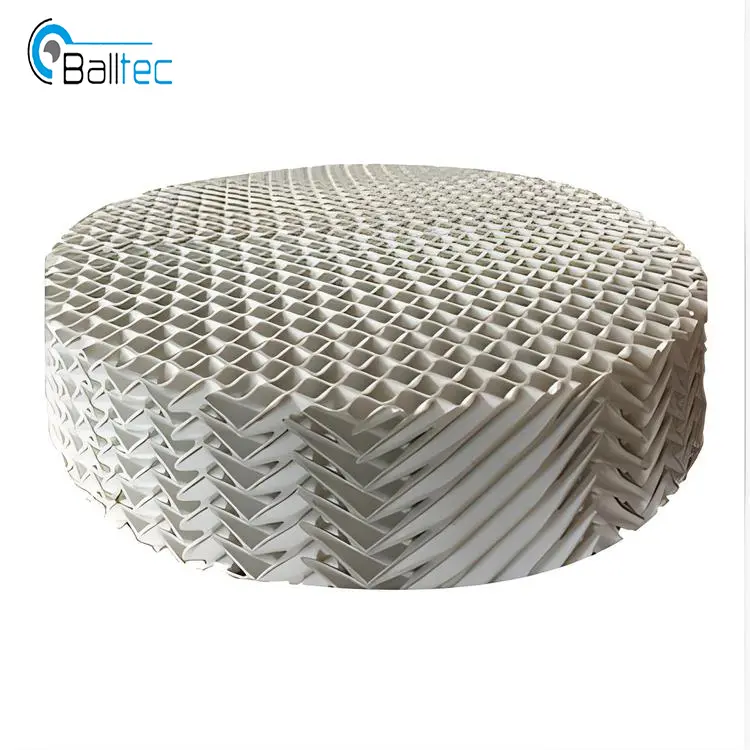
As a major type of tower packing, ceramic corrugated packing is widely applied in equipment such as rectification towers, absorption towers, extraction towers, heat exchangers and mist eliminators for industrial processes in the petrochemical, fine chemical and environmental engineering industries.
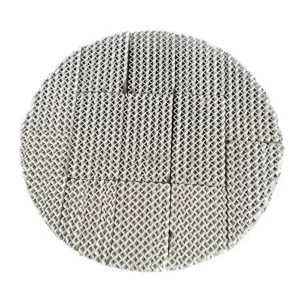
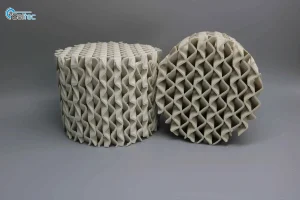
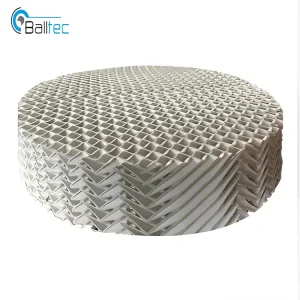
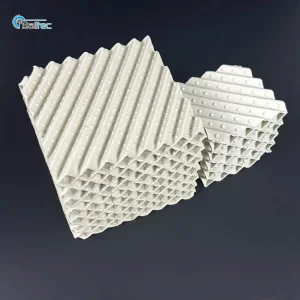
Since their advent, ceramic packing has developed rapidly due to its advantages of corrosion resistance and low cost, and new types of ceramic packing have been continuously developed. Ceramic corrugated packing is a new type of structured packing that has been widely used in recent years. As a kind of structured packing, it is fired from ceramic corrugated plates.
The specific surface area of ceramic structured corrugated packing is larger than that of random packing, with an increase of more than 15%.
The wettability of the ceramic corrugated packing surface is improved, which increases the wetted specific surface area of the packing, thereby raising the interfacial area and mass transfer efficiency. It intensifies gas-liquid disturbance and accelerates liquid surface renewal rate.
Geometric characteristic data include tray diameter, tray height, peak height, wave pitch, wave length, tooth angle, corrugation inclination angle and bulk density, which are the basic parameters reflecting the geometric characteristics such as the specification and shape of the packing.
| Item | Specification | Remarks (Adapted for Industrial Tower Application) |
|---|---|---|
| Product Name | Ceramic Corrugated-Plate Structured Packing / Ceramic Structured Packing | High-efficiency structured packing for gas-liquid mass transfer and separation |
| Main Material | Cordierite, Mullite, Alumina (Al₂O₃), Ceramic Composite Material | Customizable according to corrosion resistance and temperature requirements; Alumina type for high temperature resistance; Cordierite type for low thermal expansion |
| Structure Type | Corrugated plate structured, staggered stacking | Corrugated plates with tooth-shaped design, uniform flow channels |
| Corrugation Inclination Angle | 30°, 45° (optional); Customizable | 45° recommended for high mass transfer efficiency; 30° recommended for high liquid load |
| Specific Surface Area | 125-500 m²/m³ | 125-250 m²/m³ for large tower diameter; 350-500 m²/m³ for fine separation |
| Porosity | 75-90% | High porosity, low gas-liquid resistance, good mass transfer effect |
| Bulk Density | 300-600 kg/m³ | Depends on material; Lower than random packing, reducing tower load |
| Plate Thickness | 0.3-1.0 mm | Thicker plates for high pressure; Thinner plates for high specific surface area |
| Operating Temperature Range | Long-term: -50℃ to 800℃; Short-term: Up to 1000℃ |
Stable operation under high temperature conditions, no deformation or damage |
| Corrosion Resistance | Resistant to various inorganic acids (except HF), organic solvents, alkaline media | Suitable for harsh corrosion environments in chemical, metallurgical industries |
| Pressure Drop | ≤ 0.5-1.5 Pa/m (at normal temperature and pressure, air flow rate 1 m/s) | Lower than random packing, reducing energy consumption |
| Mass Transfer Efficiency (HETP) | 0.15-0.6 m (depends on specification and operating conditions) | HETP: Height Equivalent to a Theoretical Plate; Higher efficiency than random packing |
| Tower Diameter Adaptation | 0.1-10 m | Customizable for small laboratory towers and large industrial towers |
| Packing Module Size | 100×100×50 mm, 200×200×100 mm (customizable) | Module design, easy to install and disassemble |
| Wear Rate | ≤ 0.1% | Good wear resistance, suitable for long-term cyclic operation |
| Packaging | 20kg/50kg sealed moisture-proof plastic bags; 100kg/200kg fiber drums (with shock-proof lining) | Avoid moisture and collision during storage and transportation |
| Service Life | 5-8 years (under normal operating conditions) | Depends on operating conditions, medium corrosion and maintenance frequency |