Follow 


An engineering analysis of material synthesis, fine particle dispersion, structural ceramic components, and thermal-dielectric performance in high-reliability electronic assemblies.
The global electronics manufacturing landscape is undergoing a paradigm shift driven by high-frequency telecommunications (5G/6G), electric vehicle (EV) power electronics, semiconductor miniaturization, and green energy conversion systems. At the core of this transformation lies advanced industrial ceramics—specifically Yttria-Stabilized Tetragonal Zirconia Polycrystals (Y-TZP), High-Purity Alumina ($Al_2O_3$), Silicon Nitride ($Si_3N_4$), and engineered zeolites. These materials provide the thermal management, electrical insulation, mechanical toughness, and contamination-free processing required by tier-1 electronics original equipment manufacturers (OEMs).
As a leading China-based advanced ceramic component and chemical packing manufacturer, Pingxiang Baitian (Ball-tec) New Materials Co., Ltd. integrates state-of-the-art ceramic powder synthesis, cold isostatic pressing (CIP), high-temperature vacuum sintering, and nanometer-level precision machining. This technical whitepaper explores the systemic advantages of modern Chinese ceramic fabrication, critical physical property metrics, localized application engineering, and procurement strategies for global supply chain leaders.
Why Tier-1 global technology buyers source high-precision ceramic substrates, bearing balls, and ultrafine grinding media directly from Pingxiang, Jiangxi.
China commands over 70% of global rare-earth oxide and zirconium silicate purification capacity. Factories in the Pingxiang industrial cluster leverage immediate, direct access to high-purity $ZrO_2$ and $Al_2O_3$ feedstocks, eliminating cross-border raw material volatility and securing uninterrupted production schedules for high-volume orders.
By pairing fully automated continuous tunnel kilns and high-pressure Isostatic pressing systems with refined process control, Chinese OEMs achieve high sintering density ($>99.5\%$ theoretical density) at a fraction of Western production costs. This provides procurement managers a 25-45% total cost reduction without degrading component life.
Leading facilities operate under ISO 9001:2015, ISO 14001:2015, and ISO 45001 management frameworks. Every production lot undergoes rigorous laboratory verification—including laser diffraction particle size analysis, X-ray fluorescence (XRF) elemental purity checks, and crush-strength compression testing.
Key technological shifts shaping the procurement and specification of electronic ceramic components and fine dispersion media.
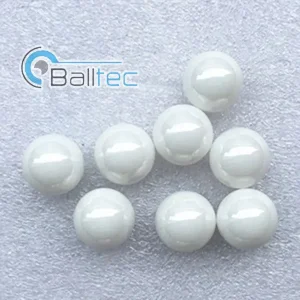
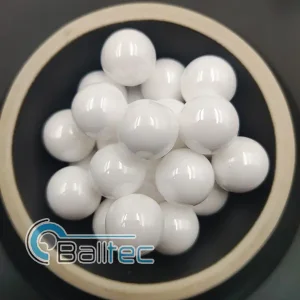
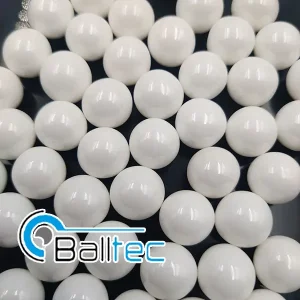
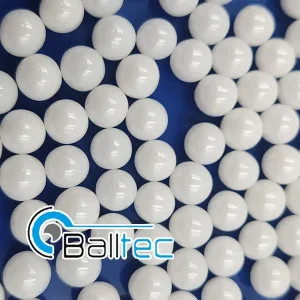
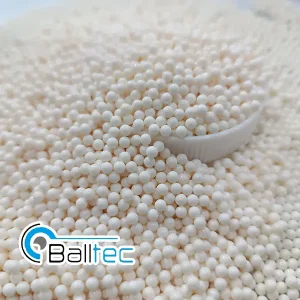
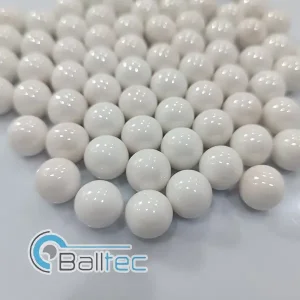
The lithium-ion and solid-state battery sectors demand ultra-fine dispersion of Lithium Iron Phosphate ($LiFePO_4$) and cathode/anode active materials. High-density Y-TZP zirconia beads ($6.0\text{ g/cm}^3$) allow nano-milling below 100 nm without metal ion contamination that causes battery short circuits.
High-purity $Al_2O_3$ (99.99%) and Silicon Nitride ($Si_3N_4$) are rapidly replacing metal components in wafer processing chambers, chemical mechanical planarization (CMP) slurry pumps, and high-frequency dielectric insulators due to plasma resistance and thermal stability.
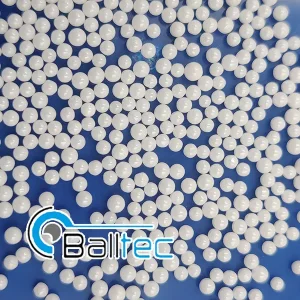
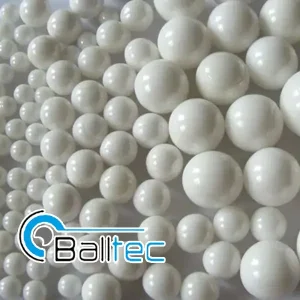
Multilayer Ceramic Capacitor (MLCC) manufacturing requires ceramic dielectric powders milled to exact particle size distributions. Micro-beads ($0.05\text{mm} - 0.2\text{mm}$) engineered with ultra-smooth surfaces prevent grain boundary defects in ultra-thin dielectric layers.
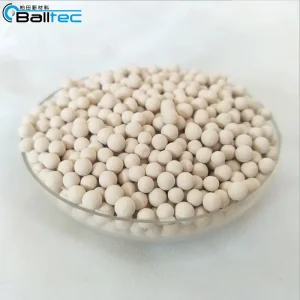
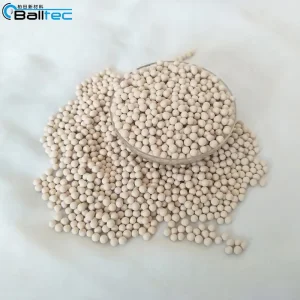
The purification of specialty gases (e.g., Silane, Ammonia, Fluorocarbons) for semiconductor fabrication relies on synthetic 3A, 4A, 5A, and 13X molecular sieves to eliminate moisture down to sub-ppm levels, preventing micro-corrosion during deposition.
Comprehensive engineering applications across primary high-tech industrial sectors.
| Material Classification | Primary Composition | Density (g/cm³) | Hardness (Mohs / HV) | Key Industrial Application |
|---|---|---|---|---|
| Yttria-Stabilized Zirconia (Y-TZP) | $ZrO_2 \ge 94.8\%, Y_2O_3 \approx 5.2\%$ | $\ge 6.00$ | 9.0 Mohs / 1250 HV10 | Lithium battery slurry, MLCC dielectric milling, dental restorations |
| High-Purity Alumina (4N) | $Al_2O_3 \ge 99.99\%$ | $3.92 - 3.96$ | 9.0 Mohs / 1700 HV10 | Semiconductor chamber parts, chemical-resistant wear plates |
| Silicon Nitride ($Si_3N_4$) | $Si_3N_4 \ge 98.0\%$ | $3.25$ | 1500 HV10 (G3/G5 Grade) | EV drive motor bearings, robotics joints, high-speed machine spindles |
| Synthetic Zeolite (13X) | $Na_2O \cdot Al_2O_3 \cdot 2.8SiO_2 \cdot xH_2O$ | Bulk: $0.65 - 0.72$ | High Crush Strength ($>45\text{N}$) | Air pre-purification, catalyst carrier, $CO_2$ & $H_2O$ deep removal |
In semiconductor front-end and back-end manufacturing, structural integrity and particle purity are mandatory. Ultra-high purity alumina components (99.99%) provide resistance to aggressive fluorine and chlorine plasma etching environments. Simultaneously, high-density zirconia grinding media are deployed in attrition mills to process polishing slurries (silica, ceria, alumina slurries) used in Chemical Mechanical Planarization (CMP). The absence of micro-fracturing in Baitian zirconia media prevents scratch defects on silicon wafers during sub-10nm planarization processes.
The transition toward high-energy-density EV batteries (NMC, LFP, and Solid-State) demands zero metal contamination during wet milling. Metal contaminants like free iron, copper, or zinc induce dendritic growth, leading to battery catastrophic failure. Yttrium-stabilized $ZrO_2$ beads exhibit extremely low wear rates ($<0.01\text{ g/kg}$), ensuring battery slurry purity. Additionally, precision $Si_3N_4$ ceramic bearing balls (ISO 3290 Grade G3) provide electrical insulation inside EV traction motors, eliminating electrical erosion (stray currents) on bearing raceways.
In mass transfer towers, ceramic chemical packing (Pall Rings, Raschig Rings, and 500Y Corrugated Structured Packing) delivers resistance to extreme acid, alkali, and thermal cycles. Paired with molecular sieves (3A, 4A, 5A, 13X), these systems purify feedstock gases, remove traces of water, hydrogen sulfide, and mercaptans, and serve as structural bed supports for expensive precious metal catalysts in refineries worldwide.
Delivering operational transparency, certified quality management, and global logistics reliability for B2B supply chains.
Every batch of advanced ceramic balls and molecular sieves undergoes rigorous quality checks. Samples are analyzed via ICP-OES for elemental purity, SEM (Scanning Electron Microscopy) for crystalline grain uniformity, and specialized drop-test equipment to verify shock resistance under extreme kinetic impact.
We support custom engineering requests ranging from sub-millimeter micro-beads ($0.05\text{mm}$) to large industrial tower packing structures ($100\text{mm}+$), customized chemical doping ($Y_2O_3, CeO_2, MgO$ stabilization), and private-label export packaging compliance for North American, European, and Asia-Pacific ports.
To streamline vendor qualification for multinational procurement teams, Baitian provides full technical documentation upon inquiry: Material Safety Data Sheets (MSDS), Technical Data Sheets (TDS), ISO Certificate copies, and RoHS / REACH chemical safety compliance statements.
Practical engineering implementation of advanced ceramic media across industrial workflows.
In conductive ink and conductive paste manufacturing for printed circuit boards (PCBs), agglomerated conductive particles cause trace breaks. Utilizing 0.1mm Yttrium-Stabilized Zirconia beads in high-energy pin-type agitator bead mills achieves uniform sub-micron dispersion without introducing metallic impurities, ensuring consistent electrical conductivity.
High-purity hydrogen gas stored for fuel cell electric vehicles (FCEVs) must meet stringent ISO 14687 water content thresholds ($< 5\text{ ppm}$). Baitian 3A and 5A molecular sieve desiccant beds operate in dual-tower pressure swing adsorption (PSA) systems to reliably scrub moisture from high-pressure hydrogen gas streams.
Chemical manufacturing plants operating corrosive acid vapor absorption columns deploy Acid-Resistant Ceramic Raschig Rings and Pall Rings. These structural packing elements maintain structural integrity under continuous $300^\circ\text{C}$ thermal shock and concentrated sulfuric acid exposure, maximizing liquid-gas contact efficiency.
Clear, engineering-backed answers addressing critical search intent and buyer queries.
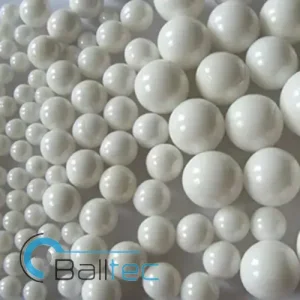
Yttria-stabilized zirconia (Y-TZP) possesses a significantly higher density ($\sim 6.0\text{ g/cm}^3$) compared to high-purity alumina ($\sim 3.6 - 3.9\text{ g/cm}^3$). The higher density delivers greater kinetic impact energy during mill rotation, accelerating particle size reduction down to nanometer scales. Furthermore, Y-TZP exhibits superior fracture toughness ($K_{IC} \ge 9 - 10\text{ MPa}\cdot\text{m}^{1/2}$), making it resistant to bead breakage in high-energy agitator mills. Alumina media, while less dense, offer an economical solution for medium-fine grinding where trace alumina contamination is acceptable (e.g., structural ceramics, glazes).
Selection depends on the effective pore diameter and molecular kinetic diameter of the target adsorbates:
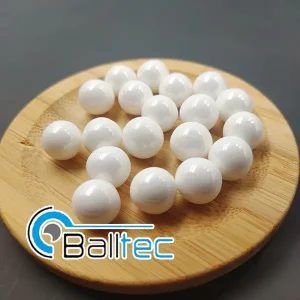
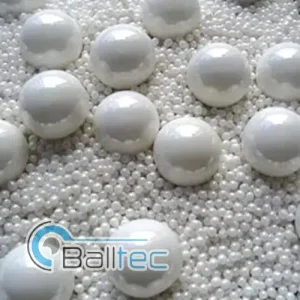
Baitian manufactures Silicon Nitride ($Si_3N_4$) and Zirconia ($ZrO_2$) ceramic bearing balls compliant with ISO 3290 and ABMA standards, available in precision grades from G3 (highest precision) to G10. Grade G3 and G5 balls feature sub-micron sphericity errors ($<0.08\,\mu\text{m}$) and surface roughness ($Ra < 0.01\,\mu\text{m}$). These high-precision hybrid ceramic components are utilized in high-speed CNC machine tool spindles, electric vehicle traction motors, aerospace instruments, and robotics joints requiring zero magnetic interference and low friction loss.
Our ISO 9001:2015 certified production workflow employs automated raw material batching, continuous laser particle size monitoring, and standardized sintering curves controlled via microprocessors. Every batch undergoes mandatory quality testing prior to release, including bulk density analysis, wear-rate verification in laboratory bead mills, and crush strength measurements. Mill Test Certificates (MTC) and Certificate of Analysis (COA) documents accompany every shipping container.
Standard inventory items (such as benchmark $ZrO_2$ grinding beads and standard zeolite molecular sieves) ship within 7 to 10 business days. Custom engineered shapes, specialized chemical formulations, or micro-bead sizes under 0.1mm typically require 2 to 4 weeks for production and QC approval. We support EXW, FOB (Ningbo/Shanghai/Shenzhen), CIF, and DDP delivery terms with sea-freight bulk packaging (1-ton super sacks or steel drums on fumigated pallets).