Follow 


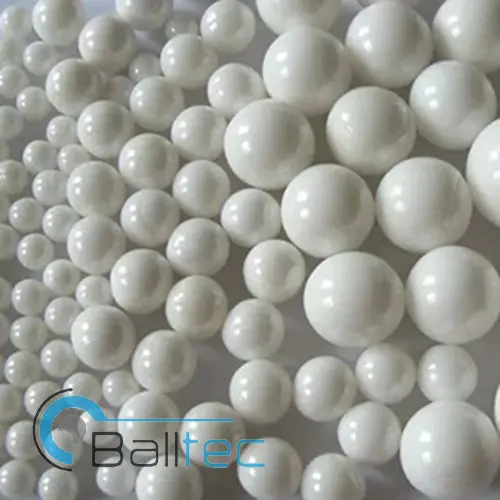
| Parameter Item | Specification |
|---|---|
| Zirconia Purity | 95% (Yttria-stabilized) |
| Bulk Density | 6.0-6.2 g/cm³ |
| Available Particle Size | 0.05mm-3.0mm |
| Vickers Hardness | ≥1200 HV |
| Metal Contamination | ≤0.3 ppm |
These ZrO2 beads excel in uniform dispersion and particle size refinement compared with traditional alumina and glass beads. Their high density enhances grinding kinetic energy, enabling rapid crushing of agglomerated particles to achieve narrow particle size distribution.
Excellent impact resistance prevents bead cracking and powder shedding during high-intensity grinding, avoiding secondary pollution and protecting material purity.
Superior chemical inertness ensures stable performance in acidic, alkaline and solvent environments, maintaining consistent grinding efficiency and improving finished product uniformity and fineness significantly.
Refines cathode and anode powders to ensure uniform particle size for better battery stability and superior performance.
Realizes ultra-fine dispersion of colorants and fillers to significantly improve gloss and color uniformity.
Widely used in advanced ceramics, pharmaceutical materials, and nano-material processing for impurity-free results.
Matching different bead sizes and milling processes, the beads can process materials down to sub-micron and nano-scale fineness, with uniform particle size distribution and no obvious coarse particles.
With ultra-low wear rate and high toughness, their service life is 3-5 times longer than glass beads and 2 times longer than ordinary alumina beads, greatly reducing media replacement costs.
The beads feature ultra-low metal precipitation (≤0.3 ppm) and stable chemical properties, with almost no impurity release, suitable for high-purity material processing in pharmaceutical and electronic industries.
They are widely adapted to high-speed bead mills and planetary ball mills, delivering consistent and stable grinding results for high-precision material processing scenarios.
Their superior chemical inertness ensures stable performance across acidic, alkaline, and organic solvent environments without degrading or compromising the finished product.
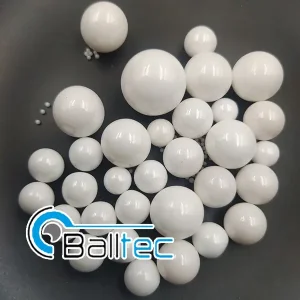
The available particle size range spans from 0.05mm up to 3.0mm, allowing precise selection based on specific material dispersion and fineness demands.