Follow 


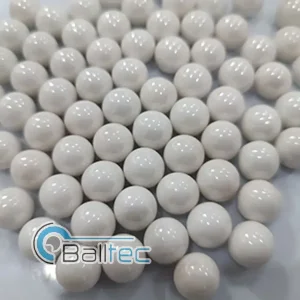
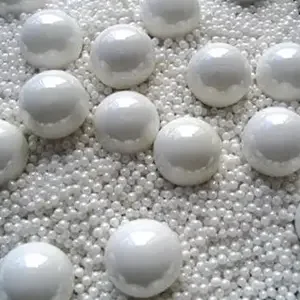
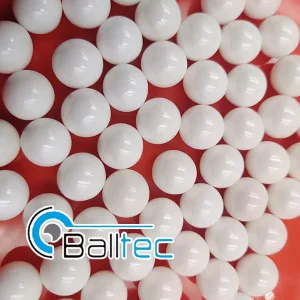
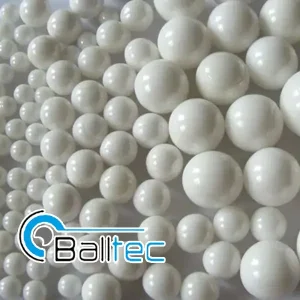
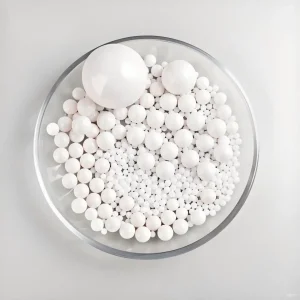
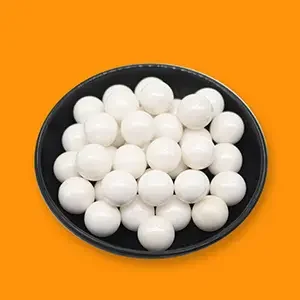
Direct factory supply of high-density YSZ beads, alumina media, and structural ceramic balls optimized for precision grinding and industrial processing.
Understanding Yttria-Stabilized Tetragonal Zirconia Polycrystal (Y-TZP) dynamics, stress-induced phase transformation, and structural integrity under dynamic kinetic energy transmission.
Standard raw zirconium dioxide ($\text{ZrO}_2$) undergoes structural phase transitions during thermal exposure, shifting from monoclinic to tetragonal at 1170°C, and cubic at 2370°C. By co-precipitating precisely 5.15% ± 0.2% Yttrium Oxide ($\text{Y}_2\text{O}_3$), wholesale 95 zirconia balls preserve a metastable tetragonal crystal structure at room temperature. This chemical configuration forms the baseline of industrial Y-TZP media.
When an advancing micro-crack exerts mechanical stress on a 95 YSZ sphere during ultra-high energy milling, the metastable tetragonal phase around the crack tip transforms into a stable monoclinic phase. This volumetric expansion (~3-5%) exerts strong compressive stress on the crack tip, effectively stopping crack propagation and yielding unmatched fracture toughness ($\ge 9.0 \text{ MPa}\cdot\text{m}^{1/2}$).
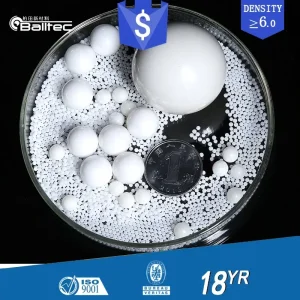
Utilizing hot-isostatic pressing (HIP) and advanced titrating-sintering techniques, 95% zirconia balls achieve an ultra-high theoretical bulk density of $\ge 6.0 \text{ g/cm}^3$ with zero internal voids. This high density provides massive kinetic impact force ($E_k = \frac{1}{2}mv^2$), drastically shortening milling duration for sub-micron and nano-scale grinding operations.
Why Tier-1 chemical processors and advanced battery material producers partner directly with Pingxiang ceramic clusters for enterprise-scale wholesale 95 zirconia ball procurement.
Located in Pingxiang, Jiangxi Province—the undisputed hub of China's industrial ceramics engineering—our manufacturing facilities benefit from complete vertical integration. From rare-earth yttrium processing to high-purity chemical precipitation of zirconium salt powders, localized supply networks cut raw material delivery lead times and ensure strict quality consistency.
By bypassing third-party chemical brokers, direct Chinese OEM factories control chemical impurity thresholds at the atomic level, keeping trace elements like $\text{SiO}_2$, $\text{Fe}_2\text{O}_3$, and $\text{Na}_2\text{O}$ below strict ppm limits.
Deploying 95 YSZ media across advanced technology sectors requiring ultra-low contamination and nano-scale grinding efficiency.
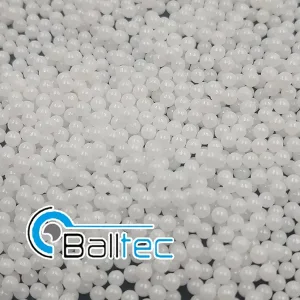
In the production of Lithium Iron Phosphate ($\text{LiFePO}_4$) and high-nickel NCM cathode materials, grind size uniformity directly controls battery energy density and charge-discharge rates. Micro-beads of 95 zirconia (sized from 0.1mm to 0.4mm) enable high-energy sand milling down to $d_{50} < 100\text{ nm}$ while maintaining zero metallic contamination, preventing dangerous internal battery short circuits.
Multi-Layer Ceramic Capacitors (MLCC), dielectric powders, barium titanate ($\text{BaTiO}_3$), and piezoelectric ceramics require ultra-pure raw materials during sub-micron dispersion. Wholesale 95% zirconia grinding balls feature exceptionally low wear rates (≤ 2 ppm/h), eliminating media-induced dielectric breakdown in electronic components.
Biomedical active pharmaceutical ingredients (APIs), sunscreen titanium dioxide dispersions, and high-end automotive inkjet inks demand smooth, spherical media with non-porous polished surfaces. Highly polished 95 YSZ media facilitate seamless CIP (Clean-in-Place) processes without residual biological or cross-chemical cross-contamination.
A rigorous quantitative comparison of density, Mohs hardness, fracture toughness, and total operational wear kinetics across industrial grinding media classes.
| Material Parameter / Type | 95% Yttria Zirconia (YSZ) | Zirconium Silicate ($\text{ZrSiO}_4$) | High Purity Alumina ($99.5\%$) | Silicon Nitride ($\text{Si}_3\text{N}_4$) |
|---|---|---|---|---|
| Bulk Density ($\text{g/cm}^3$) | ≥ 6.00 | 4.00 - 4.20 | 3.68 - 3.80 | 3.20 - 3.30 |
| Mohs Hardness | 9.0 | 8.0 | 9.0 | 9.2 |
| Fracture Toughness ($\text{MPa}\cdot\text{m}^{1/2}$) | 9.0 - 10.0 | 2.0 - 3.0 | 4.5 - 5.0 | 6.0 - 7.0 |
| Vickers Hardness ($\text{HV}_{10}$) | 1250 - 1300 | 1000 | 1400 - 1500 | 1500 - 1600 |
| Wear Rate Index (% / 24h) | ≤ 0.008% | ≤ 0.05% | ≤ 0.02% | ≤ 0.005% |
| Primary Milling Domain | Nano-Grinding / High Energy Sand Mills | Coarse Milling / Vertical Agitated Mills | Glaze & Ceramic Ball Mills | Ultra-High Speed Bearing & Specialized Nano Mills |
Why upfront capital investment in premium 95 zirconia balls delivers significant operational savings over multi-year production cycles.
Because wholesale 95 YSZ media offer a wear rate up to 10x lower than traditional glass or zirconium silicate beads, mill maintenance teams experience far fewer media re-charging interruptions. This yields higher annual equipment effectiveness (OEE) for continuous-production facilities.
With a density of $6.0 \text{ g/cm}^3$, 95 zirconia balls deliver higher kinetic impact per revolution than lower-density media. The resulting higher grinding power density enables bead mills to reach the target particle distribution ($d_{90}$) up to 40% faster, cutting electrical energy expenditure per ton of slurry output.
Contamination from worn grinding media can ruin entire batches of expensive battery slurries or electronic pastes. Utilizing ultra-durable 95% YSZ grinding balls eliminates costly batch rejections and protects long-term customer relationships.
Key technical innovations shaping the next decade of ultra-fine particle size reduction and advanced chemical processing.
As next-generation solid-state battery electrolytes and quantum-dot inks require particle size distribution ($d_{50}$) under 50 nanometers, demand for micro-beads sized between 0.03mm and 0.1mm is surging. Precision spheroidization via high-pressure centrifugal titrating allows China's premier factories to manufacture micro-beads with exceptionally uniform sphericity.
Leading Chinese exporters are implementing closed-loop heat recovery systems and solar-assisted electric kiln technology. These advancements reduce carbon footprints by up to 25% per metric ton of sintered zirconia, aligning with global corporate Scope 1 and Scope 2 sustainability mandates.
Technical guidance and sourcing information from our materials science team to streamline your procurement process.
Explore our broader range of specialized structural ceramic balls, bearing components, molecular sieves, and custom milling media formulations.