Follow 


| Item | Density | Coefficient | Elasticity Modulus | Poisson’s Ratio | Hardness (HV) | Hardness (HRC) | Bending Strength | Compressive Strength |
| Unit | g/cm3 | 10-6/k | Gpa | - | - | - | Mpa | Mpa |
| Si3N4 | 3.23 | 3.2 | 300-320 | 0.26 | 1500-1800 | 75-80 | 200 | 1400 |
| Item | Fracture Toughness | Thermal Conductivity | Electrical Resistivity | Highest Temp | Acid and Alkali Corrosion Resistance | Stress Cycles (50% failure probability) | ||
| Unit | Mpa·m1/2 | W/mk | Ω·mm2/m | ℃ | - | Times | ||
| Si3N4 | 6.0-7.0 | 18 | 1018 | 800 | Strong | 107-109 | ||
| Item | Dimensions Stability | Centrifugal Force | Non-lubrication Friction | Magnetism | Rolling Contact Fatigue Failure Mode | |||
| Unit | - | - | - | - | - | |||
| Si3N4 | Change with temp is small | Small | Small | None | Peel Off | |||
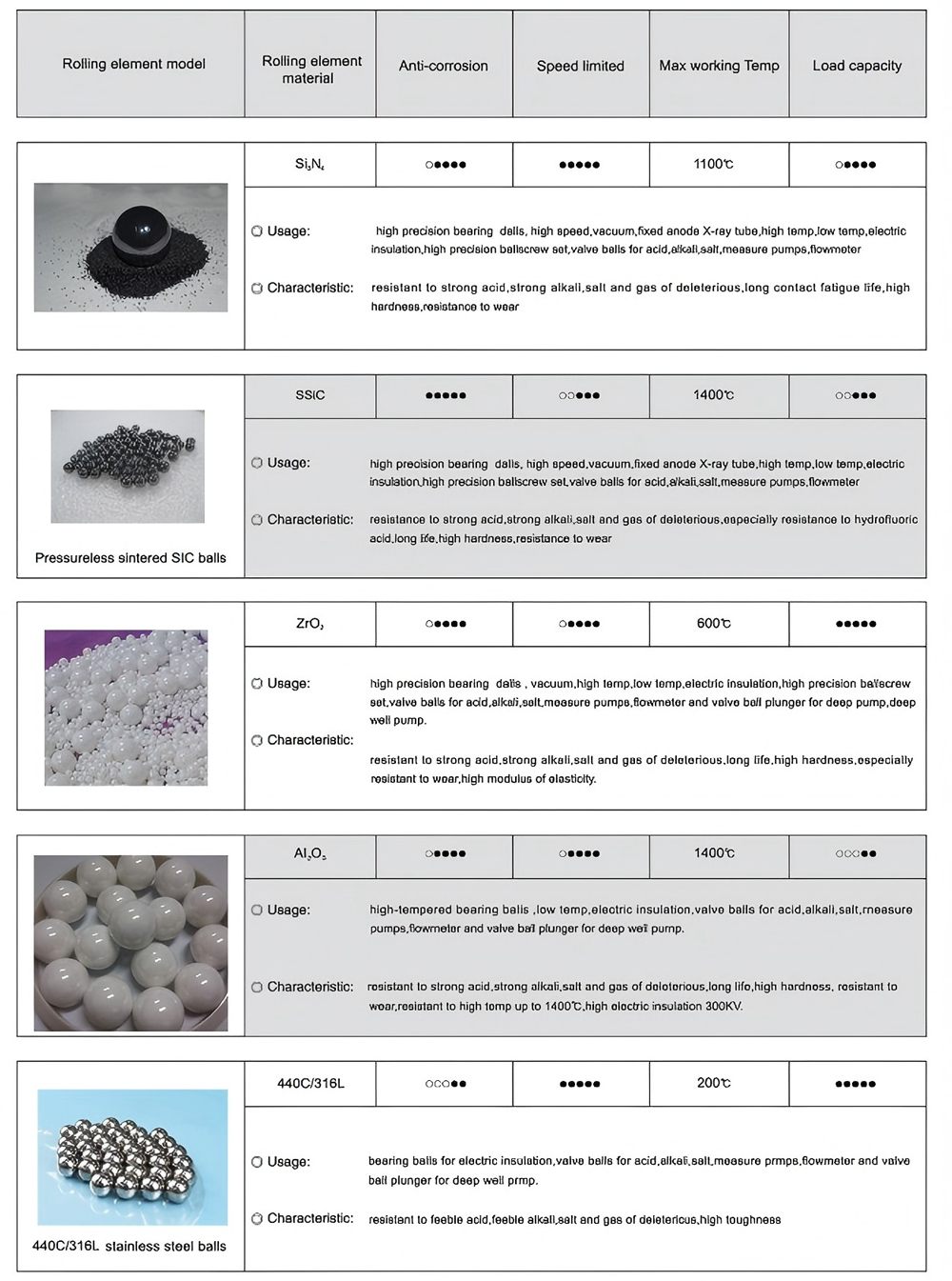
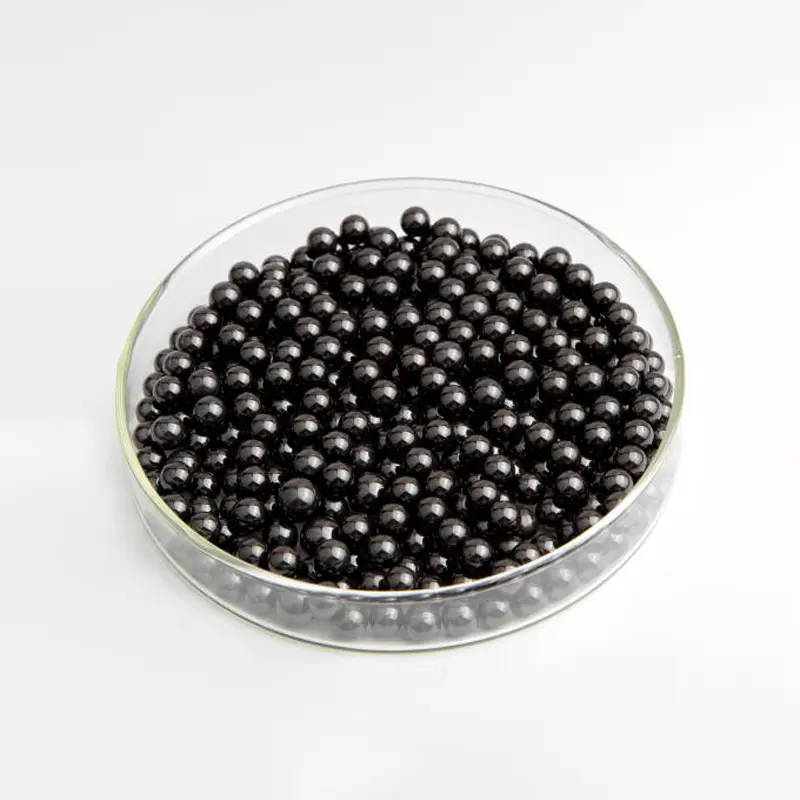
Silicon nitride bearing hardness is exceptionally high. Below are the detailed insights into its hardness metrics and material characteristics:
The hardness of silicon nitride bearings reaches a very high level. For instance, the Vickers hardness of silicon nitride ceramic balls can reach 15-16 GPa, while the Rockwell hardness is typically between 1800-2200, far exceeding traditional metal bearings.
High hardness stems from its diamond-like crystal structure, optimized preparation processes, and fine grain size. Excellent crystallinity and clear grain boundaries yield higher overall material hardness.
Widely utilized in demanding industries like automotive engineering. Withstanding high speeds and elevated temperatures up to 2000 HV, it resists wear and thermal expansion during braking to extend component service life.
Extreme hardness is directly linked to superior wear resistance. Silicon nitride bearings significantly lower wear rates and extend operational lifespans, making them ideal for heavy-duty friction environments.
Silicon Nitride (Si3N4) bearings offer exceptional hardness, reaching 15-16 GPa (Vickers hardness) for ceramic balls and 75-80 HRC (or up to 1800-2200 HV), vastly outperforming standard metal bearings.
Si3N4 features a density of 3.23 g/cm³, elasticity modulus of 300-320 GPa, compressive strength of 1400 MPa, and can operate continuously at temperatures up to 800 ℃.
In applications like high-speed automotive braking or aerospace systems, high hardness minimizes wear and thermal expansion, resulting in reduced maintenance and significantly longer service life.
Yes, Silicon Nitride bearings exhibit strong performance against acid and alkali corrosion, making them suitable for aggressive chemical environments.
No, Silicon Nitride ceramic material is non-magnetic, making it ideal for non-magnetic or sensitive electromagnetic applications.