Follow 


Directly engineered for high-stress electrical insulation, semiconductor micro-milling, and extreme chemical process environments.
Navigating the global convergence of Silicon Controlled Rectifiers (SCR), power semiconductor substrates, high-frequency energy conversion, and ultra-pure technical ceramics.
Silicon Controlled Rectifiers (SCRs)—also known as thyristors—serve as the foundation of modern high-power switching, phase-control circuits, HVDC power transmission, and industrial motor drives. Operating under high voltage gradients (ranging from several hundred volts to multiple kilovolts) and high thermal stress, SCR assemblies require exceptional dielectric insulation, zero-defect substrate planarization, and rapid heat dissipation.
As power electronics migrate toward higher power densities and extreme thermal duty cycles, procurement leaders are aligning with integrated OEM manufacturing partners capable of delivering specialized technical ceramics—including Yttria-Stabilized Zirconia (YSZ), Magnesia-Stabilized Zirconia (MSZ), 99.99% Ultra-Pure Alumina ($Al_2O_3$), and Silicon Nitride ($Si_3N_4$) components.
Achieving superior reliability in SCR modules and power electronics hinges on two critical ceramic vectors:
Tier-1 automotive, industrial power, and semiconductor equipment buyers enforce strict technical parameters for SCR electronics and ceramic component sourcing.
| Material Matrix | Primary Physical Density | Vickers Hardness (HV) | Dielectric Strength / Conductivity | Target Industrial SCR & Processing Applications |
|---|---|---|---|---|
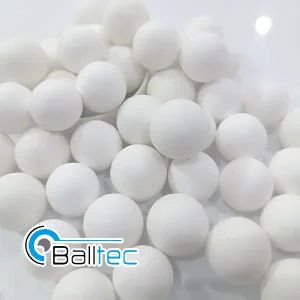
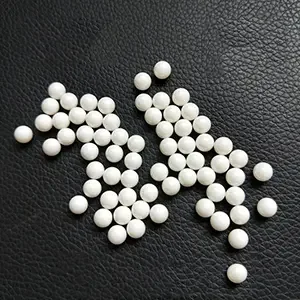
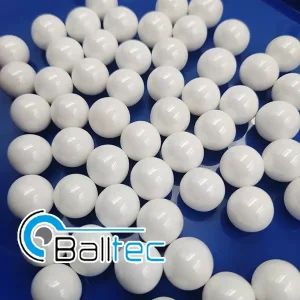
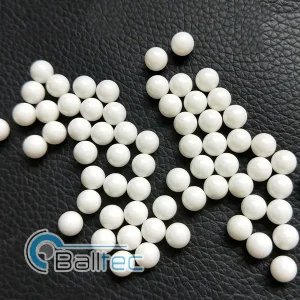
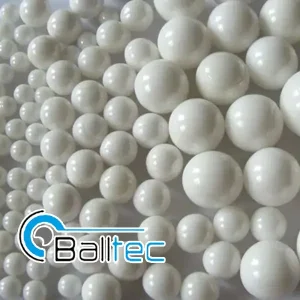
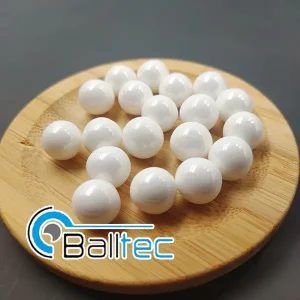
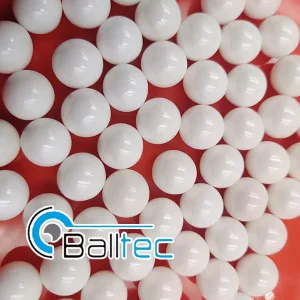
| Yttria-Stabilized Zirconia (3Y-TZP) | $\ge 6.00\text{ g/cm}^3$ | $1250 - 1350\text{ HV}_{10}$ | $10^{12}\ \Omega\cdot\text{cm}$ / $2.5\text{ W/m}\cdot\text{K}$ | Ultra-fine wet grinding media, high-friction ceramic bearing balls, SCR stress rings. |
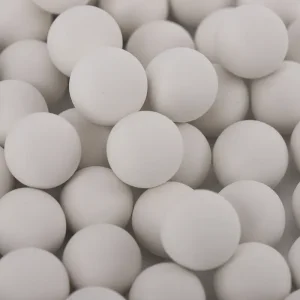
| High-Purity Alumina (99.99% / 4N) | $\ge 3.92\text{ g/cm}^3$ | $1700 - 1800\text{ HV}_{10}$ | $10^{14}\ \Omega\cdot\text{cm}$ / $30\text{ W/m}\cdot\text{K}$ | SCR electronic substrates, high-voltage ceramic vacuum interrupters, CMP slurry grinding media. |
| Magnesia-Stabilized Zirconia (MSZ) | $\ge 5.75\text{ g/cm}^3$ | $1150 - 1250\text{ HV}_{10}$ | High Thermal Shock Resistance | Thermal spray powders, heavy-duty valve components, molten metal handling dielectrics. |
| Silicon Nitride ($Si_3N_4$ G3/G5) | $\ge 3.25\text{ g/cm}^3$ | $1400 - 1600\text{ HV}_{10}$ | $15\text{ kV/mm}$ / $32\text{ W/m}\cdot\text{K}$ | EV inverter micro-bearings, high-frequency SCR power module insulation balls. |
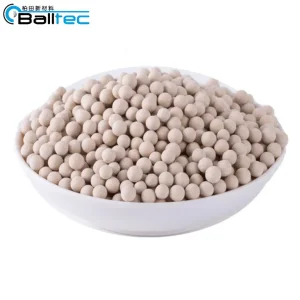
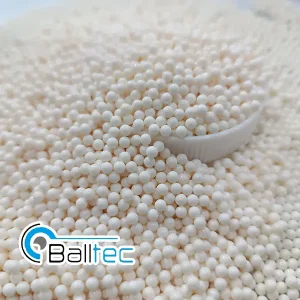
| Zeolite Molecular Sieves (4A/5A/13X) | Bulk Density $0.62 - 0.72\text{ g/mL}$ | Crush Strength $\ge 85\text{ N/bead}$ | Regenerable Adsorption Capacity | Industrial gas drying, cleanroom air pre-purification for SCR wafer manufacturing. |
Industrial SCR power electronics and micro-milling media demand zero deviation in crystallographic phases. Microstructural characterization via X-ray Diffraction (XRD) guarantees precise tetragonal/monoclinic phase ratios in zirconia media, preventing premature micro-fracturing and structural degradation.
In electronic-grade materials processing (e.g., MLCC, semiconductor CMP slurries, LFP cathode milling), metallic contamination ($Fe, Cu, Ni$) must be kept under 5 ppm. Our high-purity $Al_2O_3$ and $ZrO_2$ media eliminate iron contamination risks, preserving electronic conductivity specs.
Every procurement shipment includes certified Lot Inspection Reports covering grain size distribution, density via Archimedes method, wear rate tests, and chemical purity assay. Complete ISO 9001, ISO 14001, and ISO 45001 documentation standardizes worldwide supplier qualification.
Deploying advanced ceramic technology across key global sectors driving energy transition, high-power electronics, and advanced chemical manufacturing.
High-voltage SCR assemblies in HVDC conversion stations and heavy industrial arc furnaces generate severe electrical and thermal gradients. Precision ceramic insulators, arc-chute spacers, and $Si_3N_4$ hybrid bearings mitigate parasitic eddy currents, provide voltage insulation up to tens of kilovolts, and extend operational lifespans under thermal cycling.
Next-gen Lithium Iron Phosphate ($LiFePO_4$), High-Nickel NMC cathodes, and semiconductor electronic pastes require sub-micron milling (particle sizes below 200 nm). Our Yttria-Stabilized Zirconia (YTZP) beads offer ultralow wear ($<0.01\text{ g/kg}$), enabling agitation bead mills to achieve high energy input without media fracturing.
Semiconductor wafer fabrication cleanrooms and SCR catalyst manufacturing facilities depend on dry, impurity-free carrier gases. 4A, 5A, and 13X Zeolite Molecular Sieves remove traces of moisture ($H_2O$), carbon dioxide ($CO_2$), hydrocarbons, and ammonia down to sub-ppm levels in PSA and TSA gas purification systems.
High-speed electric drives, automotive turbochargers, and industrial robotics demand lightweight, non-conductive bearing elements. G3 and G5 micro-ground Silicon Nitride and Zirconia bearing balls dramatically reduce mechanical friction, lower centrifugal forces, and eliminate electrical pitting caused by stray shaft currents in SCR-driven motors.
Refineries, fertilizer complexes, and acid processing plants utilize ceramic tower packing (Pall Rings, Raschig Rings, and 500Y Corrugated Packing) alongside inert catalyst support spheres. These components withstand continuous exposure to aggressive hot acids and bases while optimizing mass-transfer efficiency in absorption and stripping columns.
In commercial transport, internal tire balancing beads engineered from specialized ceramic spheres continuously dynamically adjust for mass imbalance in heavy truck and bus tires. This lead-free system reduces irregular tread wear, extends tire service life, and eliminates chassis vibration across long-haul operations.
Continuous innovation spearheaded by international ceramic technical experts and senior Chinese materials scientists.
Advancements in two-step hot isostatic pressing (HIP) and ultra-rapid microwave sintering are enabling grain growth containment below 100 nm. In SCR power electronics, fine-grained ceramics deliver up to 40% higher dielectric breakdown voltages. In grinding media, smaller grain sizes drastically eliminate surface micro-cracking, pushing media wear rates to near-zero thresholds during nano-dispersions.
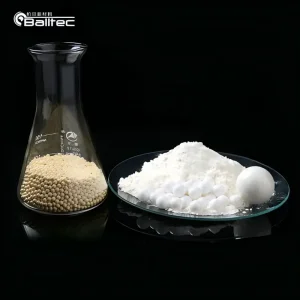
Expanding from structural ceramics into high-purity functional zirconia powders ($ZrO_2 + Y_2O_3$), our continuous spray pyrolysis and chemical co-precipitation routes produce ultra-fine powders tailored for SOFC electrolytes and high-translucency dental prosthetics. These sub-micron powders feature narrow particle size distributions ($D_{50} = 0.3\ \mu\text{m}$) and exceptional sinterability at reduced temperatures.
Pingxiang Baitian (Ball-tec) New Materials Co., Ltd. combines local industrial hub advantage with global supply chain efficiency.
Situated in the Ceramic Industrial Park, Development Zone, Pingxiang, Jiangxi, China, our 100,000 m² campus leverages decades of localized ceramic engineering infrastructure. Integrated powder preparation, forming, high-temperature sintering, and precision grinding under one roof drastically cut lead times and production costs.
We provide full-spectrum export packaging—including heavy-duty steel drums, reinforced wooden crates, moisture-proof vacuum bags, and standard 25 kg woven sacks. Custom palletization compliant with ISPM 15 wood fumigation standards ensures hassle-free customs clearance across North America, Europe, Asia-Pacific, and the Middle East.
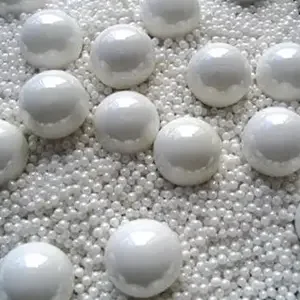
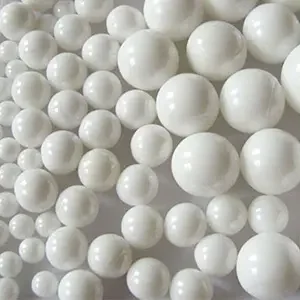
Selecting the optimal grinding bead size ($0.1\text{ mm}$ to $50\text{ mm}$) or molecular sieve mesh size requires precise mill dynamics and bed calculation. Our technical field engineers assist enterprise procurement teams with mill loading ratios, viscosity scaling, and tailored OEM size specifications, complete with complimentary lab samples for evaluation.
Expert answers addressing ceramic selection, technical specifications, and bulk ordering workflows.
Explore our complete range of ceramic grinding media, wear-resistant spheres, raw powders, and molecular adsorbents.