Follow 


When the ball mill is running, alumina grinding balls rotate with the inner wall of the mill cylinder to a certain height, then fall or cascade freely under gravity.
The falling grinding balls produce strong impact force on the large materials in the cylinder, directly crushing them into smaller particles.
The impact force is positively correlated with the mass of the grinding balls and the falling height (depending on the mill speed). The high density of alumina (typically 3.6–3.8 g/cm³) ensures sufficient impact energy, making it suitable for medium to high hardness materials.
After the materials are crushed into small particles by impact, continuous sliding and rolling friction occur between the grinding balls and materials, and between the grinding balls and the mill inner wall.
This friction grinds and compresses the small particles, gradually reducing them into finer powder until the required fineness is achieved.
Alumina grinding balls have high hardness (Mohs hardness ≥ 9, second only to diamond), which minimizes self-wear and efficiently grinds materials, avoiding contamination from ball debris during the grinding process.
During impact and grinding, the rotation of the mill drives the grinding balls and materials in circular and axial movements.
During movement, the grinding balls continuously stir the materials, fully mixing components of different compositions and particle sizes.
This “grinding while mixing” ensures the final material not only meets fineness requirements but also has uniform composition, especially suitable for industries such as ceramics and cement that require consistent formulation.
| Item | Specification |
|---|---|
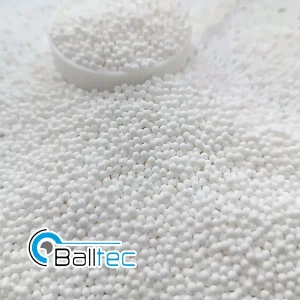
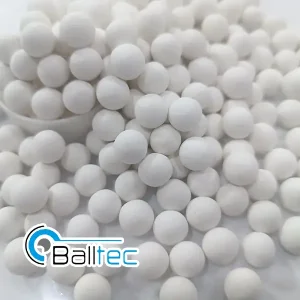
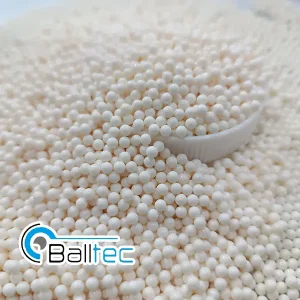
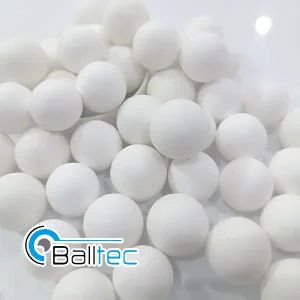
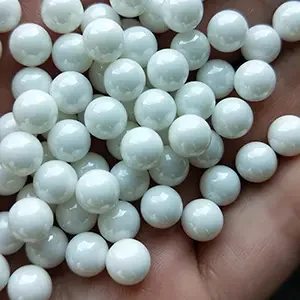
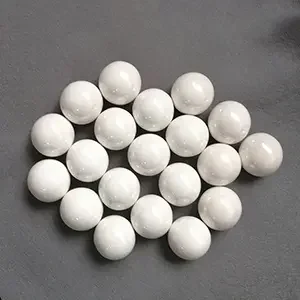
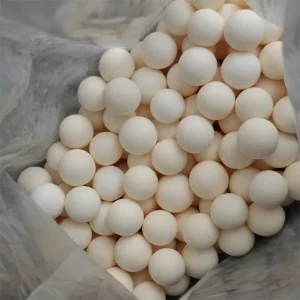
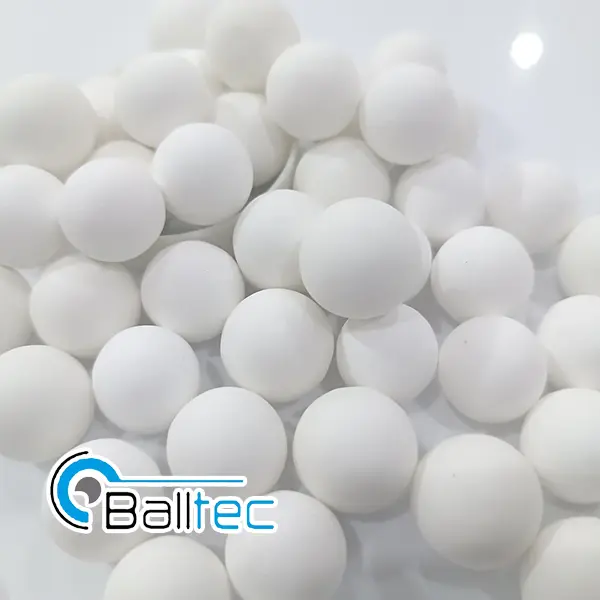
| Product Name | Wear Resistant Low Wear Rate High Purity Al₂O₃ Alumina Ceramic Grinding Balls |
| Material | High Purity Al₂O₃ (Alumina), Purity: 92% - 99.5% (Customizable) |
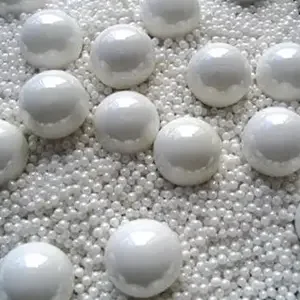
| Nominal Diameter | 0.1mm - 50mm (Common Sizes: 0.3mm, 0.5mm, 1mm, 3mm, 5mm, 10mm; Customizable) |
| Hardness (Mohs) | ≥ 9.0 (Second Only to Diamond) |
| Density | 3.6 - 3.9 g/cm³ |
| Compressive Strength | ≥ 1800 MPa (Single Ball) |
| Wear Rate | ≤ 0.003% (Per 1000 Hours of Grinding, Tested in Standard Sand Mill) |
| Particle Size Uniformity | CV ≤ 4% (Ensuring Stable Grinding Effect) |
| Max Operating Temperature | ≤ 1200 ℃ (Suitable for Normal Grinding Temperature: 20 - 80℃) |
| Chemical Inertness | Inert to Most Acids, Alkalis, Salts and Organic Solvents (Except Hydrofluoric Acid HF) |
| Surface Finish | Smooth, No Burrs, No Defects |
| Color | White (High Purity Grade), Gray (Medium Purity Grade) |
| Application | Ultra-fine Grinding and Dispersion of Various Materials in Multiple Industries |
Alumina grinding balls operate through three continuous mechanisms: impact crushing of large feed materials, fine grinding/refining via rolling friction, and simultaneous uniform mixing during mill rotation.
With a Mohs hardness of ≥ 9.0 and a density of up to 3.9 g/cm³, they offer exceptionally low wear rates (≤ 0.003%) and high chemical inertness, preventing material contamination during processing.
Diameters range from ultra-fine 0.1mm up to 50mm. Alumina purity options range from 92% to 99.5%, fully customizable according to specific application requirements.
Yes, they are resistant to max operating temperatures up to 1200℃ and remain inert to almost all acids, alkalis, and organic solvents, except hydrofluoric acid (HF).
They are extensively utilized for ultra-fine grinding and homogenization in industries such as ceramics, cement, chemical processing, advanced materials, and mineral refining.