Follow 


Engineered for high mass-transfer efficiency, low hydro-thermal degradation, and deep water/contaminant removal.
A comprehensive analysis of synthetic zeolite demands driven by Vaca Muerta shale gas expansion, the Lithium Triangle Boom, and agro-industrial bio-refining.
Argentina’s Neuquén Basin requires extreme gas desiccation down to dew points below -100°C prior to cryogenic NGL recovery and LNG liquefaction. High crush-strength 3A and 4A molecular sieves prevent hydrate formation and valve freezing in pipeline networks.
In Salta, Jujuy, and Catamarca, Direct Lithium Extraction (DLE) and refined lithium carbonate/hydroxide processing require precise gas atmosphere moisture control. Custom 13X and 4A sieves act as critical desiccant barriers during reagent drying and pneumatic transfer.
Argentina’s sugarcane and corn bio-refineries (Tucumán, Córdoba, Santa Fe) rely on 3A molecular sieve vapor-phase pressure swing adsorption (PSA) to break the water-ethanol azeotrope, yielding anhydrous fuel-grade ethanol (>99.8% purity) with zero chemical entrainer contamination.
Understanding the crystalline architecture of Type A and Type X zeolites for optimal industrial vessel design and bed life extension.
| Zeolite Type | Nominal Pore Size | Cationic Structure | Primary Adsorbate Target | Argentine Industry Application |
|---|---|---|---|---|
| Type 3A | 3 Ångströms (0.3 nm) | Potassium ($K^+$ exchanged $Na_A$) | Water ($H_2O$), excludes $CH_4$, $C_2H_6$, Ethanol | Bio-ethanol dehydration, Cracked gas, Vaca Muerta LNG feed |
| Type 4A | 4 Ångströms (0.4 nm) | Sodium ($Na^+$ form) | $H_2O$, $CO_2$, $H_2S$, $NH_3$, Methanol | Instrument air drying, Natural gas dehydration, Lithium salt storage purge |
| Type 5A | 5 Ångströms (0.5 nm) | Calcium ($Ca^{2+}$ exchanged) | n-Paraffins, $O_2/N_2$ separation, $CO$ | PSA Oxygen generation in medical & metallurgical plants, Iso-normal paraffin separation |
| Type 13X | 10 Ångströms (1.0 nm) | Sodium Faujasite ($Na_X$) | Heavy Hydrocarbons, Mercaptans, $CO_2$, $H_2O$ | Cryogenic air separation unit (ASU) pre-purification, refinery feed sweetening |
The adsorption of water molecules onto synthetic aluminosilicate frameworks is strongly exothermic, exhibiting an enthalpy of adsorption ($\Delta H_{ads}$) between 4.2 to 5.4 kJ/g of adsorbed water. In industrial packed beds (such as those operating in Bahia Blanca petrochemical refineries), minimizing the Mass Transfer Zone (MTZ) length is critical to maximizing bed capacity prior to breakthrough.
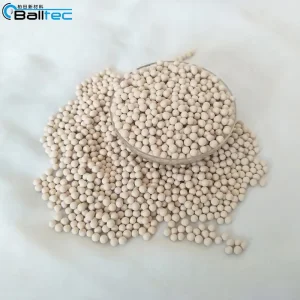
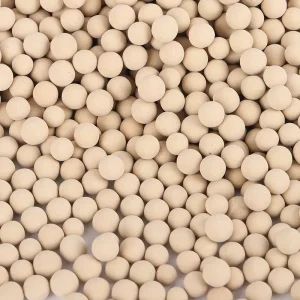
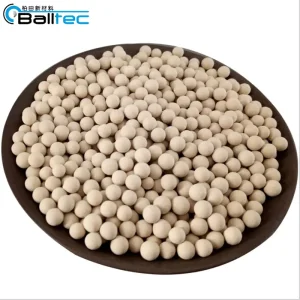
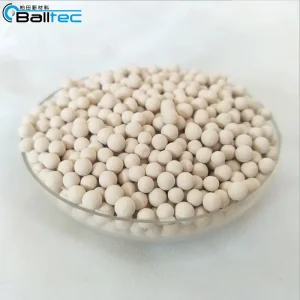
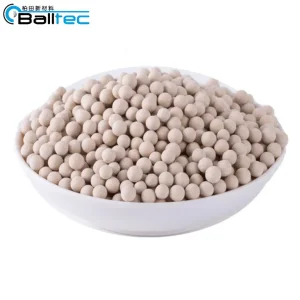
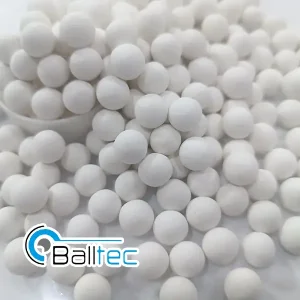
Our high-density bead formulations feature optimal binder composition (attapulgite/kaolin matrices) ensuring fast intra-crystalline diffusion rates and steep breakthrough curves even under high superficial velocities.
Repeated Thermal Swing Adsorption (TSA) cycles subject zeolite crystals to severe thermal stress during regeneration at temperatures ranging from 200°C to 310°C. Lower-grade sieves suffer structural collapse (amorphization of the crystal framework) leading to rapid dusting and differential pressure drops.
Baitian’s proprietary thermal stabilization process maintains lattice integrity over 3,000+ thermal cycles, dramatically reducing maintenance downtime for plant operators across Neuquén, Buenos Aires, and Santa Fe.
Customized chemical drying and purification solutions engineered to overcome local climate, feed-gas volatility, and severe operating conditions.
Raw shale gas extracted from the Neuquén basin carries high moisture and hydrocarbon vapors. Operating 3A and 4A dual-bed TSA units ensures moisture removal to dew points below -100°C without co-adsorbing valuable $C_2+$ natural gas liquids (NGLs).
In high-altitude lithium processing facilities (Salar de Olaroz, Salar del Hombre Muerto), lithium salts are extremely hygroscopic. Baitian 4A spherical sieves power closed-loop dry-air purge systems to prevent product clumping during packaging.
In Tucumán and Córdoba, agro-industrial plants utilize 3A zeolite beds to process crude ethanol vapors. Precise pore size control (strictly 3Å) excludes ethanol molecules ($4.4Å$), allowing only water ($2.6Å$) to be trapped inside crystal cages.
YPF and Axion Energy refineries in La Plata and Campana use 13X molecular sieves in air separation and hydrogen purification trains to eliminate trace carbon dioxide ($CO_2$) and mercaptans that foul cryogenic heat exchangers.
Healthcare facilities across Buenos Aires Province rely on high-purity 5A and Lithium-X molecular sieves for Pressure Swing Adsorption (PSA) oxygen plants, generating continuous medical-grade oxygen (>93% purity) locally.
Architectural glass manufacturers in Argentina’s urban centers integrate specialized 3A bead desiccant inside window spacer bars to absorb moisture and solvent vapors, preventing internal condensation and glass fogging.
Navigating import frameworks and offering full international certification for Argentine engineering procurement teams.
Pioneering advanced synthetic zeolites for decarbonization, green hydrogen purification, and high-efficiency carbon capture.
Traditional molecular sieves contain 15-20% inert clay binder. Our next-generation binderless sieves convert the clay matrix into active zeolite crystals, providing 20% higher dynamic adsorption capacity and lowering bed sizing requirements by up to 15%.
Specially engineered modified 13X and Lithium-exchanged Faujasite (LiX) zeolites designed for high-selectivity $CO_2$ capture from industrial flue gases and biogenic gas upgrade systems across Argentina’s industrial corridor.
Ultra-low moisture specification sieves tailored for high-pressure green hydrogen stream drying (>99.999% purity), supporting Argentina's emerging green hydrogen export initiatives in Patagonia.
Answers to common questions regarding molecular sieve selection, operation, and import to Argentina.
Ethanol has a kinetic diameter of approximately 4.4 Ångströms, while water is 2.6 Ångströms. A 3A molecular sieve has a pore opening of approximately 3 Ångströms, allowing water to enter the internal crystal cavity while co-adsorption of ethanol is strictly excluded. If 4A (pore size ~4 Ångströms) were used, ethanol would enter the pores, causing significant yield loss, thermal cracking during regeneration, and bed fouling.
Heavy hydrocarbons ($C_6+$) present in untreated natural gas can condense inside the zeolite macropores during cold adsorption cycles. During high-temperature regeneration, these trapped hydrocarbons thermally crack, forming solid carbon (coke) deposits that block access to active sites. Baitian recommends placing a high-efficiency inlet coalescer and a guard layer of silica gel or 13X molecular sieve upstream of 3A/4A main beds to trap liquid hydrocarbons and heavy aromatics.
Standard industrial bead sizes are 1.6–2.5 mm (8×12 mesh) and 3.0–5.0 mm (4×8 mesh). For high superficial gas velocities where pressure drop ($\Delta P$) must be minimized (such as large pipeline dehydration units), 3.0–5.0 mm beads are ideal. For smaller vessel footprints requiring sharp breakthrough zones and maximum dynamic capacity, 1.6–2.5 mm beads are preferred.
Under optimal operating conditions (proper mechanical filtration upstream, avoiding liquid water slugs, and adherence to regeneration temperature ramps), Baitian molecular sieves typically deliver 3 to 5 years (or over 3,000 regeneration cycles) of continuous industrial service before performance degrades to replacement thresholds.
All molecular sieves are heat-sealed inside thick multi-layer vacuum polyethylene bags filled with inert dry gas, then placed inside heavy-gauge air-tight steel drums (50L or 150L net weight) with ring-clamp closures. For bulk purchases, 1,000 kg woven super-sacks with aluminum foil moisture barrier liners are available.
Yes. Our technical sales engineering team provides full adsorption bed simulations (calculating gas superficial velocity, vessel dimensions, total equilibrium loading, pressure drop via the Ergun equation, and required regeneration heat cycle duty) based on your specific feed gas composition, pressure, temperature, and dew point targets.
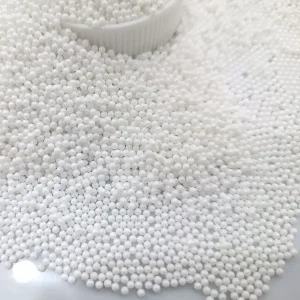
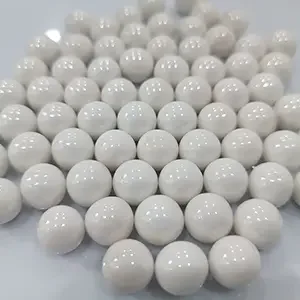
Explore our complete inventory of molecular sieves and precision ceramic grinding media available for direct factory export to Argentina.
Looking to optimize desiccant lifespan, minimize pressure drop, and secure reliable factory-direct shipments to Argentina? Speak with our Senior Chemical Engineers today.