Follow 


Engineered high-density ceramic spheres compliant with stringent commercial fleet operating standards in Singapore and ASEAN routes.
As Southeast Asia's premier logistics hub and transshipment nerve center, Singapore manages a hyper-dense network of commercial transportation fleets, container drayage vehicles, cross-border haulage trucks operating along the North-South Corridor into Malaysia, and heavy ground service equipment (GSE) at Changi Airport and Port of Singapore Authority (PSA) terminals. In this high-intensity operational framework, fleet downtime, irregular tire wear, and excessive fuel consumption pose immediate direct costs to enterprise bottom lines.
Traditional lead-based or steel clip-on wheel weights have proved increasingly inadequate under Singapore's tropical climate conditions, high humidity, and continuous stop-and-go heavy payload operations. Clip-on weights frequently detach due to thermal expansion of rims or mechanical impacts against kerbs during port maneuvering. Furthermore, static balancing only addresses initial mass asymmetry; as tires degrade over tens of thousands of kilometers, fixed weights become counterproductive, exacerbating vibration, wheel bearing stress, and driver fatigue.
Unlike static lead weights attached to the rim flange, internal ceramic micro-beads leverage centrifugal counter-force to automatically relocate to the point of heavy imbalance during rotation. This real-time dynamic adjustment compensates continuously for tire tread degradation, stone retention, and tread separation over the entire service life of the tire assembly.
Internal tire balancing utilizes the fundamental laws of rotational mechanics. When a tire rotates, any mass imbalance creates an eccentric centrifugal force vector ($\vec{F}_c = m \cdot \omega^2 \cdot \vec{r}$). At speeds exceeding the natural resonance threshold (typically above 25 km/h), the heavy spot of the tire moves outward, causing the axle to vibrate in the opposite phase direction.
Free-flowing ceramic micro-beads introduced inside the tire chamber respond instantly to this phase lag. Driven by centrifugal acceleration and localized force differentials, the high-density micro-spheres distribute themselves along the inner apex of the tire lining directly opposite to the heavy spot. This counter-balancing action nullifies radial and lateral force variations, smoothing out axle excitation and keeping the tire footprint uniformly flat against the asphalt.
The operational environment inside a heavy commercial tire is extreme. Internal temperatures can exceed 80°C during prolonged expressway hauls between Jurong Port and Johore Bahru, while internal moisture from compressed air lines creates a corrosive micro-climate. Sourcing the correct material composition is vital to avoiding powder pulverization, clump formation, or tire inner-liner abrasion.
| Performance Parameter | Baitian Advanced Ceramic Beads | Standard Tempered Glass Beads | Steel / Metal Pellets |
|---|---|---|---|
| Density (g/cm³) | 3.80 – 6.00 (Zirconia Enhanced) | 2.45 – 2.55 | 7.80 |
| Crush Strength / Hardness | Mohs 8.5 – 9.0 (Ultra High) | Mohs 6.0 (Prone to Shattering) | High (Abraying Tire Inner Liner) |
| Hydrophobic / Anti-Clumping | Silicone-Coated Nano Surface | Uncoated / Highly Hygroscopic | Susceptible to Rust & Moisture Oxidation |
| TPMS Sensor Compatibility | 100% Non-Conductive & Dielectric | Non-Conductive | Interferes with RF Frequencies |
| Environmental Compliance | REACH, RoHS, NEA SG Compliant | Varies | Subject to Rust Contamination |
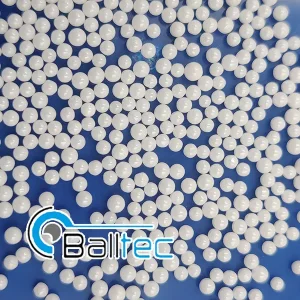
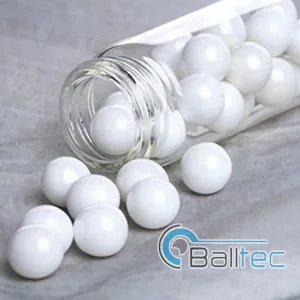
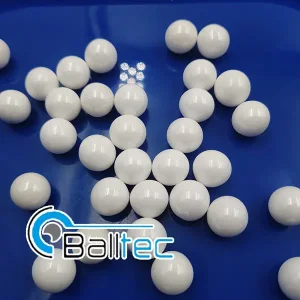
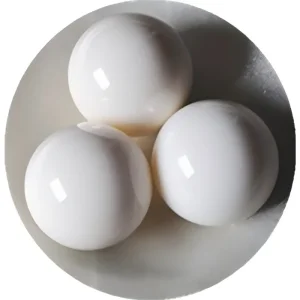
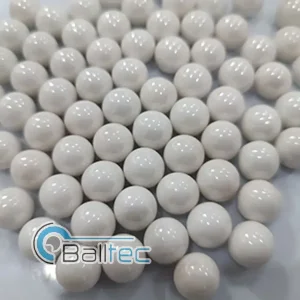
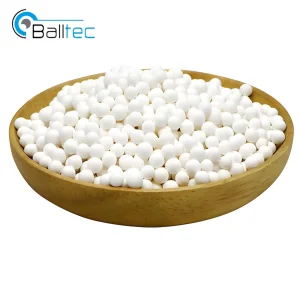
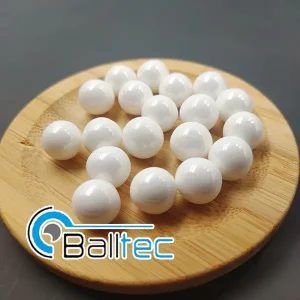
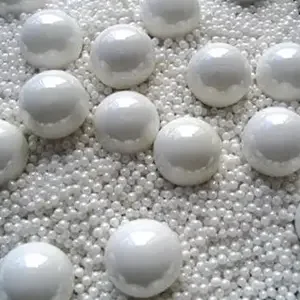
Our engineered ceramic balancing beads are synthesized using high-purity microcrystalline alumina ($Al_2O_3$) and yttria-stabilized zirconia ($ZrO_2$). Through high-pressure iso-static pressing and elevated sintering at 1550°C, the resulting beads feature an exceptionally smooth surface finish, perfect sphericity (>99%), and extreme abrasion resistance. A proprietary fluoropolymer hydrophobic coating ensures that even in damp compressed air environments common in tropical Singapore maintenance workshops, the beads remain completely free-flowing without clumping.
Global fleet owners, OEM vehicle assemblers, and logistics operators face mounting regulatory pressure to align with green transport initiatives. The Singapore Green Plan 2030 explicitly targets reduction in transport-related emissions and waste generation. Traditional lead wheel weights are recognized as environmental contaminants; lost lead weights degrade along roadside gutters, washing toxic heavy metals into rainwater catchment systems.
By transitioning to wholesale ceramic balancing beads, Singaporean fleet operations achieve threefold quantifiable returns on investment:
Every batch of Baitian ceramic tire balancing beads undergoes strict QA testing including grain crush strength tests, optical sphericity scans, moisture reaction testing, and simulated 100,000 km durability friction trials. ISO 9001:2015 and ISO 14001:2015 certificates accompany all Singapore-bound consignments.
As autonomous commercial vehicle fleets and electric heavy trucks gain adoption across Singapore's industrial parks (such as Jurong Island and Changi Business Park), tire telemetry becomes critical. Future iterations of our balancing micro-beads are incorporating passive dielectric nano-coatings that harmonate with tire pressure monitoring systems (TPMS) and RFID tread sensors, enabling real-time wireless monitoring of internal tire vibration harmonics and temperature spikes without physically inspecting the tire cavity.
Explore our extended catalog of high-purity alumina, zirconia grinding media, and structural ceramic balls exported directly to Singapore and worldwide distributors.
Expert engineering answers addressing common installation, compatibility, and procurement queries from Singaporean fleet managers.
Contact our technical team to request free engineering samples, custom dosage guides, or direct factory pricing for Singapore & ASEAN distribution.