Follow 


Precision-engineered ceramic balls, zirconia grinding beads, and structural ceramics formulated for optimal dielectric purity and extreme wear resistance.
An authoritative analysis of dielectric material synthesis, high-voltage ceramic capacitors, MLCC scaling, and next-generation power electronics manufacturing in China.
As global electrification accelerates across automotive platforms, renewable energy grids, 5G/6G telecommunication architectures, and high-performance computing (HPC) AI servers, the reliance on advanced dielectric ceramic capacitors has reached an unprecedented scale. Modern electronic hardware demands components capable of enduring extreme thermal stress, maintaining precise capacitance tolerance, and exhibiting zero-voltage degradation under multi-kilovolt operational thresholds.
As a leading premier China Ceramic Capacitor Manufacturer & Advanced Ceramic Materials Supplier, Pingxiang Baitian (Ball-tec) New Materials Co., Ltd. operates at the intersection of raw material chemical synthesis, high-purity powder preparation, precision tape casting, and high-temperature co-firing technology. Industrial ceramic capacitors—spanning Class 1 temperature-compensating dielectrics (NP0/C0G), Class 2 high-permittivity dielectrics (X7R, X8R, X5R, Y5V), and Ultra-High Voltage (UHV) ceramic disc capacitors—form the backbone of modern power decoupling, EMI filtering, resonant matching, and surge protection.
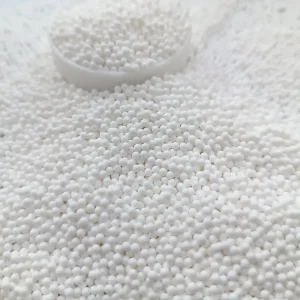
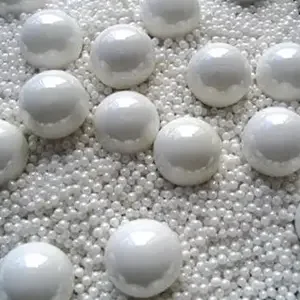
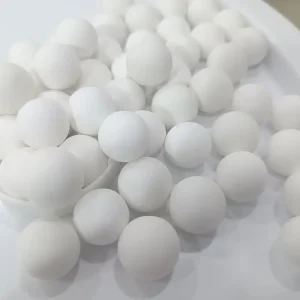
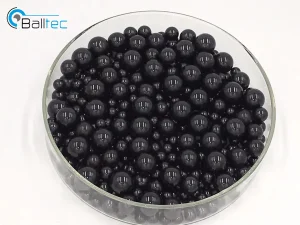
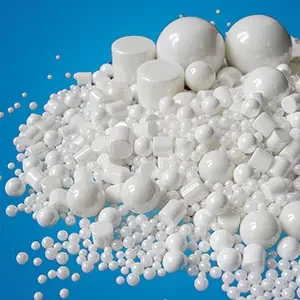
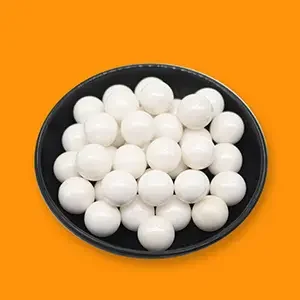
The performance of any ceramic capacitor is fundamentally locked into the microstructural uniformity and grain boundary chemistry of its ceramic powder. By deploying ultra-fine Yttria-Stabilized Zirconia (YSZ) and 99.99% High-Purity Alumina (HPA) grinding media during slurry attrition milling, we achieve sub-micron Titanate ($BaTiO_3, SrTiO_3, CaTiO_3$) grain sizes (< 0.2 µm). This eliminates lattice defects and elevates dielectric breakdown voltage ($\text{kV/mm}$) by up to 45% compared to conventionally milled materials.
Understanding dielectric constant ($\varepsilon_r$), temperature coefficient of capacitance (TCC), and dissipation factor ($\tan \delta$) across industrial operating environments.
Formulated from ultra-stable Neodymium Samarium Titanates and Rare-Earth modified Barium Titanates. Delivers a zero temperature coefficient ($\pm 30\text{ ppm/}^\circ\text{C}$), non-linear voltage dependence of zero, and minimal dissipation factor ($\tan \delta < 0.1\%$). Essential for RF power amplifiers, high-Q resonant circuits, and aerospace timing networks.
Based on Ferroelectric Barium Titanate ($BaTiO_3$) lattice systems doped with Zirconia and Niobates. Offers high volumetric efficiency with dielectric constants ($\varepsilon_r$) ranging from 2,000 to 15,000. Optimized for power distribution network (PDN) smoothing, bulk decoupling, and automotive ECU filtering operating up to +150°C.
Engineered with heavy-section Strontium Titanate ($SrTiO_3$) and specialized epoxy encapsulation. Capable of handling operating voltages from 1kV DC to over 50kV DC, featuring high impulse breakdown resistance, extremely low partial discharge (< 5 pC at rated AC voltage), and massive energy storage capacity for Marx generators and smart grid distribution.
| Dielectric Class | EIA Code | Dielectric Constant ($\varepsilon_r$) | Temperature Range | Capacitance Drift ($\Delta C$) | Dissipation Factor ($\tan \delta$) | Key Industrial Applications |
|---|---|---|---|---|---|---|
| Class 1 (Ultra-Stable) | C0G / NP0 | 15 – 500 | -55°C to +125°C | 0 ± 30 ppm/°C | < 0.15% | RF Tuning, Resonators, Pulse Timing, Aerospace RF |
| Class 2 (High Permittivity) | X7R | 2,000 – 4,500 | -55°C to +125°C | ± 15% | < 2.5% | Industrial Inverters, Automotive ECUs, Decoupling |
| Class 2 (Extended Temp) | X8R | 1,500 – 3,000 | -55°C to +150°C | ± 15% | < 3.0% | Under-the-Hood Automotive, Downhole Oil & Gas |
| Class 3 (General Purpose) | Y5V | 6,000 – 18,000 | -30°C to +85°C | +22% / -82% | < 5.0% | Consumer Electronics, Non-Critical Bypass |
| High Voltage Disc | N4700 / Y5P | 2,000 – 6,000 | -30°C to +85°C | ± 10% (N4700) | < 0.2% | Medical X-Ray, High Voltage Smart Grids, Laser Power |
How Pingxiang Baitian controls material microstructures to yield ultra-reliable ceramic dielectric components.
Using 95% Yttria-Stabilized Zirconia (YSZ) beads in continuous high-energy agitator mills, raw barium titanate and oxide dopants are wet-milled to tight particle distributions ($\text{D90} < 150\text{ nm}$). This prevents structural voids during green tape formation.
Dielectric slurries are cast into continuous organic green tapes with thickness control under $\pm 0.1\text{ }\mu\text{m}$. For Multilayer Ceramic Capacitors (MLCC), nickel or palladium-silver electrode inks are screen-printed before automated precision stacking.
Green ceramic bodies undergo binder burnout followed by high-temperature sintering at 1,200°C to 1,400°C in reducing ($N_2/H_2$) or oxidizing atmospheres. The resulting ceramic grain structure achieves > 99.5% theoretical density, eliminating internal micro-cracks.
Deploying advanced ceramic capacitors and precision components across high-stress industrial environments worldwide.
Modern 800V EV traction inverters and On-Board Chargers (OBC) demand DC-link snubber capacitors and AEC-Q200 qualified X7R/X8R MLCCs. Our dielectric formulations provide ultra-low Equivalent Series Resistance (ESR) and withstand violent thermal cycling from -55°C to +150°C under severe vibration.
Hyperscale data centers powering Artificial Intelligence models utilize massive arrays of low-ESL Class 1 C0G capacitors. Our components deliver ripple-free voltage stabilization across multi-gigahertz switching frequencies, ensuring zero power drop for high-density GPUs and RF base station transceivers.
Photovoltaic (PV) central inverters and high-voltage DC (HVDC) transmission systems rely on ultra-high voltage ceramic disc capacitors for transient surge suppression and lightning impulse protection up to 50kV DC, backed by partial discharge testing compliance under IEC 60384 standards.
Meeting strict international quality standards, providing complete technical documentation, and delivering rapid OEM customization.
For international buyers, electronic manufacturing service (EMS) providers, and automotive OEMs, sourcing ceramic capacitors and technical ceramics from China requires uncompromised transparency and certification compliance. At Pingxiang Baitian (Ball-tec), we operate under fully integrated ISO 9001:2015 Quality Management Systems, ISO 14001:2015 Environmental Systems, and ISO 45001 Occupational Health & Safety frameworks.
Pioneering advancements in lead-free ferroelectrics, sub-micron layer MLCCs, and high-density energy storage materials.
Engineers at Baitian are scaling wet co-grinding processes to manufacture sub-100nm titanate powders. This paves the way for 1000-layer MLCCs with sub-0.3 micron dielectric thickness, enabling terabit-per-second AI hardware decoupling in ultra-compact form factors.
Aligning with global environmental regulations, our R&D team is commercializing Bismuth Ferrite-Barium Titanate ($BiFeO_3-BaTiO_3$) and Sodium Niobate ($NaNbO_3$) lead-free relaxor ferroelectrics, delivering energy storage densities exceeding $10\text{ J/cm}^3$ for pulsed power applications.
Silicon Carbide (SiC) and Gallium Nitride (GaN) power switches operate at high temperatures (> 175°C) and high switching speeds ($di/dt$). Our anti-ferroelectric ceramic capacitors offer zero capacitance drop under high DC bias, matching the demanding dynamics of next-generation power electronics.
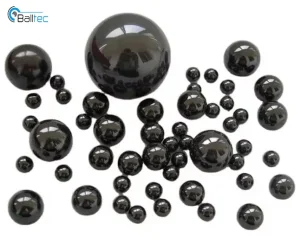
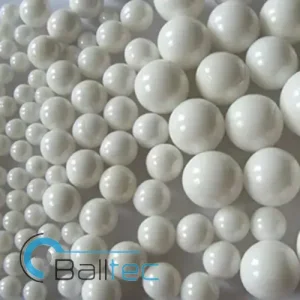
Explore our complete product lineup including precision bearing balls, nano-zirconia powders, and lithium-battery milling media.
Direct technical answers from our senior ceramic engineers regarding dielectric selection, customization, and factory testing.