Follow 


Direct factory supply of advanced zirconia, high-purity alumina, and silicon nitride materials engineered for extreme chemical, electrical, and thermal environments.
Understanding electromagnetic physics, core permeability, geometric optimization, and dielectric ceramic isolation for high-frequency B2B applications.
Inductance ($L$) represents the fundamental property of an electrical conductor or electromagnetic assembly to oppose changes in electric current by inducing an electromotive force (EMF) within itself or adjacent circuits. In modern power electronics, wireless energy transfer, medical imaging, RF communications, and high-frequency induction heating, calculating inductance with extreme mathematical precision is paramount to optimizing power efficiency, reducing parasitic capacitance, and preventing catastrophic thermal runaway.
When procurement managers and design engineers evaluate B2B contract manufacturers, the ability to model, measure, and consistently manufacture inductors to tight tolerance bounds ($\pm 1\%$ to $\pm 5\%$) serves as a benchmark for supplier capability. Inductance calculations depend heavily on geometry, turn count ($N$), core magnetic permeability ($\mu$), effective magnetic cross-sectional area ($A_e$), and magnetic path length ($l_e$).
However, industrial real-world applications involve complex non-linearities: AC skin effect, proximity losses, core saturation under DC bias, and high-temperature permeability degradation. Advanced engineering teams utilize finite element analysis (FEA) and empirical formulas (such as Nagaoka coefficients for multi-layer air-core coils and Wheeler equations for planar surface-mount inductors) to determine real-world operational performance.
High-frequency electronic inductors and industrial induction equipment rely on non-conductive, thermally resilient ceramic substrates and precision nano-milled soft ferrite slurries.
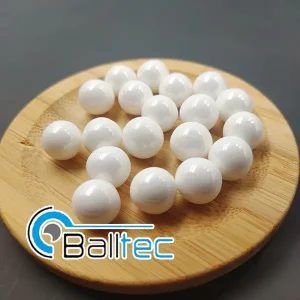
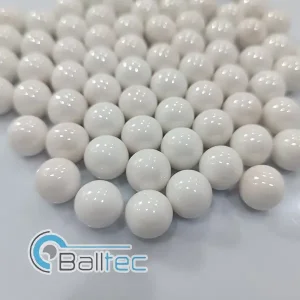
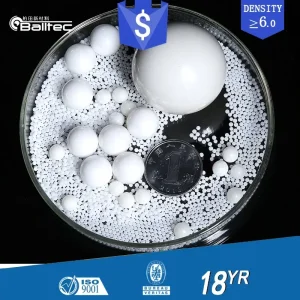
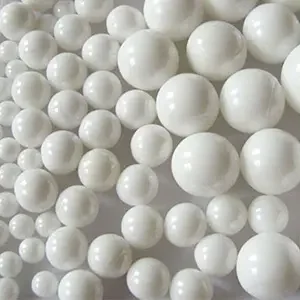
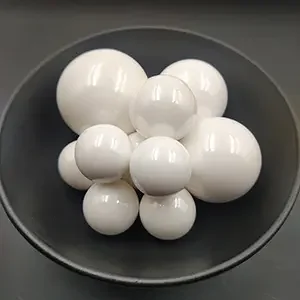
High permeability ($\mu_r > 2000$) manganese-zinc (MnZn) and nickel-zinc (NiZn) ferrites require sub-micron particle dispersion during synthesis. Utilizing high-density Yttria-Stabilized Zirconia (YSZ) grinding media eliminates metallic contamination, yielding uniform grain boundaries essential for ultra-low core losses at high frequencies (100 kHz - 10 MHz).
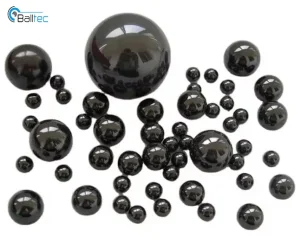
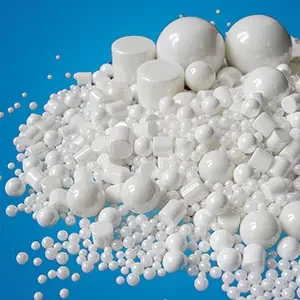
In planar inductors and high-frequency RF chokes, High-Purity Alumina ($Al_2O_3 \ge 99.99\%$) and Silicon Nitride ($Si_3N_4$) serve as insulating structural formers. Their high dielectric strength (>15 kV/mm) and low loss tangent ($\tan\delta < 0.0002$) prevent breakdown under extreme voltage stress while guaranteeing mechanical rigidity.
Inductors operating in automotive electric vehicle (EV) inverters and renewable energy converters generate localized resistive heating. Advanced structural ceramics deliver high thermal conductivity combined with zero electrical conductivity, conducting heat away from copper windings to cold plates without introducing short-circuit paths.
| Material Class | Relative Permeability ($\mu_r$) | Dielectric Constant ($\epsilon_r$) | Max Operating Temp (°C) | Primary Inductive Industry Role |
|---|---|---|---|---|
| Manganese-Zinc (MnZn) Ferrite | 1,000 - 15,000 | 10 - 100 | 120 - 250 | Low-frequency power chokes, isolated transformers (< 3 MHz) |
| Nickel-Zinc (NiZn) Ferrite | 15 - 1,500 | 10 - 20 | 150 - 300 | High-frequency RF inductors, EMI suppression beads (3 MHz - 1 GHz) |
| 99.99% High-Purity Alumina ($Al_2O_3$) | ~ 1.0 (Non-Magnetic) | 9.8 | 1,650 | Air-core coil bobbins, planar substrate formers, insulating spacers |
| Yttria-Stabilized Zirconia (YSZ) | ~ 1.0 (Non-Magnetic) | 25 - 30 | 2,200 | Contamination-free bead milling media for magnetic slurry processing |
| Silicon Nitride ($Si_3N_4$) | ~ 1.0 (Non-Magnetic) | 8.2 | 1,200 | High-stress structural insulators for high-voltage pulse inductors |
Integrating raw material purification, automated micro-winding, precision ceramic sintering, and rigorous QA verification within centralized industrial clusters.
China commands over 70% of the world's refined rare-earth, zirconia, and high-purity alumina chemical processing. Concentrated in specialized industrial zones such as Jiangxi Pingxiang, raw powder synthesis to final sintered component happens under one ecosystem, reducing lead times by up to 45% compared to fragmented international supply chains.
Chinese contract manufacturers leverage state-of-the-art multi-axis CNC automated coil winders and high-temperature continuous tunnel kilns. Computerized tensioning controls wire strain down to ±0.01g, eliminating localized inductance variation and guaranteeing consistent turns ratio across bulk wholesale production runs.
Bulk purchasing power and high-throughput automated assembly line operations drive down unit production costs. Overseas OEMs purchasing custom inductive components and ceramic support media achieve substantial capital efficiency without sacrificing engineering quality or ISO compliance.
Exploring localized usage across automotive, telecommunications, industrial heating, and renewable power infrastructure.
EV onboard chargers (OBC) and DC-DC converters utilize custom high-power boost inductors operating at frequencies up to 500 kHz. Accurate calculation of self-inductance and leakage inductance under extreme operating currents (200A+) prevents saturation, maintaining zero-voltage switching (ZVS) efficiency across wide temperature windows.
In radio frequency matching networks, chip inductors manufactured on high-purity alumina substrates must maintain extremely high Quality Factors ($Q > 80$ at 2.4 GHz). Calculating micro-strip parasitic inductance prevents impedance mismatch, minimizing signal reflection losses (S11) in cellular base stations.
Commercial photovoltaic grid-tie inverters depend on heavy-duty filter inductors to convert raw DC power into clean AC sine waves. Precision inductance modeling eliminates harmonic distortion (THD < 1%) while optimizing heat dissipation via custom ceramic thermally conductive mounting plates.
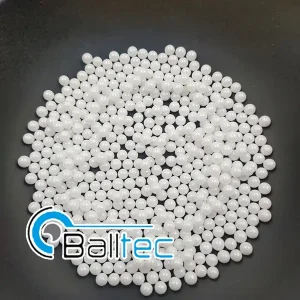
To achieve exact inductance values in ferrite cores, raw materials must be wet-milled into sub-micron powders without introducing stray metal impurities. Utilizing 95% Yttria-Stabilized Zirconia beads guarantees uniform particle distribution ($d_{50} < 0.5\mu m$), directly translating to predictable core permeability in mass production.
Emerging wide-bandgap semiconductors, AI-assisted FEA simulation, and green manufacturing standards driving component evolution.
As power electronics shift to Wide-Bandgap (WBG) devices operating at multi-megahertz frequencies, inductors require smaller inductance values ($L$) but drastically higher operating $Q$-factors and lower AC losses. Core materials are moving toward ultra-fine nanocrystalline alloys and low-loss dielectric ceramic formers.
Leading manufacturers are integrating artificial intelligence algorithms with 3D Maxwell electromagnetic solvers. Parametric optimization automates coil geometry tuning, predicting skin depth effects, localized hot spots, and parasitic inter-winding capacitance in seconds prior to tooling fabrication.
Additive manufacturing of technical ceramics allows complex internal cooling channels and non-standard magnetic core geometries impossible through conventional pressing. This allows custom high-density power inductors to achieve unprecedented power densities in aerospace applications.
Rigorous engineering evaluation metrics for supply chain leads, component buyers, and quality verification managers.
When issuing a Request for Quotation (RFQ) for custom inductors, magnetic cores, or ceramic substrate formers, providing comprehensive parameter limits eliminates engineering revisions and expedites sample turnaround. Key technical parameters include:
To ensure supplier reliability and compliance with Search Quality Guidelines and international manufacturing standards, verify the following accreditation documents:
Expert answers regarding inductance calculation, ceramic core selection, custom manufacturing, and global logisitics.
Factory-direct technical ceramic components engineered for high-performance milling, ball bearing systems, and tower packing.