Follow 


Factory-direct wholesale precision ceramic balls, microcrystalline grinding media, and structural ceramic elements manufactured under strict ISO 9001 and ISO 14001 quality controls.
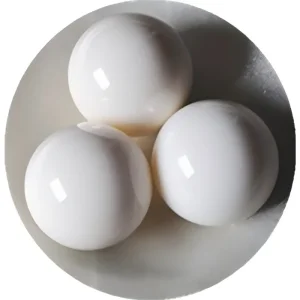
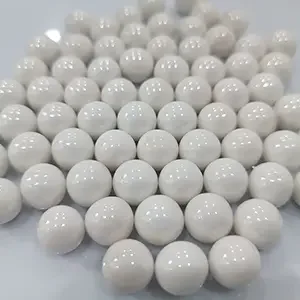
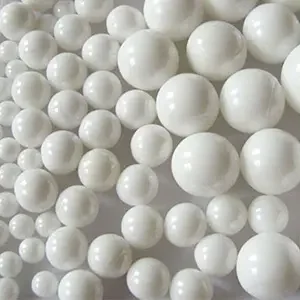
The transition from conventional chrome steel (AISI 52100) to advanced engineered ceramics in high-speed, high-temperature, and corrosive industrial applications.
Next-generation 800V EV traction motors generate parasitic stray currents, causing electrical discharge erosion (fluting) on traditional steel bearing raceways. Hybrid ceramic bearing balls utilizing Silicon Nitride ($Si_3N_4$) provide absolute galvanic isolation ($10^{14} \;\Omega\cdot\text{cm}$ electrical resistivity), eliminating stray current damage while reducing rotational inertia by 60%.
Modern high-speed machining centers operate at DN factors exceeding $2.5 \times 10^6$. Lower density ceramic balls ($3.2 \;\text{g/cm}^3$ for $Si_3N_4$ versus $7.8 \;\text{g/cm}^3$ for steel) dramatically reduce centrifugal forces exerted on the outer race, extending bearing operational lifespan by 300% to 500% under high RPM milling.
In extreme ultraviolet (EUV) lithography and plasma etching chambers, conventional grease lubricants cause severe outgassing contamination. Self-lubricating ceramic bearing balls ($Si_3N_4$ and $ZrO_2$) function unlubricated in ultra-high vacuum environments ($10^{-9} \;\text{Torr}$) without seizing or degradation.
Selecting the optimal ceramic compound based on mechanical stress, thermal shock, chemical exposure, and electrical breakdown requirements.
| Material Property | Silicon Nitride ($Si_3N_4$) | Zirconia ($ZrO_2$ YSZ) | Alumina ($Al_2O_3$ 99.9%) | Chrome Steel (AISI 52100) |
|---|---|---|---|---|
| Density ($\text{g/cm}^3$) | 3.25 (Ultra-light) | 6.05 (High mass) | 3.95 (Medium) | 7.85 (Heavy) |
| Vickers Hardness ($\text{HV}_{10}$) | 1,600 – 1,800 | 1,200 – 1,350 | 1,500 – 1,700 | 700 – 800 |
| Compressive Strength ($\text{MPa}$) | 3,000 | 2,000 | 2,500 | 1,000 |
| Fracture Toughness ($K_{IC} \;\text{MPa}\cdot\text{m}^{1/2}$) | 6.0 – 7.5 | 8.0 – 10.0 (Toughest) | 3.5 – 4.5 | 20 – 25 |
| Thermal Expansion Coefficient ($10^{-6}/\text{K}$) | 3.2 | 10.5 (Matches steel) | 8.1 | 12.5 |
| Max Operating Temp ($\text{°C}$) | 1,000 °C | 500 °C | 1,400 °C | 150 °C |
| Electrical Resistivity ($\Omega\cdot\text{cm}$) | $>10^{14}$ (Insulator) | $>10^{12}$ (Insulator) | $>10^{14}$ (Insulator) | $10^{-5}$ (Conductor) |
| Modulus of Elasticity ($\text{GPa}$) | 320 | 210 | 380 | 210 |
We manufacture wholesale ceramic bearing balls to exacting aerospace and micro-electronics standard specifications:
Sphericity: 0.08 µm (0.000003")
Lot Diameter Variation: 0.13 µm
Surface Roughness (Ra): 0.010 µm
Sphericity: 0.13 µm (0.000005")
Lot Diameter Variation: 0.25 µm
Surface Roughness (Ra): 0.014 µm
Sphericity: 0.25 µm (0.000010")
Lot Diameter Variation: 0.50 µm
Surface Roughness (Ra): 0.020 µm
Sphericity: 0.40 µm (0.000016")
Lot Diameter Variation: 0.80 µm
Surface Roughness (Ra): 0.025 µm
Inside Pingxiang Baitian (Ball-tec) New Materials Co., Ltd. 100,000 m² Integrated Ceramic Manufacturing Campus.
Our advanced Hot Isostatic Pressing (HIP) process subjects presintered $Si_3N_4$ and $ZrO_2$ preforms to inert gas pressures up to 1,800 Bar at temperatures exceeding 1,750 °C. This eliminates sub-surface micro-porosity, yielding 99.99% theoretical structural density and eliminating micro-fracture initiation sites under heavy cyclic loads.
Utilizing high-speed planetary magnetic fluid polishing machines and optical laser sorting systems, we achieve sub-nanometer surface roughness ($Ra < 0.01 \;\mu\text{m}$) and strict diameter uniformity across bulk wholesale production lots, guaranteeing zero vibration spikes in high-precision assemblies.
From chemical synthesis of sub-micron nano-powders to high-pressure cold isostatic pressing (CIP), precision CNC green machining, high-temperature sintering, and batch-traceable ultrasonic testing, Baitian maintains complete control over quality and cost resilience.
Real-world deployment of wholesale ceramic balls across high-demanding industrial verticals.
In metering pumps handling aggressive concentrated acids ($\text{H}_2\text{SO}_4$, $\text{HCl}$) and caustic alkalis, stainless steel check valve balls rapidly undergo localized pitting corrosion and seal leakage. Yttria-Stabilized Zirconia ($ZrO_2$) and High-Purity Alumina ($Al_2O_3$) check valve balls offer total immunity to acidic corrosion, extending pump maintenance intervals from months to years.
Liquid hydrogen ($\text{LH}_2$) and liquid oxygen ($\text{LOX}$) rocket propellant valves operate at cryogenic temperatures down to $-253 \;\text{°C}$ where metallic alloys become brittle and oil lubricants freeze solid. Silicon Nitride ($Si_3N_4$) balls exhibit extremely low thermal contraction and retain high fracture toughness without lubrication.
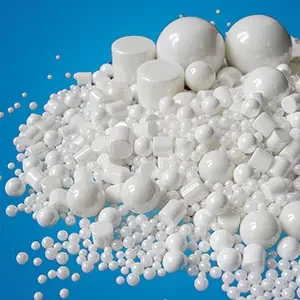
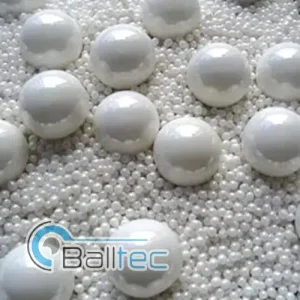
Production of Lithium Iron Phosphate ($\text{LiFePO}_4$) cathode slurries requires bead milling down to the nanometer scale ($D_{90} < 100 \;\text{nm}$). High-Density YSZ Micro-Beads (0.1mm - 2.0mm) deliver maximal kinetic energy transfer while maintaining near-zero wear rates, preventing metallic contamination that causes battery internal shorting.
A step-by-step decision framework for design engineers and industrial buyers evaluating ceramic material grades.
If your bearing assembly operates at high rotational velocities ($\text{DN} > 1.5 \times 10^6$), select Silicon Nitride ($Si_3N_4$). Its low mass density ($3.25 \;\text{g/cm}^3$) drastically decreases skidding, dynamic slip, and centrifugal loads on the bearing raceway.
If ceramic balls are integrated into standard steel bearing rings (AISI 52100 or 440C) under variable temperatures, Zirconia ($ZrO_2$) is preferred due to its thermal expansion coefficient ($10.5 \times 10^{-6}/\text{K}$), matching steel closely and preventing radial clearance binding.
For industrial check valves, flowmeters, and catalyst support applications where high contact fatigue resistance is not required, High-Purity Alumina ($Al_2O_3$ 99.5%–99.9%) delivers superior acid resistance at a significantly lower volumetric cost.
Specify ISO 3290-2 Grade 3 (G3) or Grade 5 (G5) for high-speed spindles and medical turbines. Request batch-level 100% Eddy-Current surface fault detection and CMM dimensional inspection certificates.
Detailed technical responses from our senior materials research lab and global sales engineers.
Silicon Nitride ($Si_3N_4$) is substantially lighter ($3.25 \;\text{g/cm}^3$), harder ($\sim 1700 \;\text{HV}$), and withstands much higher operating temperatures ($1,000 \;\text{°C}$), making it ideal for high-speed hybrid bearings and EV motors. Zirconia ($ZrO_2$) has a higher density ($6.05 \;\text{g/cm}^3$), higher fracture toughness ($8-10 \;\text{MPa}\cdot\text{m}^{1/2}$), and a coefficient of thermal expansion similar to chrome steel, making it ideal for full-ceramic low-speed bearings, valve balls, and impact-heavy environments.
In high-voltage EV powertrains, fast-switching pulse-width modulation (PWM) inverters generate capacitive stray voltages. These voltages discharge through conventional steel bearing balls, causing micro-pitting, electrical arc fluting, lubricant carbonization, and premature failure. Silicon Nitride ceramic balls act as electrical insulators with a dielectric strength exceeding $15 \;\text{kV/mm}$, eliminating stray current passage completely.
We produce wholesale precision ceramic balls according to ISO 3290-2 and ABMA standards ranging from Grade 3 (G3) to Grade 200 (G200). Our G3 and G5 balls feature sphericity deviations under $0.08 \;\mu\text{m}$ and surface roughness ($Ra$) under $0.010 \;\mu\text{m}$, specifically suited for spindle bearings, aerospace gyroscopes, and micro-actuators.
Standard pressureless sintering leaves microscopic internal voids and grain boundary micro-pores. During Hot Isostatic Pressing (HIP), simultaneous application of high temperature ($>1,750 \;\text{°C}$) and high inert gas pressure ($150 - 200 \;\text{MPa}$) collapses internal voids. This increases material density to $>99.9\%$, significantly elevating rolling contact fatigue (RCF) life up to 10 times compared to non-HIPed ceramics.
Yes. Our factory supports custom sizing from $0.3\text{mm}$ ultra-micro ceramic balls for medical instruments up to $100\text{mm}+$ heavy-duty valve balls for offshore chemical pumps. Custom material formulations (such as Ceria-Stabilized Zirconia or Toughened Alumina Zirconia ZTA) and tight custom diameter tolerances are routinely engineered upon request.
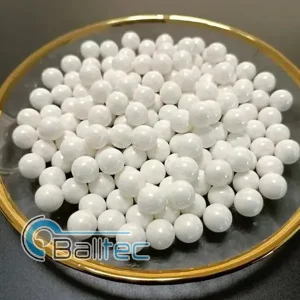
Explore our complete wholesale line of wear-resistant zirconia grinding media, electronic device micro-bearing balls, and food-grade high-purity ceramic spheres.