Follow 


Direct factory supply of precision ZrO2 beads, composite ceramics, and industrial tower packing engineered for demanding wet-milling environments.
Understanding Phase Transformation Toughening, Grain Boundary Chemistry, and Kinetic Energy Transfer in High-Energy Agitator Mills.
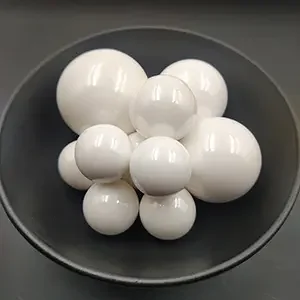
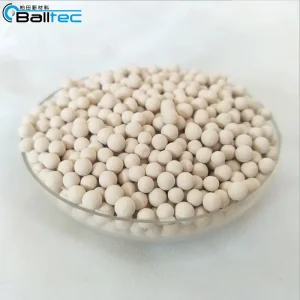
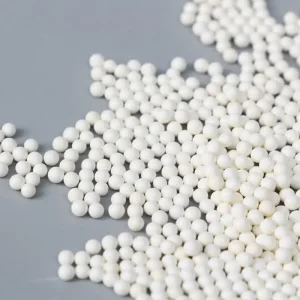
In modern ultra-fine wet-milling, the selection of grinding media directly governs particle size distribution (PSD), mill thermal balance, throughput efficiency, and contamination levels. As a premier China ZrO2 grinding beads factory and exporter, our R&D processes center around Tetragonal Zirconia Polycrystal (Y-TZP) synthesized with ~3 mol% Y2O3 (Yttria) stabilization. This specific stoichiometry locks the zirconia crystal lattice into a metastable tetragonal phase at room temperature.
When exposed to intense compressive stresses inside high-speed sand mills, bead mills, or pin-type agitators, Y-TZP undergoes stress-induced phase transformation (tetragonal to monoclinic). This volumetric expansion (~3-5%) induces micro-compressive stress fields surrounding propagating crack tips, effectively quenching crack initiation and granting Y-TZP unmatched fracture toughness ($K_{IC} > 9\text{ MPa}\cdot\text{m}^{1/2}$).
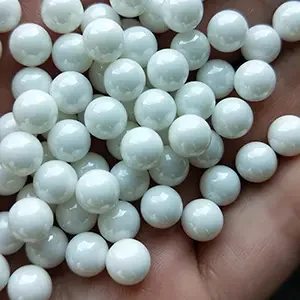
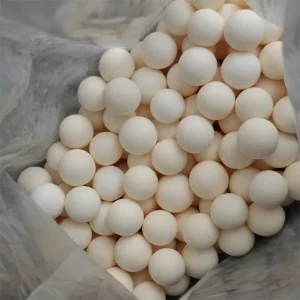
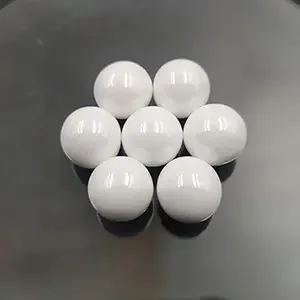
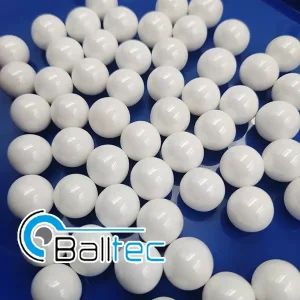
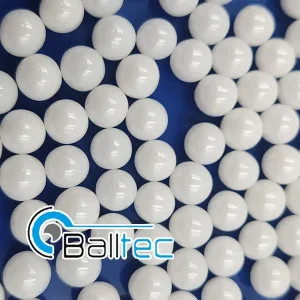
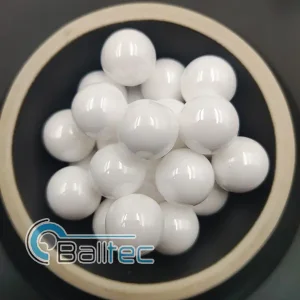
Our state-of-the-art liquid-phase titration technology delivers near-perfect sphericity (>98%), eliminating internal voids, micro-cracks, and structural eccentricity common in roll-formed beads.
Controlled hot isostatic press (HIP) assist sintering retains fine grain structures (<0.3 µm), ensuring exceptional wear resistance and zero pin-hole peeling under extreme shear stress.
With a true density exceeding 6.0 g/cm³, YSZ beads transmit significantly higher dynamic force during bead-to-particle collisions, cutting nano-grinding cycle times by up to 45%.
Comprehensive quantitative evaluation of ceramic grinding media properties for chemical procurement teams and process engineers.
| Material Category | YSZ (95% ZrO2 / 5% Y2O3) | ZTA (Zirconia Toughened Alumina) | Zirconium Silicate (ZrSiO4) | High Purity Alumina (99.5%) |
|---|---|---|---|---|
| Bulk Density (g/cm³) | ≥ 6.00 | 4.00 - 4.50 | 4.00 - 4.20 | 3.60 - 3.80 |
| Vickers Hardness (HV10) | ≥ 1250 kg/mm² | ≥ 1400 kg/mm² | ≥ 1000 kg/mm² | ≥ 1450 kg/mm² |
| Fracture Toughness (MPa·m¹/²) | 9.0 - 10.0 | 5.5 - 6.5 | 4.0 - 5.0 | 3.5 - 4.0 |
| Wear Rate (% per 100 hrs) | < 0.005% | < 0.02% | < 0.08% | < 0.05% |
| Primary Application Target | Lithium Slurry, Nano Inks, MLCC | Metallic Ores, Paints, PCC | Mid-fine Coatings, Pesticides | Glazes, White Cement, Mining |
| Sintering Method | Drop-Titration & HIP Sinter | Rolled & Sintered | Melting/Rolling | Isostatic Press / Sinter |
While Y-TZP beads require a higher initial capital outlay compared to Zirconium Silicate or Alumina, their micro-wear rate (<0.005%/100h) and exceptional toughness result in significantly lower overall operating costs. In high-speed mills operating above 12 m/s tip speed, Y-TZP prevents frequent media replenishment cycles, preserves mill seals, and guarantees zero metallic impurity cross-contamination in battery cell slurries.
How end-to-end raw material control, industrial cluster synergy, and mass scaling deliver global competitive advantages.
Our manufacturing cluster maintains direct synthesis lines for chemical-precipitation yttrium-stabilized zirconia powder. Controlling raw material purity down to ppm levels of Fe2O3, Na2O, and SiO2 ensures flawless sintering behavior and uniform grain density across millions of kilograms annually.
Utilizing ultra-long high-temperature tunnel kilns equipped with multi-zone computerized temperature controls (accurate to ±1°C), our factory delivers identical crystal phase phase stability from batch to batch, avoiding the soft-kernel phenomenon common in batch-fired operations.
Located near major deep-water ports (Shanghai/Ningbo/Shenzhen), our export department secures seamless FOB, CIF, and DDP shipments. Custom steel-drum packaging, moisture-barrier inner liners, and palletization guarantee zero contamination or physical damage during transoceanic transit.
Engineered solutions for lithium battery slurry, advanced inks, electronic ceramics, and pharmaceutical micronization.
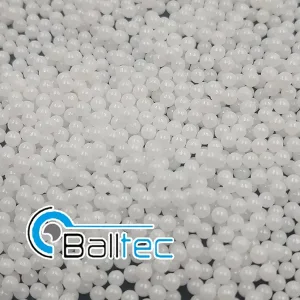
In LFP (Lithium Iron Phosphate) and NCM/NCA cathode wet-milling, 0.1mm-0.6mm YSZ micro-beads are essential to achieve D50 < 200nm particle sizes without introducing free iron contamination that causes micro-short circuits in lithium cells.
High transparency coatings, inkjet pigments, and automotive OEM finishes require narrow particle size distribution. ZrO2 beads eliminate agglomerates while preventing color shifting caused by media wear debris.
Compliant with stringent FDA and REACH heavy-metal non-leakage standards, our high-purity YSZ media delivers biostable processing for active pharmaceutical ingredients (APIs) and skincare formulations.
Key technological evolutions shaping the future of industrial fine grinding and dispersion.
As quantum dots, semiconductor CMP slurries, and solid-state battery electrolytes demand sub-50nm particles, the production of spherical zirconia media below 0.05mm requires revolutionary micro-fluidic dropping technology.
Integration of AI-driven thermal imaging and closed-loop optical sphericity sorters ensures 100% inspection of micro-bead batches, completely eliminating out-of-round media from entering mill chambers.
Leading Chinese exporters are implementing green sintering kilns powered by solar-storage hybrid energy, combined with closed-loop process water recycling, aligning with global corporate decarbonization mandates.
Detailed answers regarding technical specs, bead sizing, mill compatibility, and export compliance.
While Ceria-stabilized zirconia (CSZ) offers high density (~6.2 g/cm³), Yttria-stabilized zirconia (Y-TZP) provides vastly superior fracture toughness and flexural strength. CSZ beads are more prone to micro-chipping under high shear conditions (>14 m/s tip speeds), leading to structural breakdown and mill seal damage. Y-TZP remains the gold standard for clean, ultra-fine nano-grinding where zero bead breakage is mandated.
The golden rule of wet milling dictates that the ideal bead diameter should be approximately 20 to 30 times larger than the initial raw material particle size ($D_{90}$), and the desired final particle size should guide the final milling stage bead selection. For instance:
Our factory employs strict ISO 9001 quality assurance protocols. Every batch undergoes:
Standard export packaging includes 25 kg heavy-duty plastic drums reinforced inside 200 kg steel drums or heat-treated ISPM-15 compliant wooden crates. All packaging includes moisture-proof desiccant bags and double-layer vacuum sealed inner liners to prevent humidity exposure during sea transport.
Chinese manufacturers offer a 35% to 55% cost reduction compared to Japanese or European brands while matching or exceeding key physical properties (density ≥ 6.0g/cm³, hardness ≥ 1250 HV10). This cost efficiency stems from localized raw zircon processing, integrated power infrastructure, and massive economies of scale in dedicated industrial ceramic parks.
Every shipment is dispatched with a Certificate of Analysis (COA), Material Safety Data Sheet (MSDS), REACH registration compliance, RoHS heavy-metal test reports, and Certificate of Origin (Form E/Form A/CO) for international customs clearance optimization.
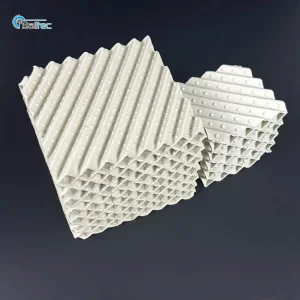
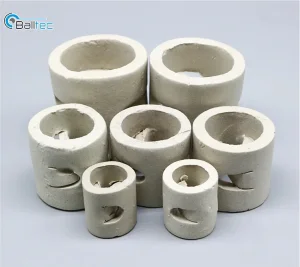
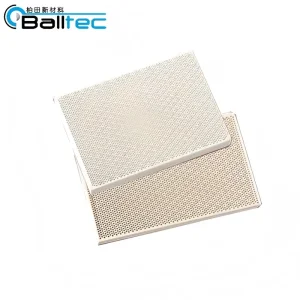
Factory-direct technical solutions for thermal processing, mass transfer, gas drying, and micro-dispersion.