Follow 


Engineered ceramic media manufactured to strict ISO 9001 quality controls for extreme wear resistance and ultra-fine dispersion.
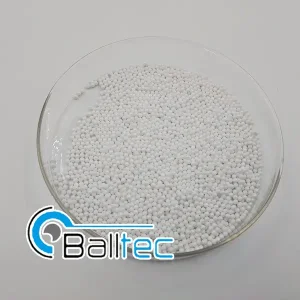
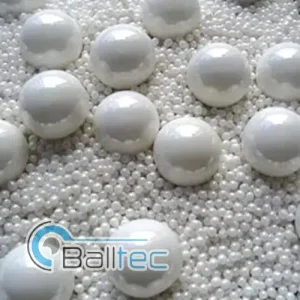
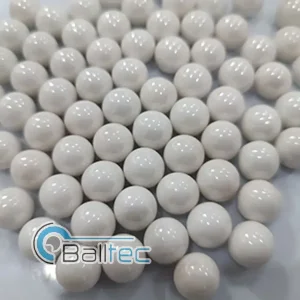
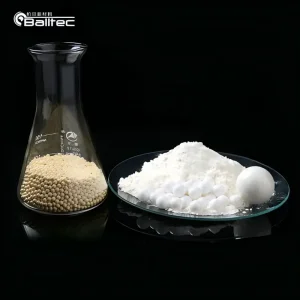
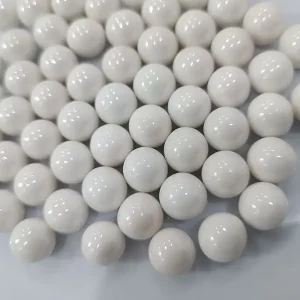
In modern industrial chemistry, energy storage manufacturing, and advanced electronics, particle size reduction down to sub-micron and nanoscale levels directly dictates product efficiency and market competitiveness.
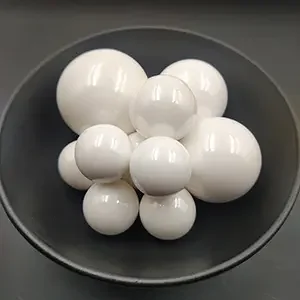
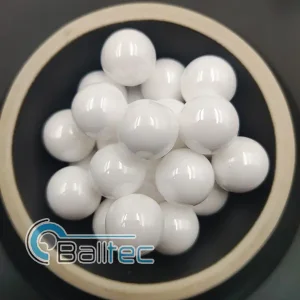
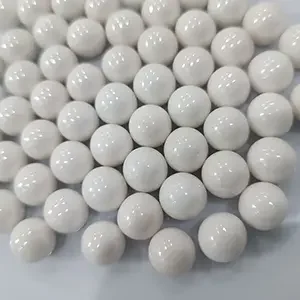
With a density exceeding 6.0 g/cm³, Yttria-stabilized zirconia (YSZ) beads deliver double the kinetic impact energy of conventional alumina media, accelerating particle breakdown while shortening milling batch cycles by up to 45%.
Designed for ultra-clean processing environments such as lithium iron phosphate (LFP) cathode synthesis, MLCC dielectric pastes, and pharmaceutical suspensions where ionic or metallic spallation causes catastrophic quality loss.
Though initial capital expenditure is higher than silica or low-grade alumina, the near-zero wear rate reduces media replenishment frequency, prolongs mechanical seal life, and minimizes mill downtime, lowering lifetime TCO.
The global demand for high-performance micro-milling media is undergoing a structural paradigm shift. As industries transition toward sub-micron and nanometer particle size distributions (PSD), conventional grinding media—such as forged steel balls, glass beads, and standard silicate ceramics—fail under intense shear forces, causing heavy wear contamination and equipment degradation. Modern high-energy agitator bead mills require media capable of handling power densities up to 2 kW/L without crushing or micro-chipping.
Four key global sectors are accelerating the adoption of wholesale yttria-stabilized zirconia grinding media:
The remarkable durability of Yttria-Stabilized Tetragonal Zirconia Polycrystal (Y-TZP) stems from a unique self-healing mechanical phenomenon known as Transformation Toughening. Pure zirconium oxide ($\text{ZrO}_2$) undergoes structural phase transitions during thermal cycles: monoclinic at room temperature, tetragonal above $1170^\circ\text{C}$, and cubic above $2370^\circ\text{C}$.
By doping the crystal matrix with approximately $3\text{ mol}\%$ Yttrium Oxide ($\text{Y}_2\text{O}_3$), the high-temperature tetragonal phase is metastably stabilized at ambient room temperature. When a micro-crack initiates due to intense mechanical impact within a mill, the stress concentration causes the local tetragonal crystals to transform into the larger monoclinic phase (a $3\text{ to }5\%$ volume expansion). This volume expansion exerts localized compressive forces that pinch the crack tip shut, stopping propagation and conferring unmatched fracture toughness ($K_{IC} \ge 9\text{ MPa}\cdot\text{m}^{1/2}$).
How Pingxiang's advanced industrial ceramic cluster delivers consistent batch-to-batch quality, rapid scalable throughput, and global logistics resilience.
Our factories utilize electrolyte liquid titration dropping processes to achieve near-perfect sphericity ($>0.98$) and uniform internal crystal density without internal air pockets or shrinkage voids.
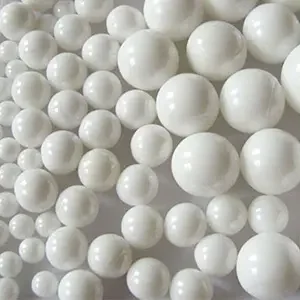
Multi-stage automated laser sizing optical sorters verify diameter tolerances down to $\pm 0.05\text{ mm}$, guaranteeing tight particle sizing essential for narrow gap dynamic separator bead mills.
Every export shipment is verified via SEM micro-structural analysis, ICP-OES elemental purity scanning, and real-world high-shear lab wear tests, accompanied by certified CoA documentation.
Selecting the optimal material chemistry for your mill operation requires balancing density, hardness, and wear performance.
| Material Type | Specific Density (g/cm³) | Bulk Density (g/cm³) | Vickers Hardness (HV10) | Fracture Toughness (MPa·m¹/²) | Self-Wear Rate (g/kg·h) | Primary Industrial Applications |
|---|---|---|---|---|---|---|
| Yttria Zirconia (Y-TZP) | ≥ 6.00 | 3.70 - 3.85 | ≥ 1250 | 9.0 | < 0.01 | Lithium battery slurries, MLCC, cosmetics, inks |
| Ceria Zirconia (Ce-TZP) | ≥ 6.20 | 3.80 - 3.95 | ≥ 1180 | 10.5 | < 0.015 | Heavy minerals, calcium carbonate, agrochemicals |
| Zirconium Silicate ($\text{ZrSiO}_4$) | 4.00 - 4.10 | 2.50 - 2.60 | ≥ 900 | 5.0 | < 0.08 | Paper coatings, TiO2 dispersion, metallic ores |
| High Purity Alumina ($99\%\ \text{Al}_2\text{O}_3$) | 3.68 - 3.75 | 2.30 - 2.40 | ≥ 1450 | 4.5 | < 0.05 | Ceramic glazes, white cement, mineral ball mills |
| Silicon Nitride ($\text{Si}_3\text{N}_4$) | 3.20 - 3.25 | 2.00 - 2.10 | ≥ 1500 | 7.5 | < 0.005 | Precision bearing balls, semiconductor slurries |
Tailored zirconia bead sizing and mill operating recommendations across high-growth manufacturing sectors.
Operating Challenge: Reducing precursor particle size ($D_{50}$) from $5\ \mu\text{m}$ down to $< 300\text{ nm}$ while maintaining absolute zero metal oxide impurity contamination.
Recommended Media: 0.3mm – 0.6mm Yttria-Stabilized Zirconia Beads ($95\%\ \text{ZrO}_2 + 5\%\ \text{Y}_2\text{O}_3$).
Engineering Result: High impact velocity causes uniform particle breakup without media fracture. Zero metal contamination ensures optimal discharge rates and cycle longevity in lithium-ion battery cells.
Operating Challenge: Dispersing high-grade organic pigments to transparent nanometer sizes without over-grinding, which leads to color shifting and loss of gloss.
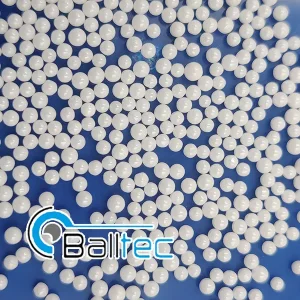
Recommended Media: 0.1mm – 0.3mm Nano Zirconia Beads in pin-type horizontal agitator mills.
Engineering Result: Ultra-fine media sizes maximize narrow bead-to-bead shear zones, achieving $D_{90} < 80\text{ nm}$ color dispersion with exceptional narrow PSD and minimal batch viscosity buildup.
Direct answers from our ceramic engineers for procurement directors, process engineers, and plant managers.
For standard horizontal pin-type or disk-type agitator mills, media loading typically ranges between 70% to 85% of the net grinding chamber volume. The required mass ($M$) can be calculated using the bulk density of YSZ ($\approx 3.7\text{ kg/L}$):
Mass (kg) = Chamber Volume (L) × Loading Percentage (%) × Bulk Density (3.7 kg/L)
For example, a 60-liter mill loaded at 80% capacity requires approximately $60 \times 0.80 \times 3.7 = 177.6\text{ kg}$ of zirconia beads.
While both are high-performance ceramics, Y-TZP utilizes $\text{Y}_2\text{O}_3$ as a stabilizer, yielding a density of $6.0\text{ g/cm}^3$, higher flexural strength ($> 1200\text{ MPa}$), and smoother surface finish ($Ra < 0.01\ \mu\text{m}$), making it ideal for ultrafine nano-milling. Ce-TZP uses $\text{CeO}_2$, resulting in a higher density ($6.2\text{ g/cm}^3$) and superior chemical resistance in highly acidic slurries, but slightly lower wear resistance in fine wet grinding.
Leading Chinese exporters utilize automated titration dropping equipment combined with continuous high-temperature tunnel kilns. Raw sub-micron zirconia powder is homogenized with stabilizers, dropped into gelling baths to form perfect spheres, sintered at $1450^\circ\text{C} - 1550^\circ\text{C}$, and classified using high-precision optical laser sizing screens. Every production lot undergoes ICP-OES chemical analysis and X-ray diffraction (XRD) phase purity testing.
Yttria-stabilized zirconia has a significantly higher density ($6.0\text{ g/cm}^3$ vs. $3.68\text{ g/cm}^3$ for alumina) and nearly 5x greater fracture toughness. In high-speed mills, alumina beads can fracture under intense shear and contaminate cathode/anode slurries with aluminum ions. YSZ media provides double the grinding energy while exhibiting an exceptionally low wear rate ($< 0.01\text{ g/kg}$).
Standard export packaging includes 25 kg high-density plastic drums or reinforced steel pails packed onto fumigated wooden or plastic pallets wrapped in shrink film (1,000 kg per pallet). Custom OEM labeling, UN-certified drums, and small-bag options (5 kg/10 kg) for lab-scale orders are available upon request.
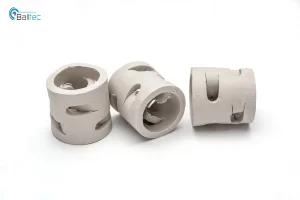
Explore our complete industrial offering including zirconia precision balls, chemical tower packing, and molecular sieves.