Follow 


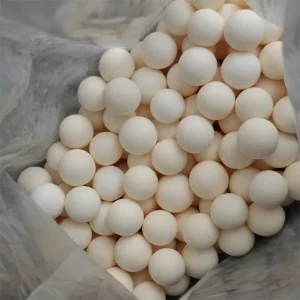
Explore our flagship high-purity ceramic elements engineered for extreme thermal stability, low noise, and maximum mechanical wear resistance across electronic substrate and precision milling applications.
In modern electrical engineering, the 100k Ohm (100k Ω) resistor serves as a foundational building block across analog signal processing, voltage measurement networks, digital pull-up/pull-down topologies, and power supply feedback loops. Specified as $100,000 \text{ ohms}$ or $0.1 \text{ M}\Omega$, this passive resistance magnitude offers the optimal impedance sweet spot—high enough to minimize current consumption and parasitic loading, yet low enough to resist ambient electromagnetic interference (EMI) and stray capacitive noise.
Global procurement requirements for 100k Ohm resistors have shifted from standard commercial grade passive components toward high-reliability, AEC-Q200 qualified, pulse-tolerant, and low-TCR (Temperature Coefficient of Resistance) solutions. As industrial electrification accelerates—driven by Electric Vehicle (EV) battery management systems, solar inverter grid ties, high-speed robotics, and 5G telecommunication infrastructure—the demand for reliable 100k Ohm resistor manufacturing has reached unprecedented volume levels.
A resistor is not merely a resistive element; it is an integrated electro-thermal system. The electrical performance of a 100k Ohm resistor under continuous load depends heavily on the ceramic core or substrate material upon which the resistive film (Thick Film ruthenium oxide or Thin Film nickel-chromium) is deposited.
Utilizing ruthenium oxide ($\text{RuO}_2$) pastes screen-printed onto high-purity alumina ceramic substrates and fired at 850°C. Excellent for general-purpose applications, surge absorption, and cost-sensitive mass production.
Sputtered metallic film (Nichrome/NiCr) deposited in a vacuum chamber onto polished 99.6% $\text{Al}_2\text{O}_3$ ceramic substrates, followed by laser trimming. Engineered for low-noise measurement circuits.
Constructed on cylindrical ceramic rods or specialized planar substrates designed to withstand dielectric breakdown voltage up to several kilovolts without catastrophic arc-over.
| Resistor Technology Type | Typical Tolerance | TCR (ppm/°C) | Substrate Material | Primary Industrial Application |
|---|---|---|---|---|
| Standard Surface Mount (SMD) 100k | ±1%, ±5% | ±100 ppm/°C | 96% Alumina ($\text{Al}_2\text{O}_3$) | Consumer Electronics, IoT Devices |
| Precision Metal Film 100k | ±0.05%, ±0.1% | ±10 to ±25 ppm/°C | 99.6% High Purity Alumina | Medical Instrumentation, Weighing Scales |
| High-Voltage Thick Film 100k | ±1%, ±2% | ±50 to ±100 ppm/°C | Alumina Ceramic Rods / Plates | X-Ray Generators, Power Distribution Grids |
| Automotive Grade (AEC-Q200) | ±0.1%, ±0.5% | ±25 ppm/°C | Toughened Ceramic Substrates | EV Battery Management Systems (BMS) |
Across modern circuit design, the 100k Ohm resistor is selected for critical control functions. Partnering with a high-capacity manufacturer guarantees component consistency, batch-to-batch repeatability, and robust long-term reliability.
100k Ohm resistors form high-impedance voltage divider networks to monitor individual lithium-ion cell voltages. High dielectric strength ceramic substrates prevent high-voltage leakage paths, preserving measurement accuracy over temperatures ranging from -40°C to +125°C.
In DC-to-AC power conversion, 100k Ω resistors act as discharge resistors across high-voltage capacitor banks and provide accurate signal feedback for pulse-width modulation (PWM) controllers, resisting thermal degradation under continuous power cycles.
Operational amplifier circuits frequently specify 100k Ohm feedback resistors to establish precise gain ratios while maintaining ultra-low input bias current error. Thin film construction guarantees low flicker noise ($1/f$ noise) in audio and sensor amplification.
The evolutionary trajectory of 100k Ohm resistor manufacturing is tightly coupled with advanced ceramic material processing. Achieving zero drift, high pulse endurance, and extreme miniaturization (0201 and 01005 SMD package sizes) requires ultra-pure raw material refinement.
Future technical benchmarks established by our R&D team focus on three core technological vectors:
Operating within a 100,000 m² modern manufacturing campus managed under strict ISO 9001, ISO 14001, and ISO 45001 quality management systems, our component production lines enforce 100% optical and electrical testing. Every reel or bulk package of 100k Ohm resistors is fully traceable from raw ceramic powder selection to final laser trimming.
All resistor products strictly comply with EU RoHS directive 2011/65/EU and REACH regulations. Heavy metals such as lead, cadmium, mercury, and hexavalent chromium are completely eliminated from electrode terminations and protective glass coatings.
With robust safety stock programs, automated tape-and-reel packaging (EIA-481 compliant), and direct export capabilities, we provide seamless door-to-door OEM logistics support across North America, Europe, Asia-Pacific, and the Middle East.
Key answers compiled by our senior passive component engineering and materials science team to assist procurement managers and circuit designers.
The 100k Ohm resistor strikes an optimal balance between power dissipation and noise immunity. A 10k resistor draws ten times more current ($I = V/R$), reducing energy efficiency in battery-powered devices. Conversely, a 1M resistor creates a very high-impedance node that is susceptible to parasitic PCB capacitance, humidity leakage currents, and ambient EMI. 100k Ohm is the industry standard for stable amplifier feedback, active filtering, and pull-up configuration.
The ceramic substrate acts as both the physical backbone and the thermal heat sink of the resistor. High-purity 96% to 99.6% Alumina ($\text{Al}_2\text{O}_3$) substrates offer high electrical insulation resistance ($>10^{14} \ \Omega\cdot\text{cm}$) and high thermal conductivity. Poor-quality substrates containing micro-voids or iron impurities cause localized hot spots, thermal coefficient distortion, dielectric breakdown, and early field failure under electrical stress.
Thick film resistors screen-print conductive paste (ruthenium oxide) at ~12–15 micron thickness, offering low unit cost and robust high-surge handling, suitable for power supplies. Thin film resistors vacuum-sputter metal film (NiCr) at less than 0.1 micron thickness, delivering ultra-precise tolerances (down to ±0.01%), extremely low TCR (< 5–10 ppm/°C), and negligible noise for precision instrumentation.
Yes. In addition to standard chip resistor dimensions (0402, 0603, 0805, 1206, 2512), we support custom ceramic substrate geometries, custom resistance values, specialized pin/pad plating (gold, tin-lead, matte tin), and tailored thermal management profiles to meet unique industrial or defense contract specifications.
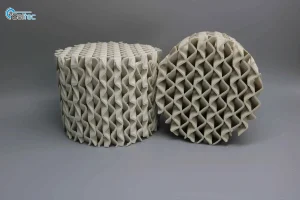
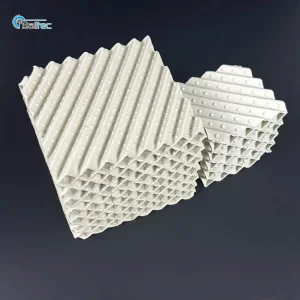
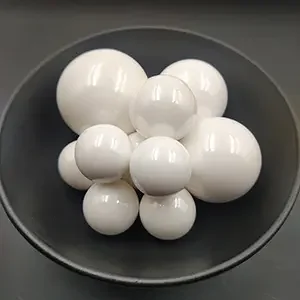
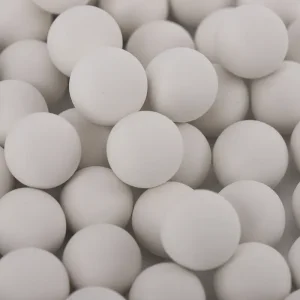
Browse our additional catalog of ceramic grinding media, inert catalyst support balls, low-impurity zirconia, and structured ceramic packing manufactured for chemical processing and industrial operations worldwide.