Follow 


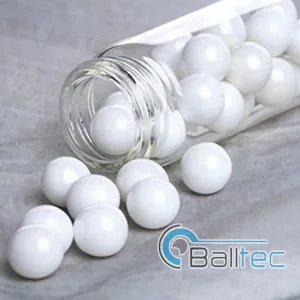
Engineered for minimal wear rates, zero cross-contamination, and maximum energy transfer efficiency.
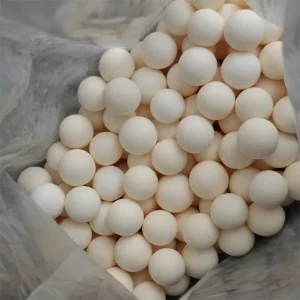
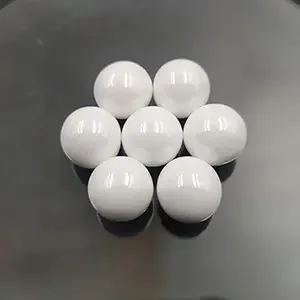
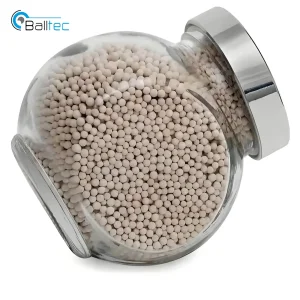
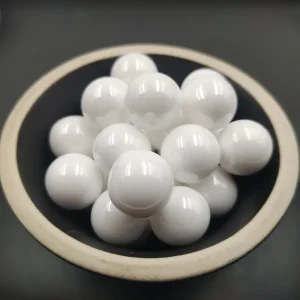
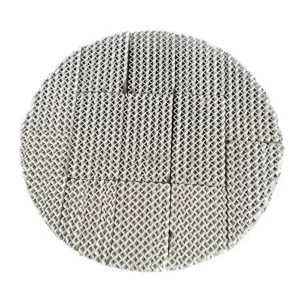
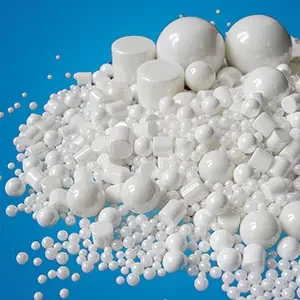
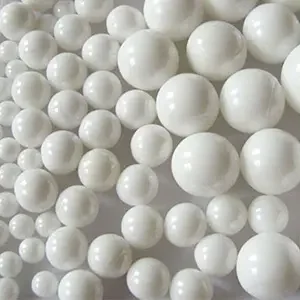
Modern industrial ultra-fine grinding processes demand an unprecedented convergence of high kinetic energy transfer, fracture toughness, microstructural uniformity, and chemical inertness. As global manufacturing transitions toward sub-micron and nanometer particle size distributions (PSD down to d50 < 100 nm), traditional steel and low-density silicate media introduce severe operational bottlenecks—including accelerated media degradation, hydrodynamic drag losses, and catastrophic metallic slurry contamination.
Evaluating prospective wholesale high-strength grinding media manufacturers & suppliers requires a comprehensive multi-variable analysis beyond nominal purchase price per kilogram. Procurement executives and process engineers must analyze the total operational lifecycle—balancing specific gravity ($\mathrm{g/cm^3}$), Vickers hardness ($\mathrm{HV}_{10}$), fracture toughness ($\mathrm{K_{IC}}$), crystal lattice stabilization chemistry, and volumetric wear rates under intense hydraulic agitation.
| Grinding Media Classification | Chemical Composition | Bulk Density ($\mathrm{g/cm^3}$) | Vickers Hardness ($\mathrm{HV_{10}}$) | Fracture Toughness ($\mathrm{MPa\cdot m^{1/2}}$) | Primary Industrial Applications |
|---|---|---|---|---|---|
| Y-TZP (Yttria-Stabilized Zirconia) | $\mathrm{ZrO_2 \ge 94.7\%},\ \mathrm{Y_2O_3 \approx 5.2\%}$ | $\ge 6.00$ | 1250 – 1350 | 9.0 – 10.0 | Li-ion Battery Materials (LFP/NCM), MLCCs, Nanomaterials, Inks |
| Ce-TZP (Cerium-Stabilized Zirconia) | $\mathrm{ZrO_2 \ge 80\%},\ \mathrm{CeO_2 \approx 18\%}$ | $\ge 6.20$ | 1150 – 1200 | 12.0 – 13.0 | Heavy Non-Metallic Minerals, Calcium Carbonate, High-Viscosity Slurries |
| ZTA (Zirconia-Toughened Alumina) | $\mathrm{Al_2O_3 \approx 80\%},\ \mathrm{ZrO_2 \approx 15-20\%}$ | 4.10 – 4.50 | 1350 – 1450 | 5.5 – 6.5 | Metallic Ores, Gold/Copper Mining, Standard Wet Bead Mills |
| HPA 99.99% (High Purity Alumina) | $\mathrm{Al_2O_3 \ge 99.99\%},\ \mathrm{SiO_2, Fe \le 10ppm}$ | 3.85 – 3.95 | 1600 – 1700 | 4.0 – 4.5 | Phosphors, Semiconductor Slurries, Bio-Inert Medical Powder Milling |
The global expansion of energy storage systems (ESS) and electric vehicles (EVs) has pushed Lithium Iron Phosphate ($\mathrm{LiFePO_4}$), Lithium Nickel Manganese Cobalt Oxide (NCM), and silicon-carbon anode manufacturing toward sub-micron particle sizes. Media contamination with metallic iron or copper can cause micro-short circuits in battery cells. High-strength yttria-stabilized zirconia beads provide the high dynamic density ($\ge 6.0\mathrm{g/cm^3}$) required to achieve $d_{90} < 200\text{ nm}$ PSD without releasing electrochemically active impurities.
Leading ceramic media producers leverage stress-induced phase transformation toughening. Yttria holds the zirconia crystal structure in a metastable tetragonal phase at room temperature. When a crack tip propagates through the bead during high-speed shear stress inside an agitator bead mill, the concentration of stress triggers a local transformation from the tetragonal ($t$) to monoclinic ($m$) phase. This volumetric expansion ($\sim 3-5\%$) exerts compressive stresses that clamp the crack shut, yielding extreme fracture toughness ($\mathrm{K_{IC}} \ge 9.0\ \mathrm{MPa\cdot m^{1/2}}$).
Industrial electricity costs account for over 65% of the total operating expense in continuous wet milling circuits. Utilizing media with optimized sphericity ($>98\%$), narrow diameter tolerances, and dense, defect-free microstructures minimizes energy dissipation via thermal friction. Higher kinetic impact energy allows mills to run at lower shaft RPMs or shorter residence times, reducing specific energy consumption ($\mathrm{kWh/ton}$) by up to 28%.
Data-backed parameters driving enterprise selection of Baitian (Ball-tec) material solutions.
Industrial grinding media do not operate in a vacuum. Selection criteria must map directly onto process-side chemistry, mill equipment architecture, and product performance requirements. Below are detailed operational frameworks tailored for global industrial supply chains:
In Multi-Layer Ceramic Capacitor (MLCC) formulation, barium titanate ($\mathrm{BaTiO_3}$) slurries must be milled to sub-100 nanometer dimensions to produce ultra-thin dielectric layers. Standard media leaching alumina or silica alters the dielectric constant ($\kappa$) and causes electrical breakdown.
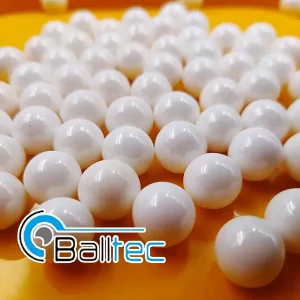
Recommended Route: Yttria-Stabilized Zirconia (YSZ) micro-beads ($0.05\text{ mm} - 0.2\text{ mm}$) featuring $>95\%\ \mathrm{ZrO_2+Y_2O_3}$, low internal porosity, and glass-polished surface finishes to prevent mechanical trapping of fine particles.
Suspension concentrates (SC) and water-dispersible granules (WDG) in agrochemicals, as well as automotive OEM coatings and digital inkjet inks, require rapid color intensity development and long-term shelf stability without flocculation.
Recommended Route: High-density Cerium-Stabilized Zirconia or Zirconium Silicate media. The elevated specific mass overcomes high slurry viscosity, enabling uniform dispersion across high-throughput pin-type vertical or horizontal mills.
Sub-micron dental zirconia powders (Y-TZP) for CAD/CAM block milling and ceramic implant components demand absolute freedom from heavy metal oxides and radio-impurities.
Recommended Route: ISO 13485 compliant 99.99% High-Purity Alumina (HPA) and Bio-Inert Zirconia media synthesized via hydrothermal precipitation to maintain ultra-clean bio-compatibility.
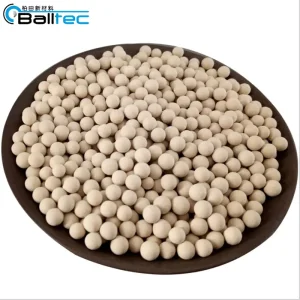
Beyond size reduction, process facilities require high-strength ceramic tower packing and zeolitic molecular sieves to withstand thermal cycling, aggressive acid washings, and extreme hydraulic crushing pressures.
Recommended Route: Wear and heat-resistant structured ceramic packings paired with synthetic 4A/5A/13X molecular sieves engineered for Pressure Swing Adsorption (PSA) oxygen generation and gas drying.
Procuring advanced ceramic materials at scale demands absolute operational compliance, supply stability, and technical collaboration. Pingxiang Baitian (Ball-tec) New Materials Co., Ltd. operates an integrated 100,000 m² industrial production complex situated within China’s premier ceramic innovation hub in Pingxiang, Jiangxi Province.
Every production lot undergoes rigorous statistical process control (SPC). Key quality gates include X-ray Fluorescence (XRF) chemical verification, Helium Pycnometry density testing, laser diffraction particle size analysis of raw powders, and accelerated wear-rate simulations in high-speed laboratory pin mills.
As comminution equipment advances toward super-fast shaft speeds ($>15\text{ m/s}$) and ultra-thin discharge separators ($<30\ \mu\text{m}$ gaps), grinding media engineering must evolve across three primary vectors:
Explore factory-direct ceramic media, molecular sieves, and structural ceramic packings.