Follow 


Direct factory procurement portfolio engineered for high-density, zero-contamination, and extreme wear-resistance applications across global industrial mills.
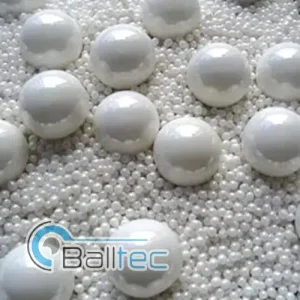
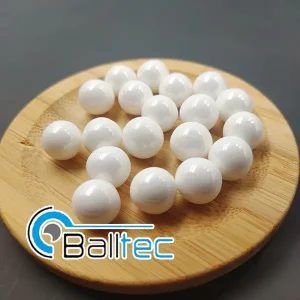
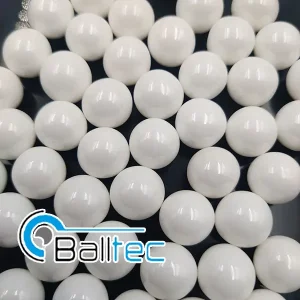
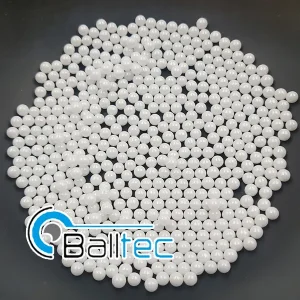
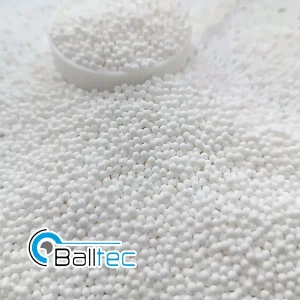
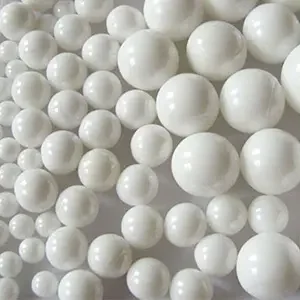
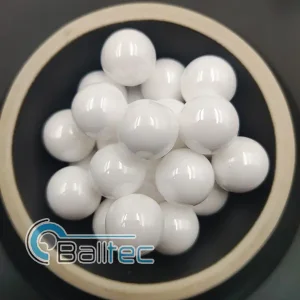
As high-tech manufacturing transitions toward nano-scale material refinement, zirconium oxide grinding balls ($ZrO_2$) have established themselves as the gold standard for high-energy bead milling, attritor grinding, and ultra-fine dispersion systems worldwide.
With a high specific density ($\approx 6.0\text{ g/cm}^3$), yttria-stabilized zirconia (YSZ) beads deliver maximum kinetic energy transfer in horizontal pin-type bead mills, enabling rapid particle size reduction ($D_{50} < 100\text{ nm}$) with reduced energy consumption per batch.
Designed for sensitive applications like lithium-ion battery cathodes ($LFP/NCM$), pharmaceutical APIs, and electronic MLCC ceramics, microcrystalline $ZrO_2$ balls eliminate metallic or silica contamination, safeguarding slurry chemical purity.
Featuring tetragonal zirconia polycrystal (TZP) microstructure and high fracture toughness ($>9\text{ MPa}\cdot\text{m}^{1/2}$), YSZ grinding media exhibit extremely low wear rates ($<0.01\text{ g/kg}\cdot\text{hr}$), outperforming alumina and silicate media by orders of magnitude.
China has evolved into the central hub for global advanced ceramic manufacturing. By combining integrated zircon chemical supply chains with state-of-the-art sintering technology, Chinese original equipment manufacturers deliver unmatched cost-efficiency, technical repeatability, and scale.
Chinese direct manufacturers utilize continuous hydrothermal liquid phase synthesis to produce ultra-fine sub-micron $ZrO_2$ powders with uniform dopant distribution ($Y_2O_3$ or $CeO_2$), guaranteeing dense, defect-free green spheres.
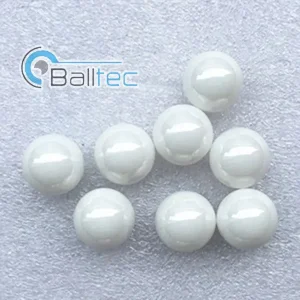
Utilizing high-pressure Isostatic Spheroidization and Automated Dripping technology, our facilities produce grinding spheres with sphericity exceeding 98%, eliminating internal voids, cracks, and structural shear planes.
Computer-controlled high-temperature tunnel kilns maintain tight thermal zones ($1450^\circ\text{C}-1550^\circ\text{C}$), ensuring complete crystal phase transformation to tetragonal polycrystals without thermal stress residual strain.
Selecting the correct ceramic grinding media requires evaluating physical properties against chemical compatibility, mill energy density, and target dispersion particle size ($D_{90}$). Below is the comparative engineering matrix across leading grinding bead grades.
| Material Classification | Chemical Composition | Specific Density (g/cm³) | Vickers Hardness (HV12) | Crush Strength (Ø2mm) | Primary Industrial Applications |
|---|---|---|---|---|---|
| Yttria-Stabilized Zirconia (YSZ) | 95% $ZrO_2$ / 5% $Y_2O_3$ | 6.00 | > 1250 | > 2500 N | Lithium Battery Cathodes/Anodes, MLCC, CMP Slurries, Pharmaceuticals |
| Cerium-Stabilized Zirconia (CSZ) | 80% $ZrO_2$ / 20% $CeO_2$ | 6.20 | > 1150 | > 2200 N | Heavy Calcium Carbonate ($GCC$), Minerals, Paints, High-Viscosity Slurries |
| Zirconium Silicate ($ZrSiO_4$) | 65% $ZrO_2$ / 33% $SiO_2$ | 4.00 | > 1000 | > 1200 N | Agrochemicals, Printing Inks, Paper Coatings, Titanium Dioxide ($TiO_2$) |
| High-Purity Alumina ($Al_2O_3$) | 99.5% $Al_2O_3$ | 3.70 - 3.90 | > 1400 | > 1800 N | Ceramic Glazes, Silica Sand, White Pigments, Ball Mill Grinding Liners |
The core advantage of Yttria-Stabilized Zirconia Poly-crystal (Y-TZP) lies in its stress-induced phase transformation. When an external impact or micro-crack stress acts on the bead surface, the metastable tetragonal crystal phase ($\text{t}$) converts to the stable monoclinic phase ($\text{m}$). This phase transition is accompanied by a local volume expansion of approximately 3-5%, generating compressive stress around the crack tip that actively halts crack propagation.
Traditional grinding media wear out via macro-chipping and intergranular grain detachment. Modern microcrystalline $ZrO_2$ grinding balls engineered by premium manufacturers exhibit sub-micron crystal grains ($<0.5\,\mu\text{m}$). This ultra-fine micro-structure resists tribochemical erosion, maintaining a mirror-polished spherical surface ($Ra < 0.02\,\mu\text{m}$) that minimizes wear on mill chambers and internal agitator discs.
Different manufacturing sectors impose distinct operational demands on grinding media. Here is how specialized zirconia grinding media perform across primary industrial processing environments.
In wet milling Lithium Iron Phosphate ($LiFePO_4 / LFP$) and Nickel Cobalt Manganese ($NCM$) precursors, micro zirconia beads ($0.1\text{mm} - 0.4\text{mm}$) reduce cathode particles down to sub-100nm without introducing iron ($Fe$) or heavy metal contaminants that compromise battery safety and electrochemical cycle stability.
Multilayer Ceramic Capacitors ($MLCC$) demand extreme dielectric powder uniformity ($BaTiO_3$). YSZ beads prevent dielectric breakdown caused by oversized agglomerates, maintaining precise particle size distribution ($PSD$) curves required for ultra-thin ceramic tape casting.
For high-end automotive refinish coatings, metallic inks, and inkjet formulations, smooth zirconia grinding beads ensure rapid dispersion of organic and inorganic pigments, maximizing color strength, optical transparency, and gloss metrics.
As industrial automation accelerates and specifications tighten, the global advanced ceramics market is undergoing key technical shifts.
The market is rapidly shifting toward sub-0.1mm micro-beads ($0.03\text{mm} - 0.05\text{mm}$). Advanced dripping titration allows manufacturers to produce tight-tolerance micro-beads required for 10-nanometer quantum dot inks and solid-state battery electrolytes.
Leading Chinese exporters are implementing green hydrogen and continuous electric atmosphere kilns. Closed-loop heat recovery reduces sintering carbon footprints by over 35%, assisting international buyers in meeting Scope 3 decarbonization targets.
Traditional manual screening is being replaced by AI-driven high-speed optical vision sorting systems. 100% of finished beads undergo inline laser inspection for ovality, diameter deviation, and microscopic surface flaws.
Evaluating wholesale grinding media solely on purchase price per kilogram creates hidden operational costs. Experienced procurement officers evaluate media efficiency using Total Cost of Ownership analysis.
A comprehensive procurement evaluation incorporates wear loss, milling batch time, equipment maintenance, and product rejection rates:
Yttria-stabilized zirconia media typically cost 3x to 4x more than zirconium silicate beads upfront. However, because YSZ exhibits 1/20th of the wear rate and cuts grinding residence time by 40%, the net TCO savings exceed 32% annually in high-throughput operations.
When vetting global B2B suppliers and Chinese original factories, request verified empirical lab metrics:
Direct technical insights provided by ceramic engineers to assist procurement managers, process engineers, and plant managers.
Yttria-Stabilized Zirconia (95% $ZrO_2$, 5% $Y_2O_3$) features higher fracture toughness, smoother surface finishes, and higher crush strength, making it ideal for micro-milling electronics, pharmaceuticals, and battery cathodes. Cerium-Stabilized Zirconia (80% $ZrO_2$, 20% $CeO_2$) has a higher density ($\approx 6.20\text{ g/cm}^3$), providing higher impact kinetic energy for coarse grinding of heavy minerals like calcium carbonate ($GCC$) in large vertical mills.
A reliable rule of thumb is that the grinding media diameter ($d_{bead}$) should be approximately 20 to 30 times larger than the initial feed particle size ($D_{90}$), and about 1000 times larger than the desired target particle size ($D_{50}$). Additionally, ensure the bead diameter is larger than the mill separator screen gap (bead diameter should be at least 2.5x to 3x the screen slot size to prevent mill clogging).
Bead breakage usually stems from four primary factors: 1) Excessive mill tip speed (> 14-16 m/s) exceeding media toughness thresholds; 2) Insufficient slurry viscosity causing severe bead-to-bead direct dry impacts; 3) Overfilling the mill chamber volume (> 85% charge factor); or 4) Inferior media containing internal porosity and residual stress micro-cracks from substandard sintering.
Wholesale orders are typically packaged in 25 kg sealed moisture-proof HDPE drums or double-lined woven bags, consolidated onto heat-treated ISPM-15 wooden or plastic pallets (1,000 kg per pallet). For cleanroom applications (battery/pharma), media can be vacuum-sealed in double 10 kg PE bags packed into reinforced steel drums.
Explore additional precision ceramic solutions designed for specialized grinding, separation, and industrial tower packing challenges.