Follow 


In modern chemical processing, mass transfer efficiency within packed towers determines the economic viability, energy intensity, and carbon footprint of global processing facilities. Ceramic Raschig Rings represent the fundamental baseline for random tower packing technology, delivering unparalleled structural integrity, extreme temperature tolerance, and chemical inertness across highly corrosive media.
As chemical plants push operations toward continuous processing under aggressive acidic environments—such as concentrated sulfuric acid production, nitric acid absorption, and petrochemical stripping columns—the performance expectations for random packing materials have escalated. Modern industrial facilities require tower packings that eliminate channeling, minimize bed pressure drop, prevent liquid holdup degradation, and withstand severe thermal shock cycles without mechanical degradation.
As a leading direct-manufacturer and exporter, Pingxiang Baitian (Ball-tec) New Materials Co., Ltd. integrates advanced microstructural engineering with precision extruding and sintering protocols. By combining regional kaolin and alumina reserves with automated industrial production lines, our facility supplies enterprise chemical engineering consortia with high-purity ceramic packing media engineered for long-term operational stability.
Global demand for chemical-grade industrial ceramics has surged across Europe, North America, the Middle East, and the Asia-Pacific region. Environmental regulations (such as REACH in Europe and EPA clean air mandates in North America) drive chemical processors to upgrade gas scrubbing, desulfurization, and VOC capture units, directly accelerating the global procurement of high-efficiency ceramic tower packings.
Extremely demanding operating environments in crude oil distillation, demethylation columns, and acid gas stripping require tower packings that resist aromatic hydrocarbons, hydrogen sulfide (H2S), and organic acids without structural spalling or fouling.
Municipal and industrial waste treatment plants deploy wet scrubbers using Ceramic Raschig Rings to neutralize halogen gases (Cl2, F2), sulfur oxides (SOx), and nitrogen oxides (NOx) under continuous, highly acidic recirculating streams.
In fertilizer manufacture (specifically wet-process phosphoric acid and contact-process sulfuric acid towers), packing bed stability directly determines plant uptime. Ceramic packings provide lifetime chemical endurance against boiling nitric and sulfuric acid concentrations.
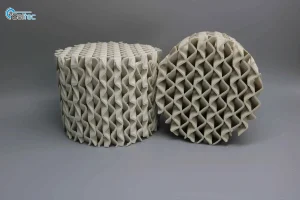
Tower packing selection involves balancing mass transfer efficiency ($K_G a$), hydraulic capacity, pressure drop ($\Delta P / Z$), and mechanical strength. While structured packings like 500Y Ceramic Corrugated Packing offer high specific surface areas for high-vacuum fractionation, random ceramic packings remain the industry standard for fouling services, heavy liquid loads, and aggressive chemical columns.
| Nominal Size (mm / Inch) | Bulk Density (kg/m³) | Specific Surface Area (m²/m³) | Free Volume (%) | Packing Factor (m⁻¹) | Crushing Strength (N/piece) |
|---|---|---|---|---|---|
| 15 mm (5/8") | 580 - 620 | 330 | 72% | 560 | > 900 |
| 25 mm (1") | 530 - 570 | 220 | 74% | 320 | > 1500 |
| 38 mm (1.5") | 490 - 530 | 145 | 76% | 210 | > 2400 |
| 50 mm (2") | 450 - 490 | 110 | 78% | 140 | > 3200 |
| 75 mm (3") | 410 - 450 | 75 | 80% | 90 | > 5000 |
Proper column performance depends on uniform liquid distribution. Ceramic Raschig Rings provide equal wall thickness ($d_{outer} = h$) designed to balance radial liquid dispersion with axial gas momentum. This continuous renewal of boundary liquid films prevents premature bed flooding and optimizes mass transfer rates in gas-liquid absorption interfaces.
In thermal regenerative oxidation (RTO) and high-temperature thermal exchange units, temperature fluctuations cause micro-fracturing in inferior ceramic grades. Our formulation incorporates controlled mullite phase crystal networks that absorb thermal stress up to 200°C/hour temperature deltas without structural failure.
The long-term performance of industrial ceramics depends directly on powder preparation, shaping precision, and sintering kinetics. At our Pingxiang manufacturing campus, technical quality control extends from raw material processing through final packaging.
High-purity kaolin clay, feldspar, quartz, and refined alumina ($Al_2O_3$) are wet ball-milled in high-capacity industrial mills. This ensures sub-micron particle dispersion, creating a homogeneous clay slurry free of coarse iron contaminants or unreacted quartz pockets.
De-aired ceramic pug mills extract air bubbles down to vacuum pressures below -0.098 MPa. High-precision extrusion dies shape the ceramic body into perfectly concentric cylindrical rings, maintaining tight tolerances on wall thickness ($t$) and aspect ratios ($h/d$).
Drying beds remove residual moisture before products enter computer-controlled gas tunnel kilns. Sintering temperatures between 1280°C and 1380°C transform kaolinite into dense mullite micro-crystals bonded by an acid-resistant vitrified glass phase.
| Chemical Constituent | Standard Chemical Grade (%) | High-Alumina Grade (%) | Acid-Proof Industrial Specification |
|---|---|---|---|
| Alumina ($Al_2O_3$) | 17% - 23% | 42% - 75% | High Chemical Stability |
| Silica ($SiO_2$) | 70% - 76% | 22% - 54% | Vitrified Matrix Layer |
| Iron Oxide ($Fe_2O_3$) | < 1.0% | < 0.5% | Minimizes Acid Leaching |
| Alkali Oxides ($K_2O + Na_2O$) | < 3.0% | < 2.0% | Ensures Vitrification Density |
Securing international chemical supply chains requires strict compliance documentation, certified product quality, and reliable export logistics. Baitian New Materials provides full documentation and testing support to streamline procurement and factory integration for enterprise clients.
All manufacturing runs comply with certified ISO 9001:2015 quality, ISO 14001:2015 environmental, and ISO 45001:2018 occupational safety standards. Production batches undergo acid resistance testing according to ASTM C515 and HG/T 4369 standards, verifying low weight loss (<0.2%) under boiling concentrated acid digestion.
Bulk shipments are packed in reinforced jumbo bags (1000 kg capacity) or fumigated wooden crates lined with heavy-duty moisture-proof polyethylene film. Optimized container loading plans ensure safe transport during transpacific and intercontinental ocean freight.
Answers to essential technical questions regarding specification, bed packing calculations, chemical compatibility, and operational maintenance for plant managers and procurement personnel.