Follow 


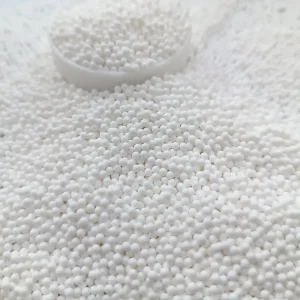
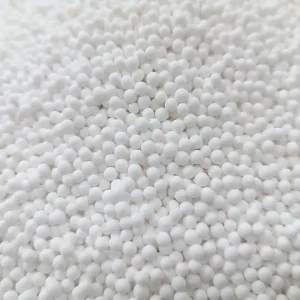
High-performance alumina beads, activated alumina spheres, and inert support balls specifically stocked and optimized for Uruguayan industrial facilities.
Deep-dive market intelligence detailing how Uruguay's economic modernization drives demand for technical ceramics in pulp milling, green hydrogen, biofuel, and chemical logistics hubs.
Uruguay has established itself as one of South America's most stable, technologically advanced, and ecologically conscious industrial economies. The national emphasis on sustainable forestry, mega-scale cellulose pulp manufacturing (anchored by multi-billion dollar investments in regions such as Fray Bentos, Paso de los Toros, and Conchillas), biofuel synthesis via ANCAP, and agricultural processing requires uncompromising process reliability. Industrial ceramic balls—ranging from inert catalyst bed support media to high-density yttria-stabilized zirconia grinding beads—play a critical, non-negotiable role in ensuring process uptime, thermal efficiency, and mechanical purity across these key Uruguayan operational sectors.
As Uruguayan process plants strive for decarbonization and higher operational efficiency, the technical demands placed on reactor internals and media attrition mills have escalated. Industrial operators in Montevideo, San José, Colonia, and Durazno require advanced materials capable of withstanding extreme thermal cycling, aggressive acid wash regimens, and severe mechanical abrasion without degrading or contaminating the end product.
Protection of catalyst beds in tall oil processing, black liquor recovery boilers, and sulfuric acid recovery units in key industrial hubs along the Uruguay River and interior basins.
Deep gas dehydration, bio-ethanol purification, and bio-diesel transesterification support using tailored zeolite molecular sieves and activated alumina spheres.
Ultra-fine bead milling of high-grade agrochemical suspensions, paints, and protective coatings using high-purity microcrystalline alumina and zirconia media.
Understanding the thermomechanical properties, microstructure optimization, and crystalline phase stability of advanced ceramic spheres.
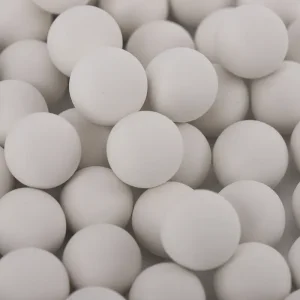
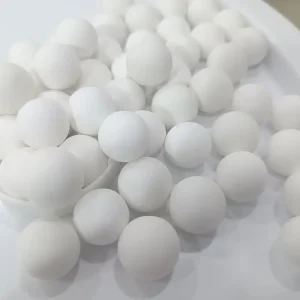
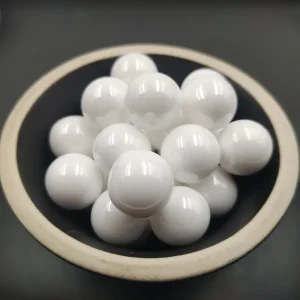
Inert ceramic balls act as catalyst bed supports, hold-down media, and thermal mass distributors in chemical reactors. The primary engineering goal is chemical inertness coupled with exceptionally low water absorption (<0.5%) and high cold crushing strength.
Our formulation utilizes high-alpha alumina ($\alpha\text{-Al}_2\text{O}_3$) combined with controlled silica-aluminate flux compounds sintered at temperatures exceeding 1600°C. This forms a densely interlocked microcrystalline structure that exhibits zero reactivity toward aggressive acidic or alkaline fluid streams, preventing catalyst bed poisoning and maintaining structural integrity under differential pressure loadings exceeding 500 kPa.
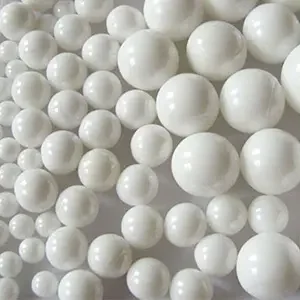
For fine grinding applications, power consumption and wear-induced contamination are the two largest cost drivers. Replacing traditional silica sand or metallic media with high-density Alumina ($Al_2O_3$) and Yttria-Stabilized Zirconia ($YSZ$) radically shifts milling dynamics.
By achieving a high density (up to 6.0 g/$cm^3$ for Zirconia), media impact energy is maximized during high-energy vertical attritor or horizontal bead mill operations. This accelerates particle size reduction down to the sub-micron and nanometer scale while reducing mill cycle times by up to 40%.
| Parameter / Specification | Inert Alumina Ball (99%) | Inert Alumina Ball (23-30%) | High Alumina Grinding Bead | Yttria Zirconia Bead (YSZ) |
|---|---|---|---|---|
| Chemical Composition | $\ge 99.0\%\text{ Al}_2\text{O}_3$ | $23-30\%\text{ Al}_2\text{O}_3, 65-75\%\text{ SiO}_2$ | $\ge 92-95\%\text{ Al}_2\text{O}_3$ | $95\%\text{ ZrO}_2, 5\%\text{ Y}_2\text{O}_3$ |
| Bulk Density ($g/cm^3$) | 2.0 - 2.2 | 1.3 - 1.4 | 2.2 - 2.45 | 3.8 - 3.85 |
| Specific Gravity / True Density | 3.6 - 3.8 g/$cm^3$ | 2.4 - 2.6 g/$cm^3$ | 3.65 - 3.75 g/$cm^3$ | $\ge 6.0\text{ g/cm}^3$ |
| Water Absorption (%) | $< 0.2\%$ | $< 0.5\%$ | $< 0.01\%$ | $< 0.005\%$ |
| Mohs Hardness | 9.0 | 7.0 - 7.5 | 9.0 | 9.0 |
| Crushing Strength ($\varnothing 20\text{mm}$) | $> 15\text{ kN/particle}$ | $> 5\text{ kN/particle}$ | $> 18\text{ kN/particle}$ | $> 25\text{ kN/particle}$ |
| Max Operating Temp (°C) | 1650°C | 1100°C | 1550°C | 1250°C |
Tailored advanced ceramic implementations addressing specific process challenges across Uruguay's core industrial sectors.
In pulp mills operating along Fray Bentos and Paso de los Toros, chlorine dioxide generation units and sulfur burner reactors demand support media immune to extreme acidic condensation. Our 99% high-purity inert alumina balls prevent silica leaching and bed collapse, ensuring uninterrupted pulp bleaching chemical supply.
Uruguay's ambitious bioenergy mandate relies heavily on deep dehydration of bio-ethanol and natural gas streams. Utilizing our high-crush 3A and 4A zeolite molecular sieves, process plants in Montevideo and Paysandú eliminate moisture down to sub-ppm levels without co-adsorbing valuable hydrocarbon molecules.
Formulating high-efficiency liquid fertilizers and micronutrient suspension concentrates requires uniform particle size distribution. Our microcrystalline 92% Alumina grinding beads enable wet milling equipment to deliver ultra-fine particle dispersion with minimal equipment wear.
Innovating for the next generation of eco-efficient process engineering in South America.
In accordance with global net-zero trajectories and Uruguay's clean energy grid leadership, our manufacturing facilities integrate ultra-high-temperature electric kilns powered by clean energy. Furthermore, the high energy efficiency of our zirconia and high-alumina media allows downstream Uruguayan mills to reduce electrical power consumption per ton of ground material by up to 25%.
Through advanced cold isostatic pressing (CIP) and spray drying technology, our R&D team controls grain growth during sintering at the nanometer scale. This eliminates internal voids, micro-cracks, and structural non-uniformities, yielding grinding spheres with unprecedented fracture toughness ($K_{IC} \ge 9\text{ MPa}\cdot\text{m}^{1/2}$ for YSZ).
Complete product range available for export, custom sizing, and direct supply across all Uruguayan ports and logistics zones.
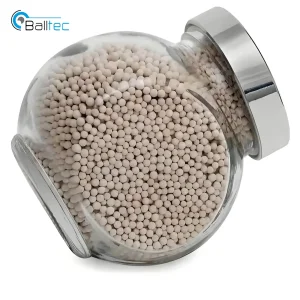 High-Quality Molecular Sieve 5A for Accelerate Polyurethane Reaction As a Catalyst or Co-Catalyst Factory, Exporters
View Details
High-Quality Molecular Sieve 5A for Accelerate Polyurethane Reaction As a Catalyst or Co-Catalyst Factory, Exporters
View Details
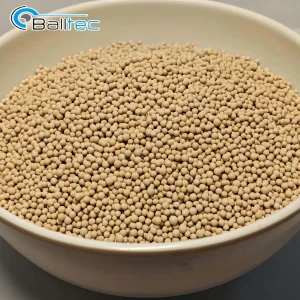 High-Quality 1.6-2.5mm 3-5mm 3A Zeolite Molecular Sieve Sphere/Pellet Adsorbent with High Separation Efficiency for Natural Gas Drying Supplier, Exporter
View Details
High-Quality 1.6-2.5mm 3-5mm 3A Zeolite Molecular Sieve Sphere/Pellet Adsorbent with High Separation Efficiency for Natural Gas Drying Supplier, Exporter
View Details
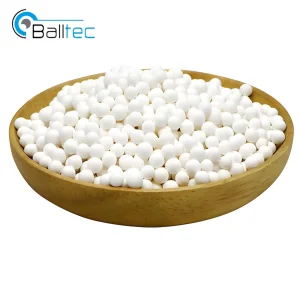 High-Quality High Crush Strength Inert Alumina Ceramic Ball As Catalyst Support Media Factory, Exporters
View Details
High-Quality High Crush Strength Inert Alumina Ceramic Ball As Catalyst Support Media Factory, Exporters
View Details
Engineering responses addressing specification selection, chemical compatibility, pressure drops, and supply chain shipping into Uruguay.
Selection depends primarily on process chemistry and thermal requirements. 99% High Alumina inert ceramic balls are essential for high-temperature reactors (>1200°C) or highly corrosive alkaline/acidic environments where silica leaching could contaminate downstream catalysts or pulp chemicals (such as in $ClO_2$ plants). 23-30% Inert Alumina balls offer an economical, highly thermal-shock-resistant solution for standard vessel support, gas buffering, and lower-temperature heat recovery applications where ultra-low silica content is not strictly mandatory.
We provide full container load (FCL) and less-than-container load (LCL) shipments directly to the Port of Montevideo or duty-free industrial zones such as Zona Franca Nueva Palmira and Zona Franca Fray Bentos. Our export packaging complies strictly with international maritime safety standards, utilizing heavy-duty moisture-proof bags housed inside reinforced wooden crates or steel drums with ISPM-15 fumigation certification.
Yttria-Stabilized Zirconia (YSZ) possesses a significantly higher true density (~6.0 g/$cm^3$) compared to High Alumina media (~3.6-3.8 g/$cm^3$). The higher density translates directly into increased kinetic impact force within horizontal bead mills, allowing operators to achieve nano-particle distributions faster. Additionally, YSZ exhibits exceptional fracture toughness, resulting in wear rates up to 10 times lower than pure alumina beads in aggressive continuous milling environments.
Every production lot undergoes rigorous laboratory testing prior to dispatch. We provide comprehensive Factory Acceptance Certificates including Chemical Composition Analysis (XRF), Physical Density, Water Absorption, Cold Crushing Strength (kN/particle), Sphericity Tolerances, and Wear Loss Test Reports. Copies of our ISO 9001, ISO 14001, and ISO 45001 accreditations are attached to all commercial documentation packages.
Yes. Our integrated 100,000 m² manufacturing plant supports full OEM customization. We manufacture inert ceramic balls ranging from $\varnothing 1\text{mm}$ micro-beads up to $\varnothing 100\text{mm}$ structural packing spheres. Special chemical formulations, controlled surface textures, and custom pore sizes can be engineered to meet your exact bed packing pressure drop specifications.
Connect with our technical ceramics engineering team today for material consultations, detailed test reports, or custom commercial quotes tailored to your operation.