Follow 


Premium mass transfer and filtration ceramic components optimized for extreme thermal shocks, corrosive acids, and high-pressure tower operations across North Africa.
The Kingdom of Morocco has rapidly established itself as the primary chemical, fertilizer, and industrial hub of North Africa. Anchored by the world's largest phosphate reserves managed by the OCP Group (Office Chérifien des Phosphates), Morocco’s industrial processing capacity requires an immense volume of chemical tower packings, catalyst support balls, and thermal ceramic media. Facilities located across key industrial nodes—such as the massive Jorf Lasfar Chemical Complex, the Safi Fertilizer Hub, and the Mohammedia Energy Platform—operate some of the world’s highest-capacity sulfuric acid ($H_2SO_4$) and phosphoric acid ($H_3PO_4$) production trains.
To sustain uninterrupted continuous processing, plant operators, EPC engineering directors, and maintenance heads in Casablanca, El Jadida, and Safi demand industrial ceramic packing materials that can endure aggressive chemical corrosion, extreme thermal variations (ranging from ambient to over 1100°C), and severe hydrodynamic stress. The shift toward higher concentration phosphoric acid (54% $P_2O_5$ merchant grade acid) and green ammonia synthesis under Morocco’s national decarbonization program has intensified the strict operational criteria for tower packings.
Key Insight for Moroccan Operations: Ceramic tower packings serving Moroccan chemical complexes must deliver an Acid Resistance Index exceeding 99.8% (ASTM C515) while maintaining precise bulk density and low bed pressure drop to minimize blower power consumption in large-scale absorption towers.
Industrial ceramics utilized in mass transfer towers have evolved from simple geometric shapes into high-surface-area, microstructurally engineered contact media. Modern ceramic packing manufacturing leverages high-purity raw materials—primarily microcrystalline calcined alumina ($Al_2O_3$), kaolin clay, feldspar, and stabilized zirconia ($ZrO_2$)—processed via vacuum de-airing extrusion, isopressed molding, and high-temperature tunnel kiln sintering above 1350°C.
Formulated with minimal free silica ($SiO_2$) content to prevent leaching in hydrofluoric ($HF$) containing streams or hot concentrated alkalis. Maintains structural integrity in 98% $H_2SO_4$ at temperatures up to 240°C.
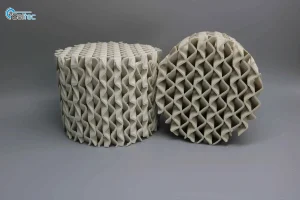
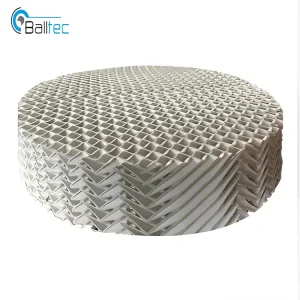
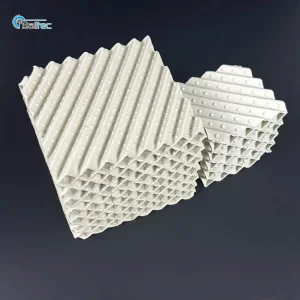
Advanced corrugated plate geometries (such as 250Y and 500Y structured packings) feature optimized geometric inclination angles (45°/60°) that facilitate liquid spreading while reducing gas phase resistance.
Calculated cold crushing strength exceeding 15–22 kN/particle for inert support balls ensures bottom bed layers in massive reactors do not fracture under deep bed loading and catalyst weight.
| Ceramic Packing Type | Alumina Content ($Al_2O_3$) | Bulk Density ($kg/m^3$) | Void Fraction ($\epsilon$) | Primary Moroccan Application |
|---|---|---|---|---|
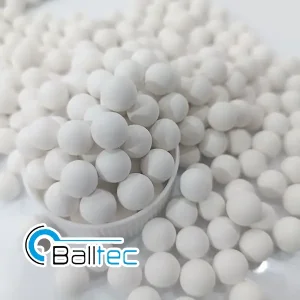
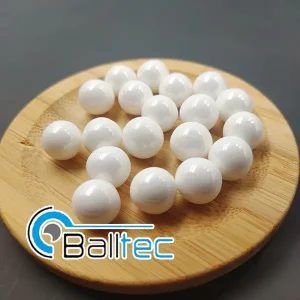
| Inert Alumina Balls (25–99%) | 25% – 99.7% | 1350 – 2050 | 38% – 42% | Catalyst Bed Support in $H_2SO_4$ Converters & Ammonia Reactors |
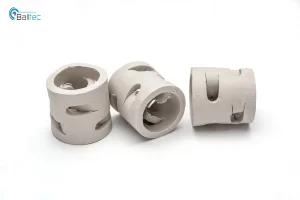
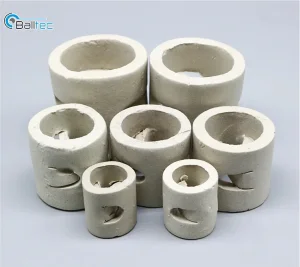
| Ceramic Pall Rings | 18% – 30% | 550 – 720 | 72% – 78% | Drying Towers, Gas Scrubbers, & Acid Stripping Columns |
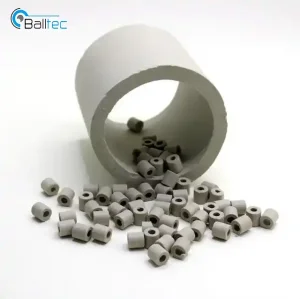
| Ceramic Raschig Rings | 18% – 25% | 650 – 880 | 65% – 72% | Corrosive Waste Gas Abatement & Primary Gas Washers |
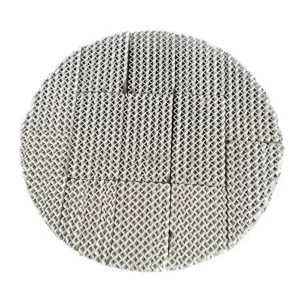
| Structured Corrugated Packing (45°/60°) | 20% – 35% | 240 – 480 | 75% – 85% | High-Efficiency Distillation, Fine Chemical Separation & VOC Scrubbing |
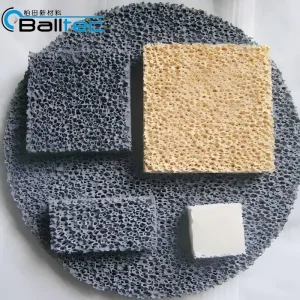
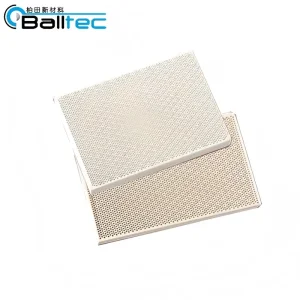
| Honeycomb Porous Ceramics | 30% – 95% (or $ZrO_2$) | 450 – 900 | 60% – 75% | Thermal Oxidizers (RTO), Molten Metal Filtration & Radiant Burners |
Procurement teams and project engineers negotiating supply contracts for Moroccan industrial plants must navigate strict vendor qualification audits. To achieve true procurement total cost of ownership (TCO) efficiency, buyers should evaluate global suppliers based on E-E-A-T (Experience, Expertise, Authoritativeness, and Trustworthiness) principles and verified material performance data.
Ensure the manufacturer maintains ISO 9001:2015 and ISO 14001 certification with certified batch-level chemical analysis. Key chemical limits include controlling $Fe_2O_3$ below 0.5% for acid towers to prevent iron contamination of refined chemicals and maintaining tight physical tolerances on ring wall thickness and sphere sphericity.
International shipments entering Moroccan entry ports like Casablanca Port or Jorf Lasfar Port require accurate Harmonized System (HS) code classification (e.g., HS 6909.19 for industrial ceramic packing). Proper documentation avoids customs delays under Moroccan Administration of Customs and Indirect Taxes (ADII) regulations.
Designed for gas scrubbing towers and fluorine recovery systems in wet-process phosphoric acid manufacturing. High-alumina ceramic Pall rings resist silica gel precipitation and $HF$ fume attack.
Utilized in Interpass and Final Absorption Towers. Structured ceramic plate packings minimize pressure drop across large gas volumes, directly increasing plant energy efficiency.
Acid and alkali-resistant Raschig rings and corrugated structured packing media provide durable mass transfer performance for sea water pre-treatment scrubbers and refinery gas desulfurization units.
Exporting heavy industrial ceramics to the Kingdom of Morocco requires rigorous packing standards to prevent breakage during sea transit and port handling. Leading ceramic factories utilize heavy-duty fumigated wooden crates (compliant with ISPM 15 standards) or reinforced woven jumbo bags with internal plastic liners.
Furthermore, technical documentation must accompany each shipment to fulfill the import requirements of the Moroccan Institute for Standardization (IMANOR). Certified test reports include:
As Morocco advances toward its ambitious Green Ammonia and Hydrogen Power-to-X (PtX) Strategy, chemical process units are being re-engineered for decarbonized hydrogen synthesis and carbon capture. Next-generation ceramic packings incorporate hybrid micro-textures and ultra-thin corrugated geometries that reduce bed pressure drop by up to 25%, drastically lowering energy consumption in high-volume gas processing towers.
Simultaneously, advanced zirconia-toughened alumina (ZTA) and high-density silicon carbide ($SiC$) ceramic matrices are being deployed in severe thermal recycling systems (Regenerative Thermal Oxidizers - RTO), offering unprecedented resistance to thermal shock cycles exceeding 1200°C.
Answers to common operational questions asked by chemical engineers, procurement officers, and plant managers in the North African chemical sector.
For primary catalyst bed support in sulfuric acid double absorption converters (such as those operating in Jorf Lasfar), 92% to 99% high-purity inert alumina balls are recommended. Lower alumina grades (25–30% stoneware ceramic) can be utilized in lower bed zones where thermal shocks are moderate, but upper catalyst support beds require high alumina content to prevent silica breakdown under hot, sulfur-laden gas streams.
Structured ceramic packings (e.g., 250Y/500Y corrugated plates) provide significantly higher specific surface area per unit volume ($m^2/m^3$) and lower hydraulic pressure drop compared to random packings like Pall or Raschig rings. While random packings offer lower capital cost and easier installation in small towers, structured packings are ideal for high-capacity absorption columns where reducing gas pressure drop directly translates to millions of dirhams in energy savings for main blowers.
Standard sea freight shipping lead times from major Asian ceramic production hubs to Casablanca or Jorf Lasfar ports typically range between 24 to 32 transit days. Standard order processing, custom manufacturing, quality testing, and ISPM-15 export packing require approximately 10 to 15 days prior to vessel departure.
Crushing strength is measured by placing a single ceramic sphere between two parallel rigid platens of a hydraulic testing machine and applying a compressive load until failure occurs. For instance, a 25mm (1 inch) 99% alumina sphere typically exhibits a crushing strength exceeding 18 kN/ball, ensuring it can support immense catalyst bed weights without disintegrating into fines that plug process gas flow.
Standard ceramic packings containing high silica ($SiO_2$) can experience gradual etching in streams with high concentrations of hydrofluoric acid. For HF-rich wet-process phosphoric acid scrubbers, high-purity alumina (>99.5% $Al_2O_3$) or specialized carbon/SiC materials are selected to minimize silica leaching and maintain long-term packing geometry.
Explore our full line of random tower packings, corrugated structured packings, and ultra-durable zirconia grinding media for industrial applications in Morocco.
Get direct technical support, custom sizing consultations, and factory-direct quotation for your chemical plants, fertilizer complexes, and refinery towers in Morocco.
Send Inquiry Now