Follow 


Direct factory export engineered for severe chemical environments, volatile organic compound (VOC) abatement, and extreme thermal processing across San Francisco industrial corridors.
As the Greater San Francisco Bay Area executes one of the most stringent clean-energy and environmental decarbonization transformations in North America, chemical refining operations, advanced material synthesizers, municipal water treaters, and semiconductor chemical suppliers face unprecedented operational pressures. Efficiency in separation towers, gas scrubbing, and thermal catalysis is no longer just an operational metric—it is a regulatory and economic imperative.
As a global premier manufacturer and exporter of chemical-grade ceramic packing, Pingxiang Baitian (Ball-tec) New Materials Co., Ltd. delivers high-performance industrial ceramics certified to global standards (ISO 9001, 14001, 18001). Engineered with precise microstructural controls, ultra-low iron content, and exceptional thermal shock endurance, our chemical ceramic solutions empower San Francisco Bay Area enterprises to optimize separation performance, minimize pressure drops, and drastically reduce operational expenditures (OPEX).
Unlike standard commercial stoneware packing, our chemical porcelain formulations utilize high-purity kaolin and microcrystalline alumina matrices fired at continuous 1450°C tunnel kiln schedules. This yields an impervious, vitrified structure with acid resistance exceeding 99.8% (ASTM C515) and near-zero water absorption (<0.5%), protecting downstream Bay Area processes from catalyst poisoning and column bed settling.
Tailored ceramic packing solutions designed for the micro-climates, environmental statutes, and advanced technology sectors of Northern California.
Major refining centers in the East Bay (such as Richmond, Martinez, and Benicia) are undergoing historic pivots toward renewable diesel, Sustainable Aviation Fuel (SAF), and green hydrogen. These processes demand heavy-duty hydro-treating catalyst supports, amine absorption ceramic packings, and de-emulsification beds capable of operating under highly corrosive organic acid environments.
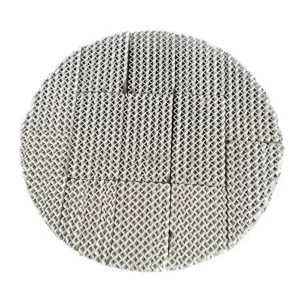
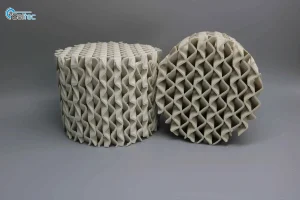
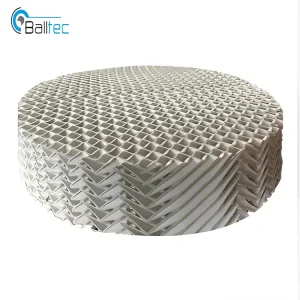
The semiconductor synthesis and advanced hardware manufacturing labs expanding throughout San Jose, Santa Clara, and South San Francisco require ultra-pure chemical distillation columns. Ceramic structured packing (such as 500Y corrugated plates) prevents metallic ion contamination during ultra-pure acid reagent purification (sulfuric, nitric, and hydrochloric acids).
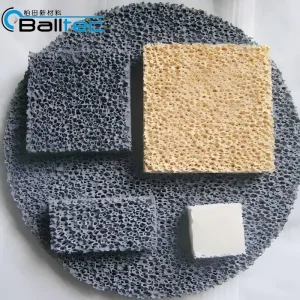
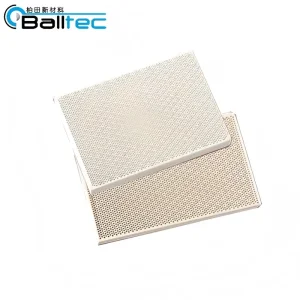
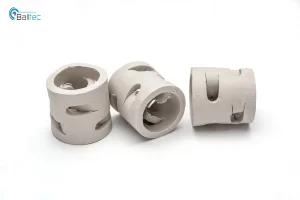
Under strict Bay Area Air Quality Management District (BAAQMD) enforcement, industrial sites must meet rigorous limits on volatile organic compounds. Regenerative Thermal Oxidizers (RTOs) using custom honeycomb porous ceramics and ceramic Raschig/Pall rings ensure thermal efficiency > 95% while destroying toxic emissions cleanly.
An in-depth comparative analysis of random vs. structured ceramic packing geometries and material physics.
| Packing Type | Material Grade | Specific Surface Area ($m^2/m^3$) | Void Fraction (%) | Mass Transfer Efficiency (HETP) | Primary Industrial Application |
|---|---|---|---|---|---|
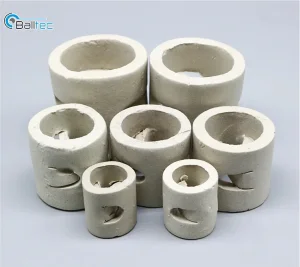
| Ceramic Pall Ring (25mm) | Chemical Porcelain (Al₂O₃ 23-30%) | 220 | 73% | Medium-High (0.4m - 0.6m) | Acid Dehydration, Amine Scrubbing, H₂SO₄ Towers |
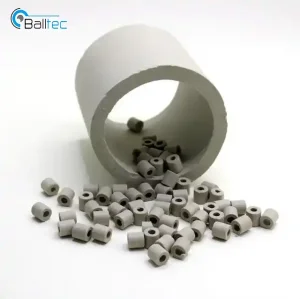
| Ceramic Raschig Ring (50mm) | Acid-Resistant Ceramic | 110 | 68% | Standard (0.6m - 0.9m) | Corrosive Waste Gas Scrubbing, Thermal Stripping |
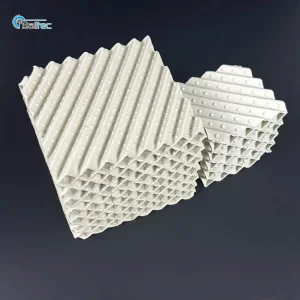
| 500Y Corrugated Structured | High-Purity Chemical Silica-Alumina | 500 | 82% | Ultra-High (0.18m - 0.25m) | Fine Pharmaceutical Distillation, High-Vacuum Towers |
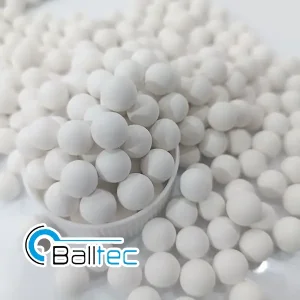
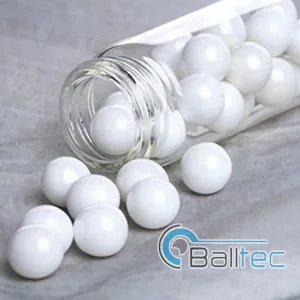
| Inert Alumina Spheres (99%) | 99.5% α-Alumina | Spherical Geometry | 40% (Bed Void) | Catalyst Support / Protection Bed | Hydro-processing, Ammonia Synthesis, High-Temp Reactors |
In packed columns, minimizing pressure drop ($\Delta P$) is critical to lowering blower and compressor energy requirements. Ceramic Pall Rings significantly outperform classical Raschig rings by incorporating internal cross-structural tabs. This design opens up the internal space of the ring cylinder, promoting liquid-gas contact while allowing fluids to pass through without localized flooding.
For San Francisco plant engineers aiming to increase tower throughput without replacing existing column shells, upgrading from standard random packing to Ceramic 500Y Structured Corrugated Sheet Packing increases capacity by up to 35% while dramatically reducing HETP (Height Equivalent to a Theoretical Plate).
Industrial towers in chemical plants experience severe thermal cycles during startup, shutdown, and solvent regeneration. Baitian’s ceramic formulations incorporate micro-porous silica-alumina matrixes that exhibit extremely low coefficients of thermal expansion ($\approx 4.5 \times 10^{-6} /^\circ\text{C}$).
How our 100,000 m² automated production campus in Pingxiang delivers unmatched quality control and cost efficiency to global markets.
Our facility integrates automated spray drying, computer-controlled cold isostatic pressing (CIP), and precision extrusion lines. By standardizing green body density prior to firing, we eliminate micro-fractures, air pockets, and structural wall variations. This yields packing rings and inert balls capable of enduring crush loads up to 30% higher than traditional manual forming methods.
Every export batch destined for San Francisco undergoes rigorous lab testing. From raw material X-ray fluorescence (XRF) chemical verification to bulk density, water absorption, crush strength, and thermal shock testing, full batch traceability documentation is compiled and delivered with every shipping container.
Supporting global carbon capture, clean energy transition, and next-generation environmental engineering.
As California drives aggressive Net-Zero targets, point-source carbon capture systems rely on ceramic packing beds for CO₂ solvent absorption. High specific surface area corrugated ceramics maximize contact between flue gases and amine solvents, minimizing liquid holdup and lowering solvent regeneration energy requirements.
Upgrading landfill gas and dairy bio-digesters to Renewable Natural Gas (RNG) requires multi-stage removal of H₂S, moisture, and siloxanes. Our acid-resistant ceramic Raschig rings and molecular sieve media beds serve as the primary defensive line in bio-gas scrubbers across Northern California agricultural and municipal facilities.
Our materials R&D lab, staffed by former senior engineers from Japanese and US ceramics leaders, is actively pioneering ultra-low thermal mass ceramic structures, advanced zirconia-toughened alumina (ZTA) media, and custom catalytic coatings to support next-generation green hydrogen generation and synthetic fuel reactors.
Navigating California’s complex regulatory frameworks (including CEQA, Cal/OSHA, and localized air district rules) requires reliable, fully documented chemical inputs. Pingxiang Baitian provides complete compliance peace of mind for engineering contractors (EPCs) and plant managers operating in San Francisco and surrounding counties.
Explore our specialized random packing, corrugated structures, and heavy-duty catalyst bed supports.
Direct insights from our chemical engineering team regarding material selection, hydraulics, and logistics.
Connect directly with Pingxiang Baitian's technical engineering team for instant technical data sheets, price quotes, and custom column packing simulations.
Send Inquiry Now