Follow 


Engineered for high mass transfer, severe chemical resistance, and extreme operational thermal shock across Gulf Coast refining towers.
The Greater Houston metropolitan area—encompassing the Houston Ship Channel, Baytown, Deer Park, Pasadena, and Texas City—represents the highest concentration of petrochemical processing, crude oil refining, and chemical manufacturing infrastructure on the planet. Operating within this intense industrial corridor demands process equipment capable of withstanding extreme operational stresses: highly corrosive acid gases, continuous thermal cycling up to 1,200°C, high mechanical crushing pressures, and relentless hydraulic drag.
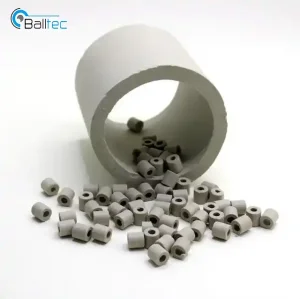
In modern chemical engineering mass-transfer columns—including sulfuric acid absorption towers, chlorine drying scrubbers, acid gas enrichers, sour water strippers, and volatile organic compound (VOC) thermal oxidizers—chemical inertness and mass-transfer efficiency determine plant profitability. Ceramic packing media (both random tower packings and high-surface structured corrugated plates) serve as the primary operational backbone for these harsh gas-liquid contact environments where metallic alloys succumb to rapid stress-corrosion cracking and plastics suffer thermal degradation.
Unlike standard commercial tower packings, chemical-grade ceramics produced by Pingxiang Baitian (Ball-tec) New Materials Co., Ltd. are formulated with high-purity microcrystalline alumina ($Al_2O_3$) and silica ($SiO_2$) matrices optimized via vacuum extrusion and high-temperature tunnel kiln sintering. This creates an engineered microstructure characterized by near-zero open porosity (<0.5%), extreme compressive strength, and total resistance to all organic solvents, mineral acids (excluding hydrofluoric acid), and oxidizing agents.
For procurement officers and senior chemical engineers evaluating wholesale suppliers in Houston, acquiring ceramic media directly from direct-manufacturer supply chains ensures strict compliance with ASME, ASTM C515, and ISO 9001 quality parameters while yielding significant total cost of ownership (TCO) advantages over domestic distribution markups.
Selecting the optimal column internals involves balancing pressure drop, hydraulic flooding capacity, and Height Equivalent to a Theoretical Plate (HETP).
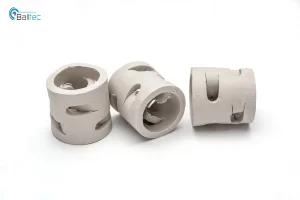
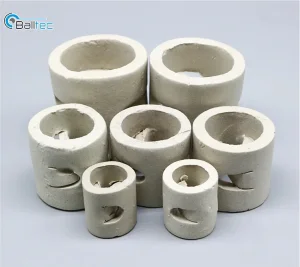
Random tower packings provide a cost-effective, robust solution for bulk mass transfer and liquid absorption. The open-wall design of ceramic Pall rings allows liquid and gas to flow uniformly through interior cross-struts, significantly reducing fluid drag and wall-channeling tendencies compared to legacy Raschig rings.
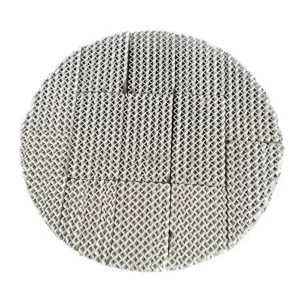
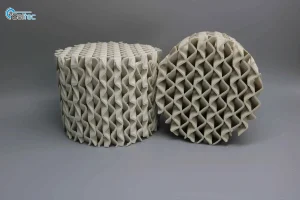
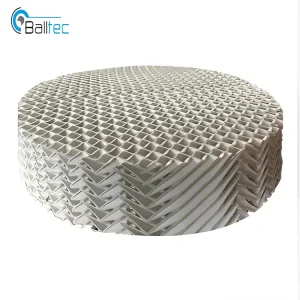
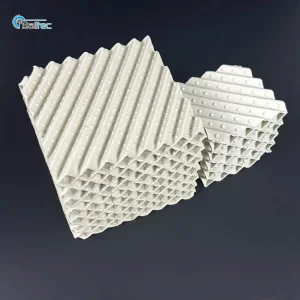
Structured ceramic packings consist of parallel corrugated ceramic plates arranged in structured blocks. The geometric orientation forces intimate counter-current gas-liquid contact while maintaining smooth gas passage channels, resulting in extremely low pressure drop per theoretical stage.
| Packing Category & Material Type | Specific Surface Area ($m^2/m^3$) | Void Fraction ($\%$) | Bulk Density ($kg/m^3$) | Primary Houston Applications |
|---|---|---|---|---|
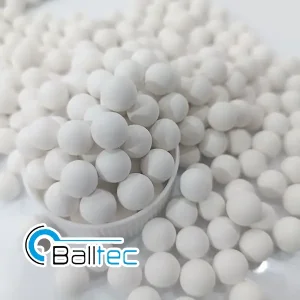
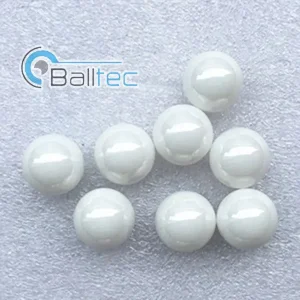
| Inert Alumina Balls (24-99% $Al_2O_3$) | 120 – 480 | 38 – 42 | 1350 – 2050 | Catalyst bed support, top hold-down beds in hydrotreaters & desulfurizers |
| Ceramic Pall Rings (25mm / 50mm) | 115 – 220 | 72 – 78 | 550 – 680 | Sulfuric acid drying towers, $SO_2$ scrubbers, acid gas treating columns |
| Ceramic Raschig Rings | 90 – 190 | 65 – 72 | 680 – 820 | Regenerative thermal oxidizers (RTO), foul water strippers, mass transfer beds |
| Ceramic Corrugated Packing 250Y | 250 | 75 | 480 | High-capacity chemical distillation, solvent recovery, organic acid towers |
| Ceramic Corrugated Packing 500Y | 500 | 68 | 620 | High-purity fine chemical separation, deep vacuum rectification, pharmaceutical towers |
The operational lifespan of ceramic tower packing in Gulf Coast chemical units depends directly on raw ceramic chemical formulations and firing kinetics. At Pingxiang Baitian New Materials, our R&D center incorporates proprietary sintering technologies developed by senior ceramic material engineers from Japanese and US industrial ceramic institutes.
In high-temperature alkaline or steam environments, low-grade ceramic packings suffer from silica leaching—a process where free silica ($SiO_2$) dissolves into hot process streams, degrading structural integrity and causing downstream boiler/heat exchanger fouling. Baitian’s high-alumina packing formulations utilize up to 99.6% crystalline Alpha-Alumina ($\alpha-Al_2O_3$), creating an interlocking corundum matrix that completely eliminates silicate dissolution under aggressive chemical attack.
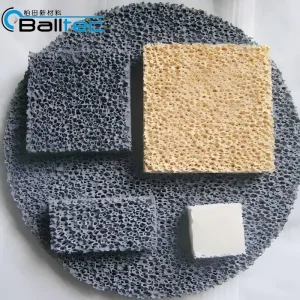
Regenerative Thermal Oxidizers (RTO) deployed in petrochemical facilities experience violent temperature shifts exceeding 500°C per minute. Our engineered ceramic media utilize cordierite-mullite micro-phases engineered with controlled thermal expansion coefficients ($\alpha \le 2.5 \times 10^{-6} / ^\circ \text{C}$). This micro-structural tolerance prevents thermal spalling, structural micro-cracking, and premature bed collapsing under continuous cyclical heating.
How Pingxiang Industrial Ceramic Cluster Synergies deliver unmatched lead times, batch consistency, and cost advantages for US buyers.
Pingxiang, Jiangxi Province is recognized globally as the capital of industrial ceramics. Operating within a 100,000 m² integrated campus, Pingxiang Baitian controls the complete manufacturing chain—from raw kaolin/bauxite refining, spray drying powder preparation, automated hydraulic pressing, to 100-meter continuous energy-efficient tunnel kilns.
This vertical integration eliminates third-party component sourcing delays, ensuring consistent physical dimensions, uniform porosity, and bulk volume availability for turn-key refinery unit overhauls.
Understanding the strict schedules of Houston refinery maintenance turnarounds (TA&O), Baitian provides end-to-end logistics coordination. Products are packaged in heavy-duty ocean-ready super-sacks (FIBCs), reinforced wooden crates, or steel drums with shrink wrapping.
To ensure flawless integration into EPA-regulated and OSHA-monitored facilities across Texas and the US Gulf Coast, all ceramic packing products from Pingxiang Baitian undergo rigorous multi-stage quality control testing before export certification:
Every shipment bound for Houston buyers includes factory-issued Certificates of Analysis (COA), physical dimensions inspection logs, crush strength verification reports, and chemical composition spectrum charts.
Explore our full range of chemical tower packings, structured corrugated elements, random rings, and grinding media available for wholesale supply in Houston.
Direct answers regarding specifications, hydraulic calculations, freight logistics, and chemical compatibility.
Standard ocean transit time from Chinese ports to Houston (Barbours Cut/Bayport) is approximately 28 to 34 days. Including factory production time (typically 7–12 days for high-volume standard sizes), bulk shipments arrive at your Houston facility in 45 days total. Emergency air-freight or pre-stocked buffer warehousing options can also be arranged for urgent turnaround situations.
Ceramic Pall rings provide total chemical immunity to aggressive mineral acids ($H_2SO_4, HCl, HNO_3$) and hot organic solvents where polypropylene or metallic alloys (316L Stainless, Hastelloy) fail due to thermal degradation or localized pitting corrosion. Ceramic media also retain high structural crush strength up to 1100°C without mechanical sagging.
For standard refinery service (amine treating, air drying), 92% to 99% inert alumina balls are recommended. In critical high-temperature hydrocracking, ammonia synthesis, and ethylene plants where trace silica contamination must be strictly avoided, 99.5%+ high-purity microcrystalline inert alumina balls are mandatory to prevent silica leaching into catalyst beds.
Yes. Our 250Y and 500Y ceramic structured corrugated packing blocks are precision manufactured into pre-segmented circular blocks designed to match your column vessel’s inner diameter ($ID$), manway dimensions, and wall wiper requirements. Custom wall wipers (Teflon or ceramic seals) are included to prevent liquid bypass along vessel walls.
Absolutely. Every production run is tested in our laboratory for chemical composition (XRF spectrum analysis), acid solubility (ASTM C515), water absorption (ASTM C373), bulk density, and crushing strength. Full material test reports (MTR) and certificates of analysis (COA) are provided prior to export dispatch.